Sudaryono and Taj Yasin Explore Prospects for 2024 Central Java Gubernatorial Election
Central Java Gerindra regional leadership council chair Sudaryono met former Vice Governor Taj Yasin Maimoen in Rembang to discuss prospects for the 2024 Central Java gubernatorial election.
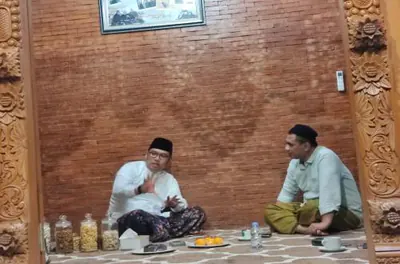
Sudaryono, chair of the Central Java regional leadership council of the Great Indonesia Movement Party (Gerindra), met former Central Java vice governor Taj Yasin Maimoen at the Al Anwar IV Sarang Islamic boarding school (pesantren) in Rembang from Tuesday night into early Wednesday, 28-29 May 2024. The meeting was part of political sounding-out ahead of the Central Java gubernatorial election on 27 November 2024.
According to a report by the Indonesian news outlet Republika, the discussion lasted more than two hours and addressed the Central Java gubernatorial contest. The two were said to share the same views. Gerindra has 17 seats in the Central Java Regional Legislative Council (DPRD), while Taj Yasin's United Development Party (PPP) has six. The minimum threshold for nomination is 24 seats, so the two parties combined are still one seat short.
Sudaryono said the possibility was open if there was a path, adding, “If there is a path, why not?”
Taj Yasin was recorded as having been elected to the Regional Representative Council (DPD) with the second-highest number of votes nationally. He left the final decision to the political process and God's will.
What DPRD Seats Mean in Regional Elections
Nominations for regional heads in Indonesia are not determined by popularity alone. The regional election (Pilkada) law gives an entry route to political parties or party coalitions that meet the threshold of support based on seats in the DPRD from the previous election. Therefore, seat numbers are the quickest political language for the public to read. Parties that have not met the requirement must build coalitions, while parties that have met it still need to calculate candidate competitiveness in the field.
Gerindra has had a strong organizational machine since the 2014 general election and has been one of the key determinants in national coalitions. PPP, on the other hand, still holds a voter base close to traditional Islamic communities, especially through networks of Islamic clerics (kiai), Islamic boarding schools (pesantren), and socio-religious organizations. The combination is attractive because it unites the structural capital of a large party with more personal social capital. In Central Java politics, this kind of social capital often becomes a differentiator in areas where voters know candidates through religious figures or religious educational institutions.
The meeting at the Islamic boarding school should also be read as a signal, not a certainty. Pesantren often become venues for political relationship-building (silaturahmi) because candidates can speak directly with students, alumni and community figures. However, nomination decisions remain in the hands of party elites, including considerations of electability, logistical readiness and the candidate's position among diverse voters. Central Java has a large electorate and a political character that does not always follow a single center of power, so coalitions that appear close among elites must be tested through surveys and fieldwork.
People who have previously held public office, such as a vice governor, generally have the capital of government experience. That capital can become an added value when voters assess candidates based on track record, not just promises. However, executive experience also makes candidates easier for the public and parties to scrutinize, because past decisions can become material for evaluation during campaigns.
What It Means for Central Java Voters
For readers in Central Java, meetings among party elites like this are not just political gossip. A gubernatorial coalition determines the direction of regional budgets, infrastructure priorities, education and health services, and social protection programs for five years. If Gerindra and PPP succeed in adding partners, voters will see a combination of a large party and a party based on religious communities. If not, the public may see more candidates from independent routes or from other parties that have not yet surfaced.
For readers outside Central Java, the news is an example of how regional politics in Indonesia still depends heavily on DPRD seats and networks of figures. This affects the speed of decision-making when a regional government needs legislative support. Voters need to pay attention to whether emerging candidates truly have programs, or are merely relying on the big names of parties and pesantren figures. A fragile coalition can produce a government that is busy negotiating seats rather than serving residents.
The most important thing to monitor is candidate registration with the General Elections Commission (KPU) and the announcement of official endorsements. Before that, all statements remain at the stage of political communication. For residents, the best opportunity to influence the outcome is not on the night of a meeting at a pesantren, but on voting day, 27 November 2024, when they choose the governor and vice governor who will manage budgets and public services around them.
Related news
- Gibran Returns to Social Media, Discusses Eastern Education and Artificial Intelligence
- Prabowo Holds Closed Meeting on Inflation, Purchasing Managers' Index (PMI) and State Budget (APBN) Efficiency
- Gibran Submits Resignation, Mechanism for Filling the Vice-Presidency