Saan Mustopa says reported ban on lawmakers leaving Jakarta is faction policy amid right-to-express-opinion proposal against Vice President Gibran
Deputy Speaker Saan Mustopa said a reported ban on members of the House of Representatives (DPR) leaving Jakarta was a policy of each parliamentary faction during the session period, according to SINDOnews.
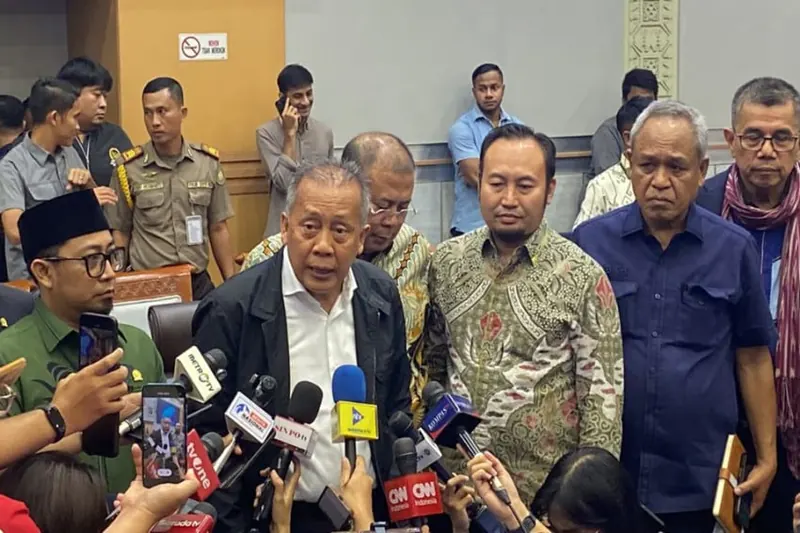
Deputy Speaker of the House of Representatives (DPR) Saan Mustopa responded to reports that DPR members were banned from leaving Jakarta on 11-12 November 2026, as reported by Indonesian media outlet SINDOnews, amid a proposal to exercise the chamber’s Hak Menyatakan Pendapat (HMP), or right to express opinion, against Vice President Gibran Rakabuming Raka.
According to SINDOnews, the news circulated on social media. Saan described the reported ban as a policy of each parliamentary faction. “That is each faction’s own policy,” he said at the Parliament Complex in Senayan, Central Jakarta, on Wednesday, 11 November 2026.
He explained that the DPR session period runs until 17 December 2026, so lawmakers are expected to be in Jakarta to attend working meetings, public hearings and commission agendas.
Attendance rules during the session period
The HMP is one of the DPR’s constitutional rights, alongside the right to interpellation and the right of inquiry. It is generally used to express a view on government policy or on a major event considered to have a significant impact on national life. In the context of the presidency and vice presidency, the HMP can open a political discussion about whether an office holder still meets the requirements for office or is suspected of violating the law. However, the HMP is not a verdict and does not by itself remove a person from office. For that reason, it is often read as a political instrument that requires support across factions, rather than a statement by one group.
The session period is when the DPR carries out its official agenda, from commission meetings and public hearings to working meetings with ministries and plenary sessions. During this period, attendance at Senayan matters because many decisions require a quorum. A quorum is the minimum number of members who must be present for a meeting to be valid and to take decisions. In questions about office, the quorum becomes important because faction votes determine the direction of a plenary session. By contrast, during recess, lawmakers return to their electoral districts to absorb public aspirations. Instructions for members to remain in Jakarta on certain days are therefore usually linked to the need to protect a quorum and maintain political concentration.
Parliamentary factions also play a key role in internal discipline. In parliamentary practice, factions can issue appeals, regulate attendance, or ask members not to leave Jakarta when a strategic issue arises. Such policies are usually internal rather than state orders, and consequences tend to be party or faction sanctions, from reprimands to suspension from parliamentary bodies. If the instruction is issued in writing, members who ignore it may be judged as lacking solidarity in important meetings. In some cases, attendance instructions are also aimed at preventing members from being lobbied by outside parties. The reported ban on leaving Jakarta should therefore be read as a signal of political consolidation, not as a legal prohibition applying to all citizens.
Public attention to the HMP can rise when questions about office are linked to personal or political controversy. Explaining what is happening is therefore important so that readers do not confuse a political proposal, a legal examination and a final decision.
Impact on the public and the DPR agenda
For general readers, the reported ban on lawmakers leaving Jakarta does not directly change prices of basic necessities, electricity tariffs or job prospects. The public also needs to see whether the legislative agenda is delayed or accelerated. The impact is felt more in the DPR’s political agenda and oversight function. If many members are required to be present at Senayan, discussions of bills, budgets and meetings with ministries can proceed more intensively. Conversely, if faction consolidation becomes too tight, space for cross-party dialogue can narrow and the public can lose access to complete information.
What should be watched next is whether the HMP proposal will be brought to an official DPR forum or remain only a discourse. The public has the right to monitor attendance lists, meeting minutes and faction positions, because parliamentary decisions concern policies that touch public money. Transparency in attendance lists and minutes is therefore a simple but important tool of public control. Until there is a constitutional ruling or a completed official mechanism, the term impeachment should be understood as a political process still underway, not a final conclusion.
Readers can compare this report with other parliamentary coverage: bans on leaving a city usually emerge when there is a sensitive agenda, such as the election of leadership, the passage of bills or a motion of no confidence against an official. The news value lies not in the ban itself, but in the message that the DPR is safeguarding its quorum and voting discipline. Without official records, social media reports can easily turn into speculation.