Prabowo Seeks Controlled Food Inflation While Farmers Enjoy Price Gains
President Prabowo Subianto chaired a limited meeting at Bogor Palace on 13 November to discuss macroeconomic indicators, food inflation and energy efficiency.
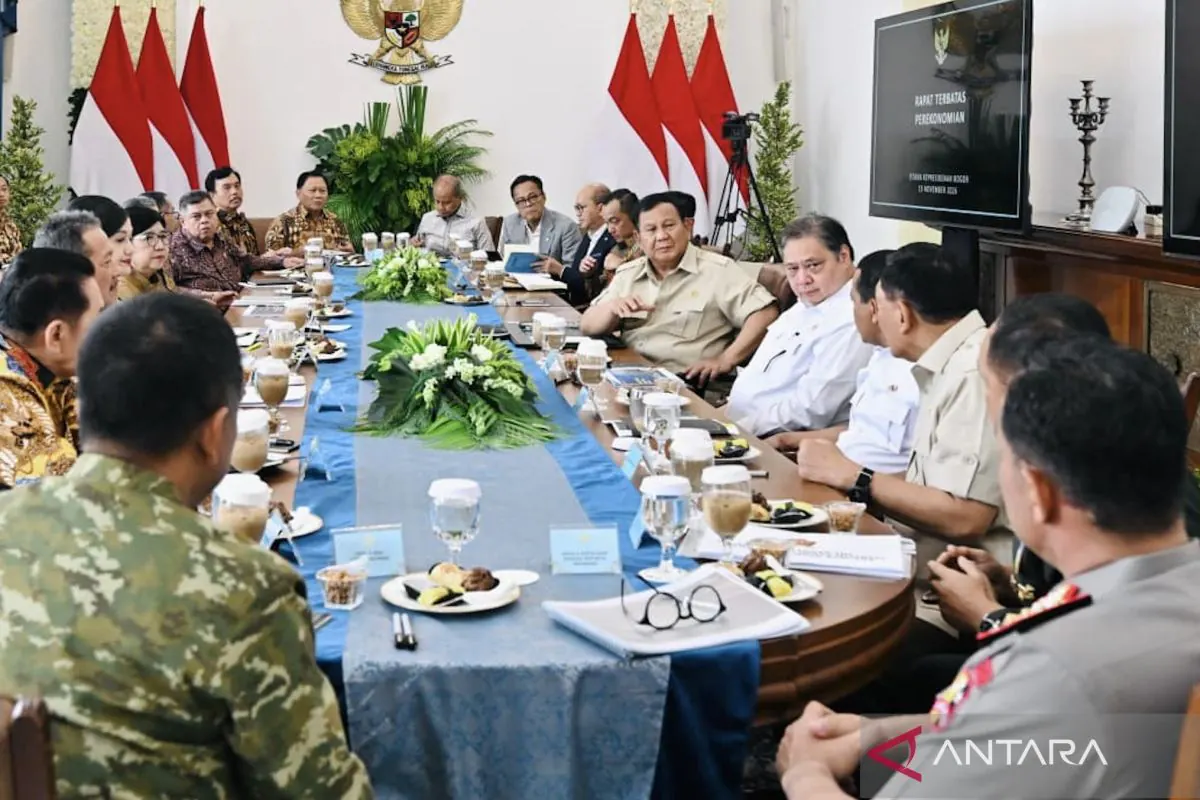
President Prabowo Subianto chaired a limited cabinet meeting at Bogor Palace in Bogor, West Java, on Friday, 13 November, to discuss macroeconomic developments and efforts to strengthen the national economy, with a focus on keeping food inflation under control.
According to a report by the state news agency ANTARA, ministers presented national economic indicators assessed as positive, including economic growth of 5.47 percent, inflation of about 3.3 percent, foreign exchange reserves of US$146 billion, equivalent to 5.3 months, a consumer confidence index above 118, and a purchasing managers’ index (PMI) of 54.
The meeting also highlighted volatile food prices, which contribute to inflation. Coordinating Minister for Economic Affairs Airlangga Hartarto, quoted in an official statement by the Presidential Secretariat, said the President directed that the situation be kept under control without reducing farmers’ opportunity to benefit from higher agricultural commodity prices.
“The President’s instruction is that, because this is still within the range, we should keep it in check, but let farmers enjoy the terms of trade, which have reached 133,” Airlangga said.
The President also ordered his ministers to review the efficiency of fuel (BBM) and electricity use, and to accelerate programs to strengthen domestic supply, including animal feed, the operation of feedmeal plants by state-owned enterprises (BUMN), and poultry farming development.
The meeting was attended by coordinating ministers, line ministers, heads of the Financial Services Authority (OJK) and the central bank, Bank Indonesia, and officials of Danantara, the state investment agency, according to ANTARA.
Why food inflation is under the spotlight
In Indonesia, food inflation is always the most keenly felt issue because most households spend a large share of their income on food. In price statistics, inflation is generally divided into core inflation, volatile prices and administered prices. Core inflation tracks relatively stable price movements, while volatile prices are shaped more by supply, weather, distribution and global commodity prices. As a result, rising food prices can quickly erode purchasing power, especially among low-income groups.
Foreign exchange reserves, the consumer confidence index and the PMI are complementary indicators. Foreign exchange reserves show a country’s ability to pay for imports and meet external obligations, and are therefore often expressed in months of imports. A PMI above 50 is commonly read as a signal that the manufacturing sector is expanding, while a consumer confidence index above 100 indicates the public remains optimistic about economic conditions. Together, the indicators help the government assess whether ongoing growth is accompanied by price stability and public confidence.
The farmers’ terms of trade index is also an important measure in food price discussions. It compares the prices farmers receive with the prices they pay for consumption and production needs. When agricultural commodity prices rise, farmers can potentially earn higher incomes. But if the rise is too sharp or is not matched by supply, consumers will bear the same burden. At that point, the government must choose between holding consumer prices down and preserving incentives for producers.
The cross-ministry and cross-agency meeting, involving the energy, food, finance and state-owned enterprise sectors, showed that inflation control cannot be left to a single institution. Fiscal, monetary, distribution, production and logistics policies must move in the same direction. Experience in various countries shows that food inflation left unchecked for too long can trigger social and political pressure, even when aggregate economic growth remains positive.
Impact on prices and the kitchen table
For households, the instruction to keep food inflation in check means the government wants to prevent spikes in the prices of the most frequently purchased basic necessities. Small changes in those prices are felt immediately in daily spending. Therefore, how quickly the government can add supply, improve distribution and keep feed production running will determine whether price pressure can be eased before it becomes a heavier burden.
The animal feed strengthening program and the operation of feedmeal plants are also relevant to the supply of animal protein. If feed production and poultry farming can be accelerated, chicken meat supply could become more stable. That stability matters because the commodity is a main protein source for many Indonesian families. Conversely, supply delays can push prices up even if demand does not change much.
The directive on fuel and electricity efficiency carries different consequences for the public. On one hand, energy savings can reduce pressure on the state budget and help maintain business competitiveness. On the other hand, the public needs to monitor whether the policy affects tariffs, subsidies or consumption behavior. For workers, positive economic growth is only felt if inflation does not erode real wages; food price control will therefore determine whether economic growth truly reaches household kitchens.