Prabowo poses with Marcos and Albanese at ASEAN-Australia summit
Indonesian President Prabowo Subianto joined Philippine President Ferdinand Marcos Jr and Australian Prime Minister Anthony Albanese for a photo at the sixth ASEAN-Australia summit in Manila, marking five years of a comprehensive strategic partnership.
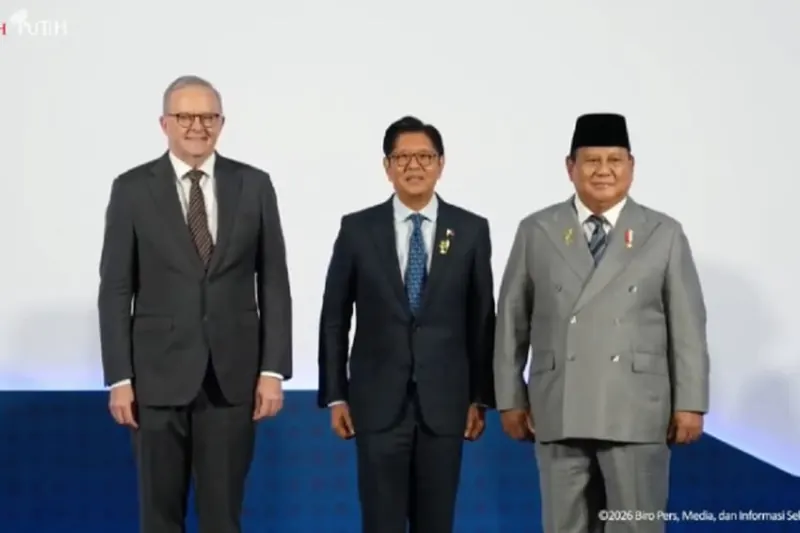
Indonesian President Prabowo Subianto posed with Philippine President Ferdinand Marcos Jr and Australian Prime Minister Anthony Albanese at the sixth ASEAN-Australia summit, a meeting between the Association of Southeast Asian Nations (ASEAN) and Australia, in Manila on Monday, 16 November 2026.
According to Indonesian news outlet SINDOnews, the photo session took place before leaders began discussing strategic issues. Marcos stood in the middle, flanked by Prabowo on the left and Albanese on the right.
Marcos then opened the meeting as host, followed by Albanese's opening remarks. Albanese said Australia was ASEAN's first dialogue partner, a country or organization with an official relationship with ASEAN, and marked five years of the Comprehensive Strategic Partnership, the highest level of ASEAN's relations with external partners.
Marcos noted that two-way trade between ASEAN and Australia reached 197.5 billion Australian dollars last year, while the upgraded ASEAN-Australia-New Zealand Free Trade Area (AANZFTA) expands market access for businesses.
Australia's role in the ASEAN partnership
The ASEAN-Australia summit is a leaders-level forum that brings together Southeast Asian countries and Australia. It is used to set the direction of cooperation in areas such as economic cooperation, connectivity, education, maritime security and transnational issues including climate change and health. Because Australia sits close to Southeast Asia, the relationship is often viewed as part of the region's broader architecture, including the role of dialogue partners in maintaining stability. Such summits also give leaders a chance to state political positions directly on issues such as maritime matters, connectivity and food security.
A dialogue partner is a country or organization that has an official relationship with ASEAN and can take part in discussions from ministerial to leader level. Australia holds a special place as ASEAN's first dialogue partner. The status gives Australia access to regional consultation mechanisms, but it does not make Australia a member of ASEAN. In diplomatic practice, dialogue-partner status is often used to shape cooperation agendas without changing membership.
The Comprehensive Strategic Partnership is the highest level of ASEAN's relations with external partners. It signals that cooperation goes beyond sector-specific projects to include political dialogue, security and economic ties in a more comprehensive way. For Indonesia, forums such as the ASEAN-Australia summit matter because Jakarta often urges that great-power competition should not displace ASEAN centrality. Centrality means ASEAN remains in control of the regional agenda, while outside partners are invited to complement rather than dominate it.
AANZFTA is a free trade agreement linking ASEAN member states with Australia and New Zealand. It covers trade in goods and services, investment and economic cooperation. When such an agreement is upgraded, the focus is usually on simplifying customs procedures, widening market access, protecting businesses and setting rules that fit modern supply chains. Those changes are relevant because companies in the region now compete not only on price but also on delivery speed and regulatory certainty. At the same time, upgrades can pose challenges for smaller businesses that are not ready to meet new standards, making support programs an important part of implementation.
What matters for Indonesia
For Indonesian readers, a summit photo does not automatically change policy. But meetings like this matter because they produce directions for ministers and technical officials to follow up on cooperation in trade, investment, education and security. If the agreements discussed in Manila are implemented, their effects could be felt in export and import costs, the reliability of goods flows, and jobs in manufacturing, logistics, agriculture and services.
The two-way trade figure cited by Marcos shows Australia is an important market for the region. For Indonesian businesses, an upgraded AANZFTA could mean more products can enter with clearer tariffs or procedures. But those benefits are felt only if exporters understand quality standards, certification, rules of origin and technical regulations. Without such readiness, wider market access will not automatically raise sales. Upgrades often also touch digital trade, customs procedures and regulatory cooperation, so their impact is not limited to goods traditionally exported but also extends to services and supply chains.
For the wider public, the issues to watch are whether the cooperation touches everyday concerns: food prices, energy supply chains, protection of migrant workers, student exchanges, disaster response and health. Summits usually produce joint statements or follow-up plans that relevant ministries must implement. Their practical value therefore depends on national follow-through, not only on symbolic closeness among leaders.