Prabowo Guarantees Full Scholarships for Children of Fallen Forest and Land Fire Volunteers
President Prabowo Subianto promises compensation and full scholarships for children of forest and land fire volunteers, disaster workers and health workers killed in the line of duty.
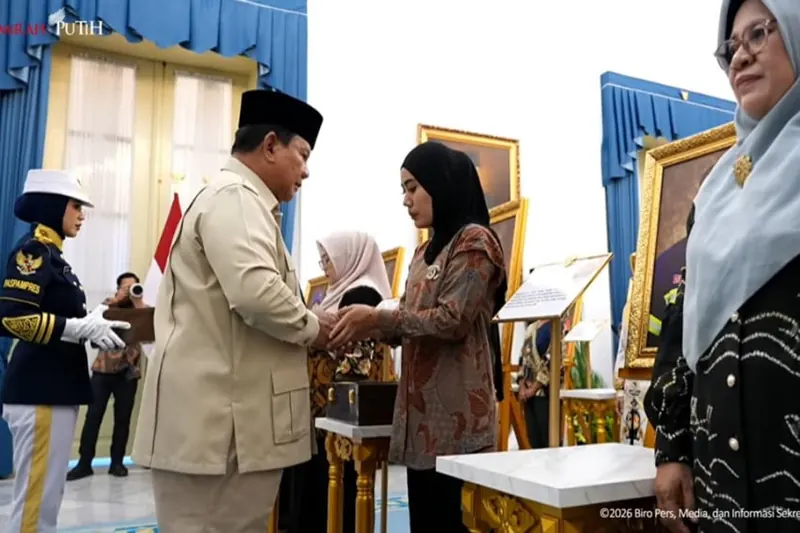
President Prabowo Subianto said the state would stand with the families of forest and land fire (karhutla) volunteers, disaster response personnel and health workers who died while on duty. He made the remarks at Bogor Palace on Friday, 13 November 2026, as reported by SINDOnews.
According to the report, the government would guarantee compensation and full education scholarships for the children of the bereaved families. Prabowo also presented the Bintang Jasa, a state service decoration, to the families of the fallen volunteers and personnel.
On the occasion, Prabowo expressed condolences for the sacrifice of the husbands and parents whose families were present. He stressed that the loss could not be replaced, but the state would not leave their families to face the future alone.
“The state will stand by you,” Prabowo said.
The role of volunteers in tackling forest and land fires
Forest and land fires in Indonesia are not simply seasonal natural disasters. During long dry seasons, dried peatland can easily ignite and is difficult to extinguish because embers can survive below the surface. A fire starting in one spot can spread rapidly when strong winds meet dry vegetation. The conditions mean that tackling karhutla requires many parties, from firefighters and Manggala Agni, the forest fire-fighting unit, to the Indonesian National Armed Forces (TNI), the Indonesian National Police (Polri), regional disaster management agencies and community volunteers. The history of forest and land fires in Indonesia is also linked to land clearing, concessions and the complex governance of forest areas. As a result, volunteers often work in spaces where economic interests, public safety and law enforcement meet.
Karhutla volunteers often work on dangerous front lines. They may take part in firefighting, building firebreaks, evacuating residents, distributing water or providing assistance in remote locations. Working in open terrain amid thick smoke exposes them not only to burns but also to respiratory problems, exhaustion, accidents and prolonged smoke exposure. When volunteers die, the social impact extends to families that lose both economic support and care. In vulnerable areas, volunteers also become information hubs for residents who need evacuation, medical aid or temporary shelter when air quality deteriorates. That experience shows their risks do not end when the fire is out.
State honours such as the Bintang Jasa are generally awarded to citizens or public officials who have rendered extraordinary service to the nation. In the context of disaster response, the award acknowledges that the work of volunteers and personnel is not ordinary voluntary activity, but part of the effort to protect public safety. Such symbolic recognition usually goes hand in hand with material policies, such as compensation, education guarantees or psychosocial support for bereaved families.
Education scholarships for the children of fallen families are also relevant because education is a long-term path to recovery. Losing a parent can change school plans, force children to work or push families into debt. Support for school costs, especially full scholarships, helps maintain continuity of learning and reduces the risk of children dropping out after a disaster or family crisis.
Impact on social protection and preparedness habits
For readers in Indonesia, the state’s promise to families of fallen volunteers underscores that tackling forest and land fires is not solely a central government matter. People who volunteer, work as field personnel or serve as health workers bear real risks. Therefore, compensation and scholarship policies can be a measure of how far the state treats social protection as part of disaster management, rather than merely a response after an event.
For affected families, full education support can ease concerns about school costs after the loss of a breadwinner. For the wider public, it encourages preparedness habits: understanding smoke risks, following warnings from authorities and not clearing land by burning. For field workers, state recognition also highlights the importance of personal protective equipment, safety protocols and sustained psychosocial support. The policy touches on social justice and the long-term survival of affected families.
What needs attention going forward is implementation. The public has a right to know the mechanism for disbursing compensation, the scope of the scholarships and the support provided to children who have lost a parent. That clarity will determine whether the policy remains a sympathetic statement or becomes reliable protection for families who have lost someone working to keep many others safe. Transparency also helps prevent gaps between families that receive aid and those that are not reached evenly.
Related news
- Denny: Prabowo’s polite stance is not a license for Gibran to stay
- LaNyalla proposes independent route for members of the House of Representatives (DPR RI)
- DPR pushes One Data bill for integration of protection and information