Prabowo Ensures Indonesia's Economic Fundamentals Remain Strong
President Prabowo led a limited cabinet meeting at Istana Merdeka, the presidential palace in Jakarta, on 2 November 2026 to ensure Indonesia's economic fundamentals remain strong.
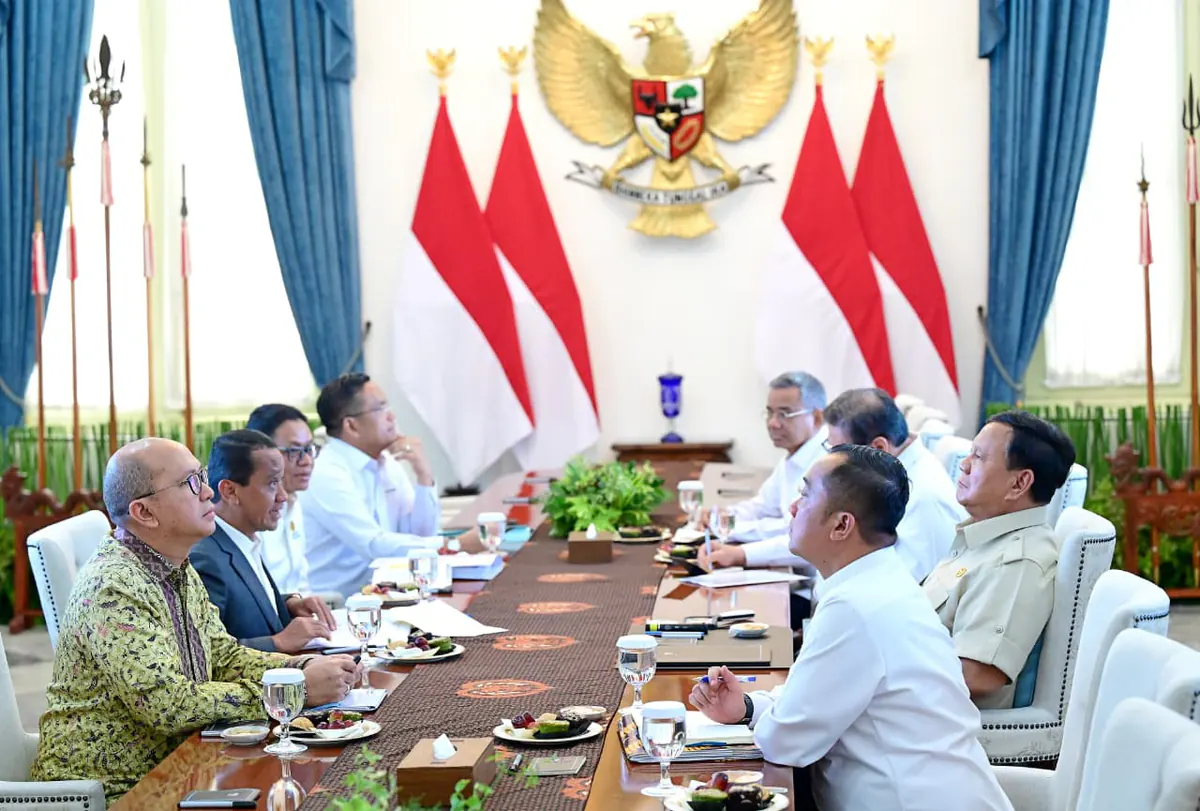
President Prabowo Subianto led a limited cabinet meeting of the Merah Putih Cabinet at Istana Merdeka, the presidential palace in Jakarta, on Monday, 2 November 2026, to ensure Indonesia's economic fundamentals remain strong. According to a report by the Cabinet Secretariat of the Republic of Indonesia (Setkab), Coordinating Minister for Economic Affairs Airlangga Hartarto presented positive indicators in manufacturing, the trade balance and inflation.
Airlangga, as quoted by Setkab, said the purchasing managers' index (PMI) for Indonesia's manufacturing sector stood at an expansion level of 54, up from 52.4 the previous month. He described the reading as the strongest expansion since March 2024.
On the trade front, Indonesia's trade balance posted a surplus of US$3.36 billion in September 2026. The surplus was supported by a US$5.67 billion non-oil and gas surplus, despite a US$2.31 billion deficit in oil and gas. Cumulatively, from January to September 2026, the surplus reached US$10.61 billion, with total exports of US$221.23 billion, up 5.58% year on year.
October 2026 inflation was recorded at 3.23% year on year and 0.22% month on month, while calendar-year inflation was 2.4%. Airlangga said the main pressure came from food and transport, but the government is preparing discounts ahead of Christmas and New Year to offset price increases gradually.
What PMI and the Trade Surplus Mean
In economic surveys, the PMI is used as an early mirror of business conditions. A reading above 50 signals expansion, while a reading below 50 signals contraction. Because it is compiled from business assessments of new orders, output, inventories and labour, the PMI is often seen as an early signal before official data are released. When the manufacturing PMI is in expansion territory, businesses are usually adding activity rather than merely surviving. A rise in the PMI is also often read as improving business optimism.
The trade balance surplus can also be read in different ways. Simply put, a surplus means export value exceeds import value. But the quality of the surplus needs to be seen from its components. A non-oil and gas surplus can come from commodities, manufacturing or services, while an oil and gas deficit shows dependence on energy imports. Therefore policymakers usually do not only chase the total figure, but also look for ways to curb high-value imports and expand value-added exports. Strong exports can help restrain pressure on the rupiah, Indonesia's currency.
On the price front, annual inflation and calendar-year inflation serve different purposes. Annual figures compare prices with the same period last year, while calendar-year figures measure price movement since the start of the year. Bank Indonesia, the central bank, has an inflation target generally around 2.5% plus or minus 1%. Within that framework, pressure from volatile food and transport tariffs needs to be offset by supply, logistics and price stimulus policies so purchasing power is not squeezed.
Such limited cabinet meetings usually serve as an inter-ministry coordination forum before policies are announced to the public. In them, the government links macroeconomic data, global risks and domestic measures. Therefore statements by economic officials at the forum can be read as a signal that the government wants to maintain market perception, while preparing policy space to sustain growth without sacrificing price stability and business confidence.
What It Means for Prices and Jobs
For Indonesian readers, those figures are felt most through two channels: jobs and prices. If the manufacturing sector continues to expand, demand for labour in factories, logistics and suppliers usually moves as well. But expansion becomes a real benefit only if orders persist, production capacity is filled and goods produced sell in the market. Conversely, if the rise is only temporary, its impact on wages and job vacancies may be limited.
On the household side, inflation still within the target range gives the government room to avoid panic-driven, large subsidy increases. But food and transport pressure remains close to daily spending. Chili, fresh fish and air transport tariffs are examples that are easy to feel. Therefore seasonal discount programs need to be monitored so they truly reach consumers, rather than becoming only temporary statistical markers.
Going forward, data consistency needs to be watched. Manufacturing expansion, a trade surplus and controlled inflation must move together over several months, not appear only in one report. If all three hold, the government has more room to maintain rupiah stability, support businesses and protect purchasing power. If not, price compensation measures need to be faster and better targeted. Monthly monitoring becomes important.
Related news
Prabowo concerned over alleged eavesdropping on the head of state
Prabowo's limited cabinet meeting discusses inflation, PMI and efficiency of the state budget (APBN)