Prabowo at ASEAN Summit: Global Challenges Require Regional Unity
President Prabowo Subianto urged ASEAN to strengthen regional resilience and unity at the 49th summit in Manila to confront economic pressure, geopolitical tensions and competition for resources.
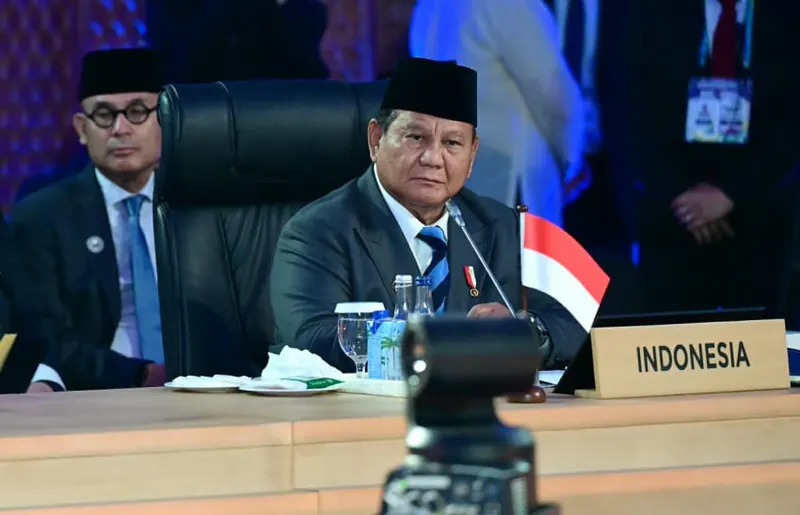
Speaking in the plenary session of the 49th summit of the Association of Southeast Asian Nations (ASEAN) at the Philippine International Convention Center in Pasay, Manila, on Sunday, 15 November 2026, President Prabowo Subianto said ASEAN member states must strengthen regional resilience and unity.
In a statement by the Press, Media and Information Bureau of the Presidential Secretariat, as reported by SINDOnews, Prabowo said economic pressure, geopolitical tensions and competition for resources required the bloc to become stronger, more capable, united and resilient. He noted that ASEAN would turn 60 next year and is home to about 700 million people, with a combined economy of more than US$4 trillion. According to Prabowo, contributions in multilateral forums could only be enlarged if each country first improved the welfare of its people; food and energy resilience, along with water security and management, were priorities.
Structure of ASEAN Cooperation
The summit is ASEAN's highest decision-making forum. Heads of state or government meet to set the region's policy direction, sign declarations and follow up on ministerial decisions. The meeting is usually held annually with a rotating host, following mechanisms agreed by member states.
ASEAN was born on 8 August 1967 through the Bangkok Declaration. Five founding members, Indonesia, Malaysia, the Philippines, Singapore and Thailand, formed the organization to ease post-colonial tensions, reduce the potential for conflict among Southeast Asian states and build economic and social cooperation. Over time, membership expanded across the region, guided by basic principles of mutual respect for sovereignty, non-interference in internal affairs, peaceful settlement of disputes and decision-making through consensus.
ASEAN's structure rests on three pillars: the political-security community, the economic community and the socio-cultural community. The political-security pillar governs cross-border cooperation, including counterterrorism, cybercrime and human trafficking. The economic pillar covers free trade, connectivity and market integration. The socio-cultural pillar addresses education, health, the environment and mobility for citizens. In practice, ASEAN decisions often rely on consensus rather than majority voting, so a single member that is not ready can delay an agreement.
The summit also serves as a space for diplomacy with external partners. Major powers such as the United States, China, Japan, South Korea, Australia, the European Union and India are often invited to related meetings. For Indonesia, the forum is important because its geographic and economic position makes it a hub for regional connectivity and a mediator when friction arises among member states.
In the context of global challenges, regional resilience refers to member states' ability to maintain supply, price stability and access to basic services during crises. This includes food reserves, diversification of energy sources and cross-border water governance. Because many production supply chains are spread across several countries, a disruption at a port, border or sea lane can affect prices in domestic markets. For consumers, that can mean more stable commodity prices, although adjustments take time.
What It Means for Indonesian Readers
For Indonesian readers, Prabowo's remarks at the ASEAN summit do not directly change rice prices or electricity tariffs, but they touch policy channels that can affect both. Food, energy and water security are issues that intersect with household spending: harvests, imports, distribution, subsidies and production costs. When the region strengthens food reserves and energy cooperation, potential price shocks from global supply disruptions can be better controlled. Conversely, if coordination is weak, external pressure can more easily spill into domestic markets.
The most tangible effects are usually medium term. Indonesia relies on ASEAN as an export market, a source of investment and a base for industrial supply chains, from electronics and automotive products to processed food. Regional stability helps sustain jobs in manufacturing, logistics and tourism. Reduced geopolitical competition also lowers risks in logistics, insurance and transit costs. However, readers should look for concrete follow-up: whether regional commitments become infrastructure projects, trade agreements or clear crisis mechanisms.
Therefore, the steps to watch are the implementation of the priorities Prabowo mentioned: food, energy, and water security and management. These issues are close to daily life, but their final impact depends on national policy, budgets and cooperation among member states. Without measurable follow-up, statements made at the summit remain an annual diplomatic note.
Related coverage
Related coverage: Lestari Moerdijat Calls for Dialogue at Bosphorus Summit; Prabowo Guarantees Scholarships for Children of Forest and Land Fire Volunteers Who Died; Prabowo Stresses National Wealth Must Be Enjoyed by the People.