Marines Harvest Corn on 18 Hectares in Pasuruan
The Marine Corps of the Indonesian Navy harvested corn on 18 hectares in Pasuruan, East Java, to support national food security.
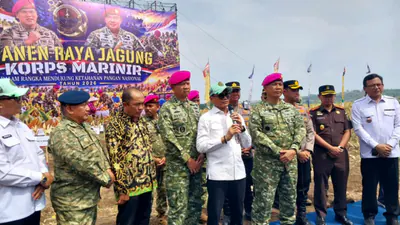
The Marine Corps of the Indonesian Navy (TNI AL), part of the Indonesian National Armed Forces (TNI), held a large-scale corn harvest at the Marine Combat Training Centre (Puslatpurmar) in Pasuruan, East Java, on Wednesday, 11 November 2026, to support the national food security programme.
The harvest was led by the Commander of the Marine Training Command (Komando Latihan Marinir), Brigadier General (Mar) Agus Dwi Laksana Putra, according to TVRI News. The activity follows an order from the Chief of Staff of the Navy to optimise land use and strengthen the Marines' role in agriculture.
The 18-hectare corn plot is managed jointly with the Marine Combat Training Centre 3 (Puslatpurmar 3), involves surrounding communities, and is supported by PT Inti Anggada, PT Advanta Seed Indonesia and research from Brawijaya University. Heru Suseno, head of the East Java Agriculture Office, attended on behalf of the provincial governor.
The use of land in the Rahlat Grati area emphasises modern planting and irrigation methods to improve productivity.
Food security and the role of training land
Corn has a dual role in Indonesia's economy. It is consumed as food and is also a main ingredient in poultry and livestock feed. As a result, corn harvests often affect prices for chicken, eggs and processed products. Food security broadly covers availability, access, utilisation and stable supply, while self-sufficiency emphasises meeting domestic needs through local production. A single local harvest therefore does not automatically mean national self-sufficiency.
National food programmes usually rely on a combination of land, seeds, water, technology and institutions. Improved seeds play an important role because they affect germination, pest resistance and yield potential. Modern irrigation helps reduce the risk of crop failure during the dry season. Post-harvest handling also matters: corn that is not dried and stored properly can lose quality and selling value. In addition, climate records and planting patterns help farmers choose safer planting times. When university research, seed companies and field units work together, farming can become more measurable than simply planting.
Using state-owned land, including training areas, is one way to expand planted area without sacrificing the land's main function. Training land remains in use for military readiness, while some space can be used for agriculture when it is not needed for training. That approach requires coordination so harvest activities do not disrupt operations, safety or training schedules. Cross-agency coordination among the TNI, local government and farmer groups is key to ensuring state assets remain productive beyond harvest day.
Community involvement also matters. Agriculture cannot stop at a ceremonial harvest; it needs maintenance, post-harvest handling, marketing and learning for local farmers. In many regions, food programmes often begin with symbolic harvests. The challenge is turning symbolism into routine production that is recorded, measurable and connected to markets. Without records of yields, distribution and equipment maintenance, similar activities can easily remain fleeting news. If the model is sustained, its results can show that state assets can be used for food production, agricultural education and community empowerment, not only as symbols of the programme.
Practical meaning for prices and farmers
For readers in Indonesia, the message from activities like this lies in the policy signal: the state wants food production not to depend entirely on one source. If idle land, training land, home gardens or village land are used with extension support, small farmers can gain examples of more efficient practices. However, the relatively small scale of the 18-hectare plot will not immediately change national corn prices. Using idle land can also reduce rental costs and open temporary jobs for residents.
What needs attention is sustainability: whether improved seeds are truly available to surrounding farmers, whether the irrigation system keeps working after the large-scale harvest, and whether the corn reaches local markets at reasonable prices. For consumers, the most tangible impact is usually felt in livestock feed prices, which then affect eggs and chicken. Transparency about harvest results and selling prices is therefore needed so the public can assess the benefits.
If the programme becomes only an annual event, its benefits will be limited. But if it is used as a field laboratory for extension workers, farmer groups and students, it can help farmers understand planting, fertilising and more water-efficient irrigation techniques. For young farmers, partnerships with universities and seed companies can open access to varieties, irrigation methods and guidance that were previously hard to reach. This matters because production costs are often farmers' main complaint.
Related stories
- Heavy rain does not damp Heroes' Day ceremony in Anambas
- Police raid Sebesi Island, find meth pipes and clip bags
- East Java Police deploy 3,000 personnel to secure demonstrations in Surabaya