Lumajang Regent Calls for Fight Against Poverty, Drugs and Corruption
Lumajang Regent Indah Amperawati calls poverty, drug abuse and corruption the modern struggles to fight on National Heroes' Day 2026.
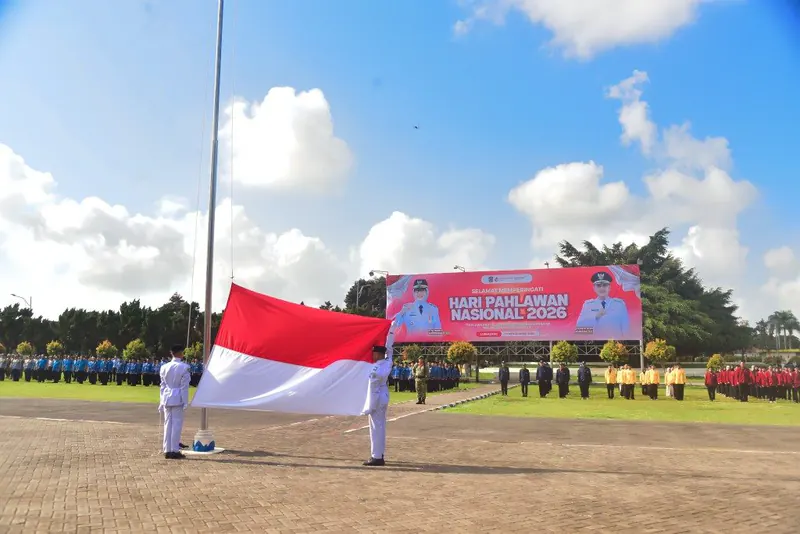
Lumajang Regent Indah Amperawati led the 2026 Hari Pahlawan, or National Heroes' Day, ceremony at Alun-Alun Kabupaten Lumajang, the regency square, in Jawa Timur (East Java) on Tuesday, 10 November 2026, urging residents to fight poverty, drug abuse and corruption as the struggles of the present day.
According to a report by InfoPublik, the government's public information portal, Indah — known by the nickname Bunda Indah — made the call during a ceremony themed 'Pahlawanku Teladanku: Melangkah Bersama, Melanjutkan Perjuangan' (My Hero, My Example: Moving Forward Together, Continuing the Struggle). She said the three problems were linked to welfare, the future of the younger generation and public trust in government.
During the ceremony, Indah also read a message from the Minister of Social Affairs. She stated, “Today’s struggle is no longer about taking up arms.”
She stressed that regional development required the roles of families, society, educational institutions and community groups, not only the government.
Heroes' Day in regional development
Every year, National Heroes' Day on 10 November offers a moment to reconnect the nation's collective memory with unfinished local tasks. The date recalls the Battle of Surabaya, when residents and fighters defended independence. In local government, commemorations are often used by regional leaders to turn symbols of struggle toward issues facing their communities. The symbols become a bridge between history and policy.
Poverty, drugs and corruption are often described as interlinked social challenges. Poverty can make vulnerable groups more exposed to the informal economy, low education and living pressures that create openings for substance abuse. If drugs spread, they erode young people's productivity and add burdens on families and social services. Corruption, meanwhile, reduces the quality of public spending because budgets meant for schools, roads, health care or social assistance can be misused. Corruption also discourages residents from participating because they feel their rights to public services are not guaranteed.
In places such as Lumajang, development is measured not only by buildings, infrastructure or economic growth, but also by a sense of safety, fairness and residents' trust in government. Social problems usually cannot be solved by one agency alone. Schools, families, religious leaders, youth communities, village governments and law enforcers each have different roles. The call to unite and continue the struggle can therefore be read as an appeal for heroism not to stop at ceremonies, but to enter public services, gotong royong (mutual cooperation) and prevention of social problems. When trust falls, social programmes can be hampered because residents are unsure aid reaches those entitled to it.
The term 'hero of today' also needs simple meaning: residents who maintain integrity at work, parents who ensure children keep learning, teachers who prevent bullying, or officials who are transparent in using budgets. With such a meaning, commemorations of heroism become closer to daily habits and can be measured by residents' participation in open village deliberations (musyawarah desa). This kind of heroism does not need a big stage, but consistency in small repeated actions.
What residents should watch for
For readers in Lumajang and other regions, calls like this are most useful when followed by visible steps: how clearly poverty data is used to distribute aid, how active drug prevention is in schools and villages, and how openly officials manage budgets. Such oversight matters because public money and social assistance touch basic needs. Without those measures, Heroes' Day risks becoming a moral message that fades quickly after the ceremony ends.
The impact reaches everyday habits. Residents who take part in village deliberations, report misuse of aid, reject illegal levies or keep children away from risky social circles are practising a concrete form of heroism. Local investors and small business operators also need certainty that permits, levies and projects are not held back by dishonest practices. For the world of work, officials' integrity and clean public services affect the cost of doing business, investor confidence and the quality of jobs. Public attention therefore needs to be directed at follow-up: what programmes are run, who is served, and how residents can oversee them.
If this issue only appears during national moments, readers need to ask whether there are complaint mechanisms, updated aid recipient data and sustained education on the dangers of drugs. In addition, residents can monitor whether drug prevention activities reach out-of-school teenagers, not only groups already active. Questions like these help turn appeals into more practical public oversight.