Lampung Governor Calls on Residents to Safeguard Tolerance and Cultural Diversity
Lampung Governor Rahmat Mirzani Djausal called on residents to protect interfaith tolerance and preserve cultural diversity while attending Hindu ceremonies in Central Lampung Regency.
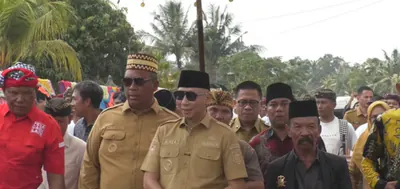
Lampung Governor Rahmat Mirzani Djausal has called on residents to protect interfaith tolerance and preserve cultural diversity in Central Lampung Regency, according to a report by TVRI News, Indonesia's state broadcaster, on Monday, 16 November 2026.
He made the appeal while attending the Manusa Yadnya Pawiwahan and Metatah ceremonies, Balinese Hindu rites for marriage and tooth filing, in Seputih Raman district. Community and traditional leaders, including Edward Syah Pernong, attended the event, and the governor was welcomed by I Made Surajaya with an udeng, a Balinese headcloth.
In his remarks, Rahmat described Lampung as a shared home for people of different ethnic groups, religions and cultural backgrounds. He said the spirit of Sai Bumi Ruwa Jurai, the provincial motto, should be realised through mutual respect and the maintenance of unity.
Cultural diversity and Hindu traditions in Lampung
Lampung has historically grown as a meeting place for many communities. Besides the native Lampung population, the region is home to people from Java, Bali, Sunda and other parts of Indonesia, some of whom arrived through resettlement programmes and others for work or education. Those differences are visible in language, arts, cuisine and the way residents organise village life. Regions such as Lampung can therefore act as social laboratories, showing how different identities can live together without erasing one another.
The motto Sai Bumi Ruwa Jurai is often used to describe that spirit. Literally, it can be understood as 'one land, two lineages'. In the context of Lampung custom, the two lineages usually refer to the two major currents of tradition, Pepadun and Saibatin. In public discussion, the motto is also used more broadly to suggest that differences need not become a source of division but can serve as social capital for cooperation. In governance, it can be read as a reminder that development must not focus only on physical projects but must also nurture mutual trust.
The Balinese Hindu tradition present in Lampung includes a cycle of life ceremonies known as Manusa Yadnya. The rites mark important stages in the life of a Hindu adherent, from birth and adulthood to marriage and obligations to ancestors. Metatah, or tooth filing, is generally understood as a marker of entering adulthood and a moral reminder to control negative traits. Pawiwahan is a marriage ceremony that unites not only two individuals but also two extended families and wider social networks. Ceremonies of this kind are therefore not only an internal matter for one community but part of the region's cultural mosaic.
When such religious events are given space in a region, they often become meeting points across communities. Residents from different backgrounds may take part as neighbours, members of the organising committee or authorities helping with security. For local government, attending cultural and religious events is also a way to show that harmony policies should not stop at slogans but should be present in the social spaces where residents meet.
What regional readers should watch for
For readers in Indonesia, calls to maintain tolerance in the regions are not merely ceremonial. Social harmony affects people's sense of safety in residential areas, the smooth running of economic activity and the quality of public services. Safety also matters for the mobility of workers, students and families moving between regions. When religious and cultural communities feel recognised, residents are more likely to cooperate in village activities, maintain public facilities and prevent conflicts that carry high social costs.
The practical impact is visible in everyday spaces. Religious ceremonies, cultural markets, local festivals and customary events can create interaction across identity lines. For small businesses, a peaceful atmosphere supports visits and the circulation of money in the region. At the level of the smallest neighbourhood units, known as RT and RW, or in villages, harmony makes deliberation easier and helps sustain gotong royong, the tradition of mutual assistance. For parents, an environment that respects differences helps children learn to live together in schools, workplaces and on social media.
What matters going forward is consistency in regional policy, especially the protection of the right to worship, space for cultural expression and regular interfaith dialogue. The public can assess that consistency through equal treatment in event permits, security and access to public space. Without it, messages of tolerance risk remaining little more than opening remarks. If regional policies are applied consistently, diversity can become an asset for more stable and inclusive local development.
Related news
East Java police chief visits the LDII Islamic organisation to maintain public security and order; main road in Golak hamlet, Bandungan, paved, making residents more comfortable; Jember police assist residents affected by tornado.