KPK Student Camp 2026 equips 90 Central Sulawesi students as anti-corruption agents
The Corruption Eradication Commission (KPK) held Student Camp 2026 in Palu to equip 90 senior and vocational high school students in Central Sulawesi as anti-corruption agents.
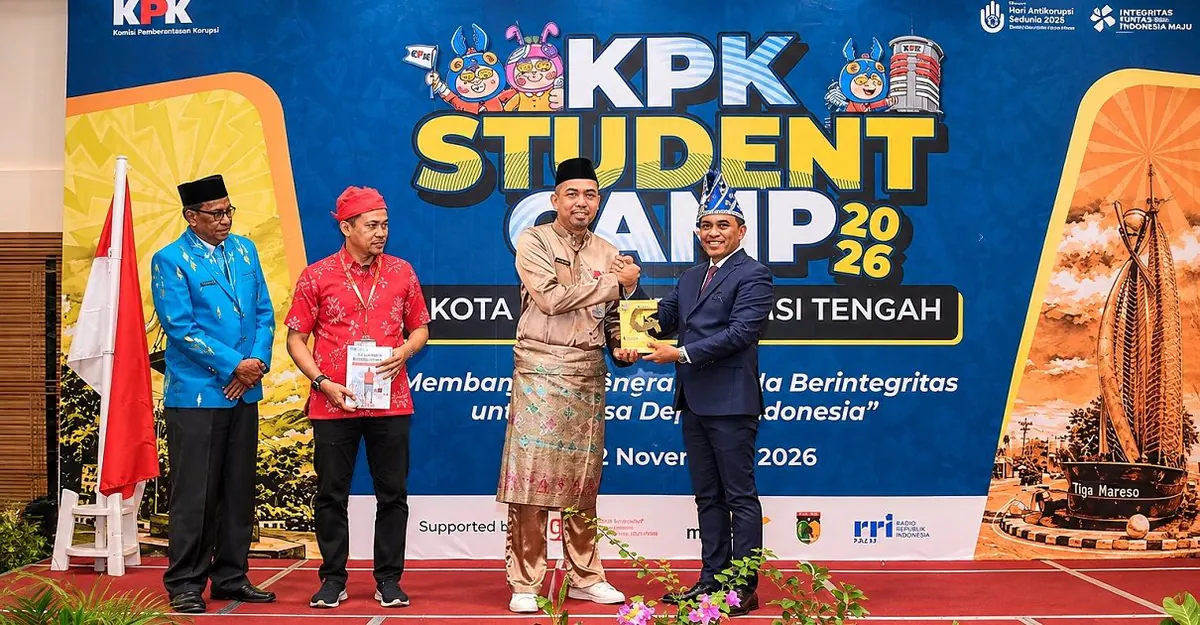
The Corruption Eradication Commission (KPK) held its Student Camp 2026 in Palu on 10-12 November 2026, bringing together 90 senior and vocational high school students from various regencies and cities across Central Sulawesi. The KPK prepared them as drivers of anti-corruption culture in schools and society.
According to a KPK report, participants were equipped with anti-corruption education, leadership and skills to develop integrity actions over three days. They were selected by the KPK together with the Central Sulawesi provincial government.
The programme was designed as a participatory learning space. Besides understanding integrity values, students were invited to prepare integrity projects, produce student journalism works and take part in the KPK Mengajar programme.
Amir Arief, the KPK director of socialisation and anti-corruption campaigns, said the activity was expanding anti-corruption education to young people. Central Sulawesi Governor Anwar Hafid urged participants to become integrity role models at school.
This year, the learning also linked integrity with environmental conservation, natural resource governance and sustainability. Participants will put anti-corruption education into practice at several elementary schools in Palu and Sigi Regency.
The programme also involved cooperation with GIZ Sentra Sulawesi Tengah.
The role of education in corruption prevention
Anti-corruption education is usually treated as part of prevention rather than enforcement. In the anti-corruption framework, legal action against officials or businesspeople only addresses cases that have already emerged, while education targets habits that make corruption seem normal. That is why many institutions treat schools as an entry point for instilling honesty, discipline, responsibility and the courage to reject small acts of cheating from an early age.
As the state institution tasked with eradicating corruption, the KPK also has a prevention mandate. In practice, prevention is carried out through system improvements, oversight and public campaigns. Student education matters because young people are in a stage of character formation and have fast-moving social networks. When students learn to distinguish rights, duties and the temptation to cheat, they are better prepared for workplaces prone to conflicts of interest.
Environmental issues in character education are not merely add-ons. In many regions, natural resource conflicts intersect with weak oversight, problematic permits and non-transparent practices. Central Sulawesi has mining, forestry and coastal landscapes that are sensitive to economic pressure. Integrity can therefore mean not only refusing bribes, but also having the courage to protect shared living spaces from exploitation that harms residents.
Participatory learning models such as camps are relevant because students absorb messages more easily when actively involved. Discussions, projects and teaching practice give them the role of subjects rather than mere recipients of lectures. In the long term, such methods can form small communities that remind one another. But the success of such programmes depends on follow-up after the camp ends, not on the number of participants gathered over three days. Without guidance from teachers and schools, the message can easily fade.
What it means for schools and regions
For readers in Indonesia, programmes like this remind us that corruption is not only a matter for courts or state financial reports. Integrity values appear in small things: not cheating on exams, not submitting attendance cards for others, not manipulating school activity reports and not misusing organisation funds. If such habits are left unchecked, the public will find it harder to trust the promises of officials or regional budget transparency. Therefore, anti-corruption education in schools can be read as a social investment whose impact is not immediately felt in prices or wages, but in the quality of public services.
The most tangible impact for regions is the possible emergence of student groups that are more critical of information and policy. They can monitor local issues such as school cleanliness, operating funds, learning facilities or regional government programmes in an orderly way. For parents and teachers, this is a reminder that digital literacy must be directed toward distinguishing true news, hoaxes and propaganda. Without support, anti-corruption campaigns can stop at slogans.
What needs attention going forward is the sustainability of the programme. Schools need to provide space so integrity projects do not disappear after the camp ends, for example through student councils (OSIS), journalism activities or courses that strengthen student profiles. For the community, the measure of success is not how many participants graduate, but how often they dare to reject cheating and demand transparency in their environment.
Related news
- Anti-corruption comic by ISI Bali students and KPK in 2026
- Asahan meets Ber-Aksi indicators, KPK highlights anti-corruption implementation
- KPK and MIND ID integrate whistleblowing system