KPK Pushes Regional-Owned Enterprise Leaders to Master Good Corporate Governance and Business Judgment Rule
The Corruption Eradication Commission (KPK) urged directors, commissioners and supervisory boards of Jakarta's regional-owned enterprises to understand good corporate governance and the business judgment rule so business decisions do not end in legal trouble.
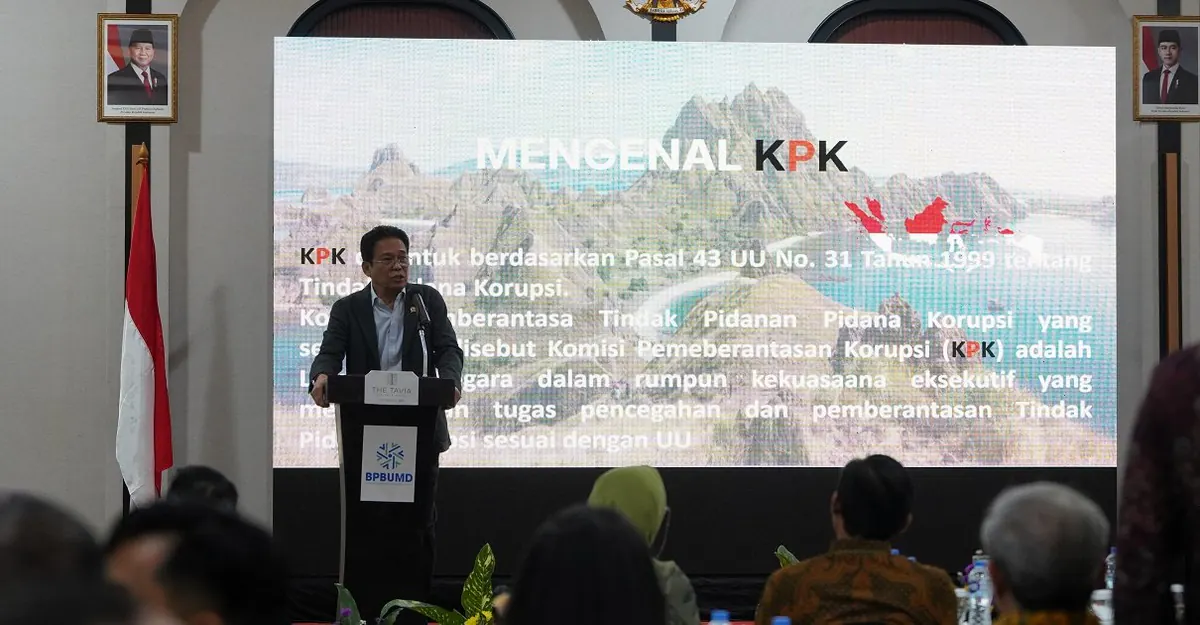
The Corruption Eradication Commission (KPK) urged directors, commissioners and supervisory boards of regional-owned enterprises (BUMD) in Jakarta to master the principles of good corporate governance (GCG) and the business judgment rule (BJR) at the Directorship Program held at the Tavia Heritage Hotel in Jakarta on Thursday, 12 November.
According to the KPK, the event brought together the leadership of all BUMD under the Jakarta provincial government. KPK Deputy Chair Johanis Tanak said the forum was intended to strengthen understanding of corporate governance and the limits of authority in making business decisions.
Tanak stressed that directors have the independence to run companies, but that independence must not be based on personal interests. The KPK said strategic policies must be grounded in the articles of association, internal regulations and applicable laws.
The KPK also warned that actions taken outside a company's authority could drag leaders into legal trouble, such as granting credit facilities from regional banks without proper procedures and without the company's knowledge.
The head of the Jakarta BUMD Development Agency, Syaefuloh Hidayat, said the forum helped align leaders' perceptions of the boundaries of authority so that legal risks in business decisions could be mitigated.
BUMD at the Crossroads of Profit and Public Service
BUMD were created as business vehicles for regional governments to manage assets, generate revenue and provide services that the market cannot always deliver. Because their capital comes from regional equity participation, they sit in a gray area between commercial corporations and public policy instruments. Directors are expected to pursue profit while also safeguarding tariffs, service quality and access for residents.
At that point, governance becomes decisive. GCG principles demand transparency so the public knows the basis for decisions, accountability so every policy can be accounted for, responsibility so companies comply with regional interests, independence so directors are not subject to political pressure, and reasonableness so decisions are not arbitrary. Without those principles, business decisions can easily slide into decisions that benefit particular groups.
The Business Judgment Rule gives directors room to take reasonable business risks. The doctrine is generally understood as protection so that a failed decision is not automatically treated as a criminal act, provided it was made in good faith, with due care, without conflicts of interest and within the scope of authority. In practice, BJR requires evidence of the decision-making process, not merely a profitable outcome.
Therefore, strengthening the capacity of BUMD leaders is not only about preventing corruption but also about preserving the courage to do business so it does not turn into excessive fear. When the rules of the game are clear, directors can innovate; when the rules are vague, strategic decisions are vulnerable to later challenge. At the same time, regional government shareholders also need to keep distance from management so they do not turn directors into political arms. Forums like this are important to align the language of regulators, shareholders and managers. Without that, legal risk and political risk are hard to separate.
Impact on Local Services and Public Money
For residents, BUMD governance touches everyday matters that often go unnoticed: clean water tariffs, transport costs, the quality of regional health services and prices of goods sold by regional government-owned companies. Unaccountable decisions by directors can raise operating costs, which are ultimately paid by the public through tariffs, subsidies or regional budgets.
If GCG and BJR are properly understood, the effect is not only legal protection for directors but also service certainty for regions. BUMD leaders who are willing to take measured risks can improve performance, create jobs and curb budget leakage. Conversely, when decisions are made without a sound process, regional losses can become a fiscal burden that leads to cuts in public programs. Public trust in regional government is also shaped by whether regional-owned companies are managed cleanly or merely become sources of rent-seeking.
What readers should watch going forward is BUMD information disclosure: financial reports, strategic decisions and oversight mechanisms. The more the public can assess decision-making processes, the smaller the space for irregularities disguised as business decisions. In many regions, BUMD also generate dividends for development, so poor governance can squeeze social spending. Therefore, BUMD evaluation cannot focus only on annual profit and social impact. The public also has the right to know whether internal oversight is functioning or merely a formality.
Related news
- KPK strengthens global cooperation to push recovery of corruption assets
- Low MCSP, KPK pushes governance improvements in Sorong City
- KPK and MIND ID integrate whistleblowing system