KPK Appoints Seven Strategic Officials to Strengthen Anti-Corruption Work
The Corruption Eradication Commission (KPK) has appointed four senior leadership officials and three administrators, including its director of investigations, to strengthen its anti-corruption institutions.
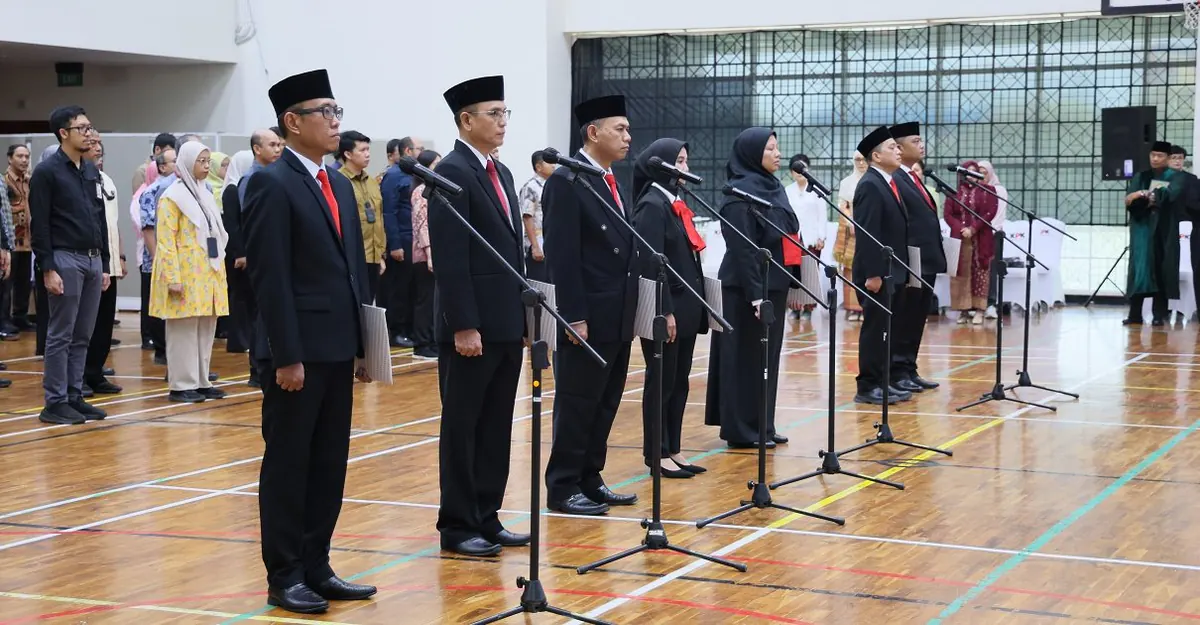
The Corruption Eradication Commission (KPK) inaugurated seven new officials on Thursday, 5 November, at Gedung Juang Merah Putih in Jakarta. The ceremony, led by KPK Secretary General Cahya H. Harefa in his capacity as the agency’s personnel management authority, covered four senior leadership positions and three administrator-level posts.
The senior leadership appointments were Achmad Taufik Husein as Director of Investigations, Arend Arthur Duma as Director of Corporate Anti-Corruption, Imam Turmudhi as Director of Regional Coordination and Supervision III, and Juned Junaidi as Inspector.
The three administrator posts were given to Amalia Rosanti, Elih Dalilah and Raden Natalia Kristianto, according to the KPK. They will serve respectively as head of the general affairs division of the secretariat of the Board of Supervisors, head of the secretariat for prevention and monitoring, and head of the litigation and witness protection division.
The appointments were made through talent management and a merit system. Cahya urged the new officials to safeguard the agency’s integrity and credibility. “Carry out the mandate of your office with full integrity,” Cahya said.
The Role of Senior Leadership Positions at the KPK
The inauguration of senior officials at the anti-corruption agency is not merely a bureaucratic rotation. Senior leadership positions typically set policy direction for units handling prevention, enforcement, regional coordination and internal oversight. Administrator-level posts sit below them and manage administrative affairs, secretariat functions and support work that determines whether organizational processes run smoothly. If structural posts remain unfilled, routine duties and case handling can be delayed.
In Indonesia’s bureaucracy, the filling of structural posts is governed by merit systems and talent management. A merit system places civil servants based on competence, track record and performance rather than personal closeness. Talent management helps agencies prepare cadres for critical positions. At the KPK, this mechanism matters because investigative, regional supervisory and witness protection roles require high technical capacity and integrity. These positions also involve coordination across institutions, oversight of state officials and protection for whistleblowers and witnesses. That is relevant when the agency is expected to act quickly while remaining accountable.
The Director of Investigations, for example, sits on the front line of law enforcement processes. The Director of Corporate Anti-Corruption deals with prevention in the business and corporate sector, while the Director of Regional Coordination and Supervision III relates to assistance and oversight in regions. The Inspector performs internal oversight functions, while administrators help ensure that administration, coordination and witness protection run smoothly. These functions are interconnected: weak prevention can burden enforcement, while poor internal oversight can erode legitimacy.
The KPK’s credibility also depends on its ability to uphold the oath of office, avoid abuse of authority and set an example in civil service governance. Each decision by an official can be read by the public as a signal of whether the agency is operating professionally or bowing to particular interests. For that reason, inaugurations are always an evaluation point: whether new officials can continue programs, improve coordination and preserve trust built over years. Internal oversight also requires officials to understand the limits of their authority, public ethics and mechanisms for reporting conflicts of interest. In other words, the inauguration is a test of organizational capacity, not just a ceremony.
Impact on the Public and Law Enforcement
For general readers, the inauguration does not immediately change cases under investigation, but it can affect the speed of services and the consistency of prevention. When investigative, internal oversight and witness protection posts are filled, the public is entitled to assess whether coordination between units improves or new obstacles emerge. Delays in filling posts can postpone work targets and weaken coordination between divisions. For residents dealing with reports, witness protection or case coordination, changes in leadership can shape the agency’s response.
The most tangible impact is in the business sector and in the regions. The Director of Corporate Anti-Corruption relates to preventing corruption in companies, while regional supervision touches local governments and public services. If the new officials carry out their functions well, the public can expect improvements in governance, not only enforcement. That matters for businesses that need certainty and for local governments that are being monitored.
What will need attention in the coming period is transparency of performance: targets, reports and complaint mechanisms. The inauguration is not an endpoint but the beginning of accountability. As long as the new officials maintain integrity and professionalism, public trust in the KPK has the chance to recover and strengthen. The public also needs to monitor whether talent management produces competent officials, rather than simply filling chairs.