Khofifah discusses Saudi investment interest in East Java hospitals and infrastructure
Governor Khofifah Indar Parawansa met Maedin Al Bina chief executive Mohamed Fathi to discuss Saudi investment interest in East Java hospitals and infrastructure.
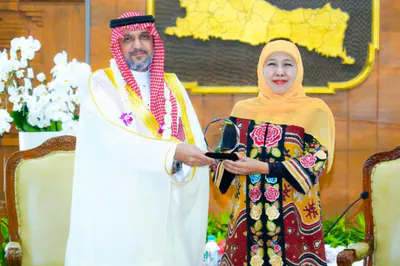
On Friday, 20 November 2026, Maedin Al Bina Chief Executive Mohamed Fathi met East Java Governor Khofifah Indar Parawansa at Gedung Negara Grahadi, the state guest house in Surabaya. The meeting discussed the Saudi company's interest in investing in the hospital, bus terminal and tourism sectors, as reported by TVRI News, Indonesia's public television news service.
A preliminary team from Maedin Al Bina had visited earlier, from 5 to 8 October 2026, and a delegation continued exploratory talks from 17 to 21 November 2026. Initial contact was made when Khofifah met company representatives at the Konsulat Jenderal Republik Indonesia Jeddah, the Indonesian Consulate General in Jeddah. In that meeting, Maedin Al Bina presented a plan to build a hospital worth about Rp1.7 trillion (about US$106 million). According to TVRI News, four sites were the focus of the study: RSUD Ar Rozy, a regional public hospital, in Probolinggo City, requiring Rp402.58 billion (about US$25 million); the Purabaya bus terminal, valued at Rp1.74 trillion (about US$109 million); RSUD dr. Mohammad Zyn in Sampang, requiring Rp789.98 billion (about US$49 million); and RSUD Dr. Soetomo in Surabaya, for a hospital hostel and hotel facility. Khofifah also offered tourism infrastructure development at Gunung Bromo and Air Terjun Tumpak Sewu. She stressed that any partnership must take into account feasibility, legal certainty, governance and long-term benefits. The East Java Investment and One-Stop Integrated Services Office (DPMPTSP) will facilitate communication with the hospitals, local governments and the Kementerian Perhubungan (Ministry of Transportation). The next stages include submission of official data, a feasibility study, legality, financial capacity, and the establishment of the prospective investor's business entity in Indonesia.
The role of public-private partnerships in regional projects
Public-private partnership (KPBU) schemes are used when public projects need private capital, technology and management, but the assets or services remain under government responsibility. Under such a scheme, the business entity usually builds or finances the project, operates it for a set period, then hands over management to the state or the region. It therefore requires a strict feasibility study, clear risk sharing and legal certainty so the regional revenue and expenditure budget (APBD) is not burdened.
For hospitals, another scheme may also be used, such as cooperation with a regional public service agency (BLUD). BLUD gives public service units more flexibility to manage their own revenue, but they remain subject to regional financial rules. When a foreign prospective investor is involved, the arrangement may take the form of a foreign investment company (PMA), regulated through a business entity in Indonesia. The BOT and DBFOM terms mentioned in the project discussion refer to infrastructure financing models: BOT means build-operate-transfer, while DBFOM covers design, build, finance, operate and maintain.
For East Java, hospital and terminal projects are not only about physical buildings. Hospitals need medical equipment, human resources and service standards, while terminals need spatial planning, safety and integration with public transport. Foreign investors therefore need to comply with land, licensing, environmental and partner-selection regulations. These stages mean investment interest does not automatically turn into a contract, but becomes a lengthy process involving ministries, local governments and prospective partners. Investors from the Middle East also need to demonstrate a project track record and funding capacity before entering tender mechanisms. Natural tourism destinations also require environmental impact analysis, spatial planning and adequate basic infrastructure.
What East Java residents should watch for
For residents of East Java, the visit does not yet mean the projects are under way. What exists now is interest and exploratory work, so direct effects on prices, hospital services or passenger flows cannot yet be confirmed. However, if the feasibility studies and partner selection succeed, the public may experience improved health facilities, better-organised terminals and more comfortable tourist destinations. Those benefits will depend on the investor's ability to meet quality, safety and governance standards.
From a regional economic perspective, the entry of a prospective foreign investor can add financing options without relying entirely on the APBD. This matters because hospitals and terminals require large costs, while public needs continue to rise. For job seekers, construction projects and supporting facilities may create jobs, but the number can only be known after labour needs and investment stages are set. The public therefore needs to wait for official announcements about the selected partner, final value, financing scheme and construction schedule. Transparency in the tender process and protection of workers' rights also need oversight. If projects involve regional assets, the public has the right to know land-use plans and their impact on public services. Local governments also need to ensure access to services remains affordable for low-income groups and does not create new tariff burdens.
Related coverage
Related coverage: Six Eselon II officials of the East Java provincial government inaugurated by Khofifah; Polres Sukoharjo, the Sukoharjo police station, deploys 760 personnel to secure village head elections (Pilkades); customers of BPR IAS Ambarawa, a rural bank, demand return of Rp1.1 billion.