Sukoharjo Police Deploy 760 Personnel to Secure Village Head Elections
Sukoharjo Regency Police will deploy a combined force of 760 personnel to secure the 2026 simultaneous village head elections in 126 villages with 458 polling stations on 10 December 2026.
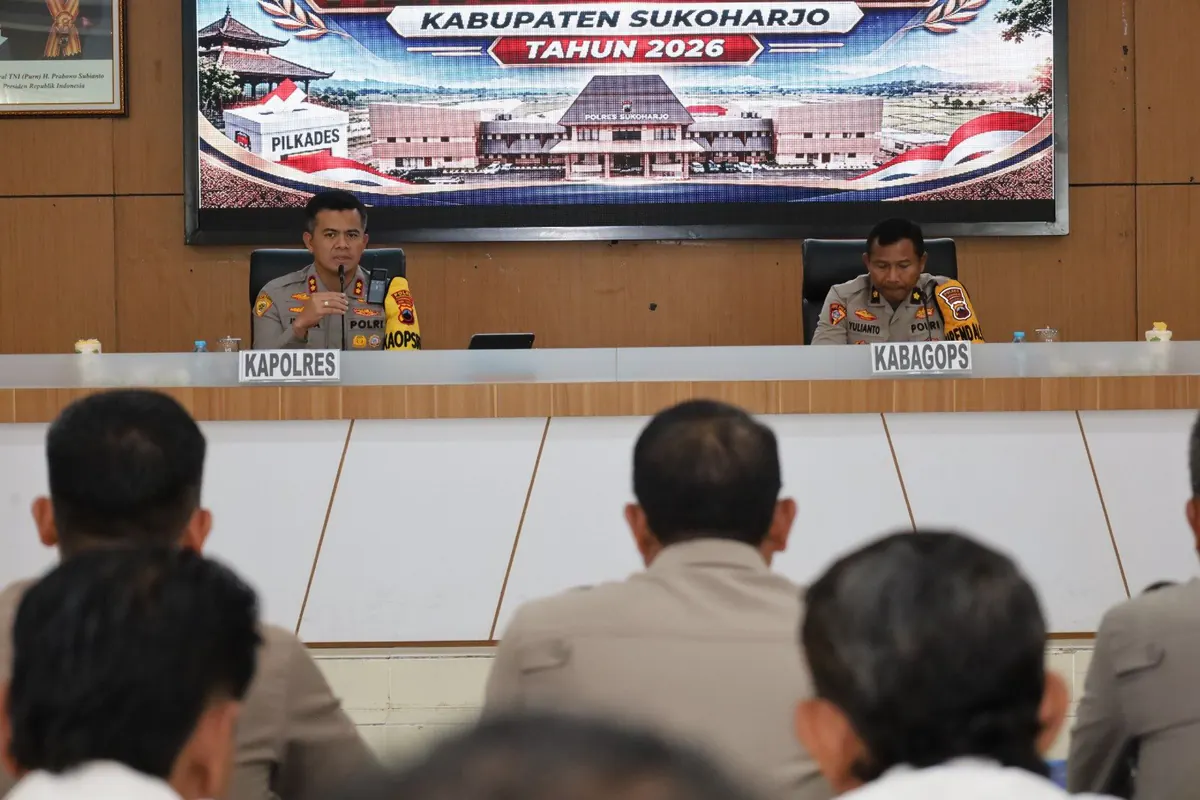
Sukoharjo Regency Police (Polres Sukoharjo) have prepared a combined force of 760 personnel to secure the 2026 simultaneous village head elections, known locally as Pilkades Serentak, scheduled for 10 December 2026 in Sukoharjo, Central Java. Security will focus on 126 villages with a total of 458 polling stations (TPS), according to a report by Jateng Pos.
The readiness was discussed in a coordination meeting at the R. Kusnadi Hall of the Sukoharjo Regency Police headquarters on Thursday, 19 November 2026, led by Regency Police Chief AKBP Indra Maulana Saputra. He said, “Every area has different characteristics and levels of vulnerability.” The meeting reported that 670 internal Sukoharjo personnel would be reinforced by 90 operational command support personnel, known locally as Bantuan Kendali Operasi (BKO), comprising 30 from the Mobile Brigade Corps (Brimob) and 30 each from the Karanganyar and Boyolali regency police commands.
Sukoharjo Regency Police Head of Operations Division Kompol Yulianto said the BKO personnel would be divided into four zones to speed up mobilisation: north at Gatak Police Station, east at Mojolaban Police Station, central at Nguter Police Station, and south at Tawangsari Police Station. He added that the security pattern at each polling station would be adjusted to the level of vulnerability, geographic conditions and the needs of each village.
The security intelligence unit (Satintelkam) of the Sukoharjo Regency Police mapped potential disturbances including rivalry among prospective candidates, money politics, hoaxes, smear campaigns, suspected neutrality violations by village officials and staff, and rejection of vote count results. Several subdistricts drew attention, including Weru, Bulu, Tawangsari, Nguter, Bendosari, Grogol, Baki, Gatak and Kartasura. Bentakan, Sanggung and Pucangan villages are also being monitored because each has more than five prospective village head candidates and therefore requires additional selection.
Village elections carry higher social stakes
Village head elections are often seen as socially more volatile than regency or provincial elections because candidates, voters and organisers live in the same social circles. In villages, kinship ties, neighbourhoods, farmer groups, Islamic study groups and youth organisations can quickly turn into political camps. If differences in choice are not managed, friction does not stop at the polling booth but carries into everyday interactions.
What is contested is not merely the symbolic office. A village head stands at the front line of public services, village asset management, delivery of development programmes and coordination with subdistrict and regency governments. Candidates and supporters therefore tend to place high expectations on the access, programmes and social position that come with the office. This makes money politics, mobilisation of village officials and staff, and pressure on voters persistent risks.
In security terms, Bantuan Kendali Operasi (BKO) means placing additional personnel from other units to strengthen an area judged to need a rapid response. Satintelkam is the security intelligence function that maps potential disturbances, while Bhabinkamtibmas are police officers assigned to villages for guidance and early detection. The term cooling system refers to efforts to lower political tension, for example through peace declarations, appeals from community leaders and joint prayers, not only physical security.
Smear campaigns and hoaxes have become new challenges because negative messages can spread quickly through chat groups. Unlike criticism of programmes, smear campaigns usually target personal reputations, distort information or provoke emotions. This is where residents' media literacy and organisers' neutrality are tested, because a single piece of false news can trigger fights between supporters that are hard to separate from family and neighbourhood relations.
What it means for Sukoharjo residents
For residents, a safe village head election determines whether village services continue smoothly after voting. A village head elected through a clean process is more likely to be accepted across groups, so development programmes, civil registration and social problem handling are not immediately held hostage by political grudges. Conversely, if conflict is allowed to fester, residents can remain divided for a long time and trust in village officials declines.
Large-scale security also sends a message that the state is present, but it should not be seen as solving all problems. Residents need to protect village digital spaces from hoaxes, reject money politics and ensure voting rights are used without pressure. Election participants also need to accept available dispute or review mechanisms rather than mobilising supporters into the streets.
Going forward, attention should focus on the neutrality of village officials, transparency of stages and rapid response to violation reports. When voters believe the results reflect the people's will, the legitimacy of a village leader is stronger for mobilising gotong royong, or mutual cooperation. If those indicators work, the 2026 simultaneous village head elections can become a local democracy exercise that strengthens social cohesion rather than a win-lose contest that divides residents.