Malang Regency Police Plant 1,266 Tree Saplings to Support Green Policing
The Malang Regency Police planted 1,266 tree saplings simultaneously across Kabupaten Malang on Friday, 20 November 2026, to strengthen Green Policing and environmental awareness.
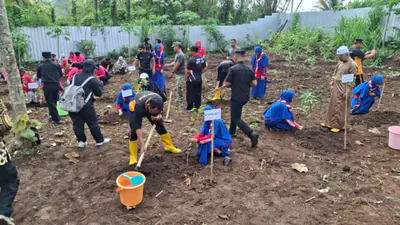
The Malang Regency Police (Polres Malang) planted 1,266 tree saplings at the same time across Malang Regency (Kabupaten Malang) on Friday, 20 November 2026, as part of support for Green Policing, an environmental policing approach, according to TVRI News, the news service of Indonesia's public broadcaster. The activity framed greening as a joint effort among police, local government, Islamic boarding schools (pesantren) and the public.
The central planting was held at Pesantren Al-Quran dan Agribisnis Assa’idiyah in Kepanjen district (Kecamatan Kepanjen). Attendees included Malang Regency Vice Regent Lathifah Shohib, Malang Regency Police Chief AKBP Rulian Syauri, with AKBP denoting a senior police rank, the Malang branch of Bhayangkari, the police wives' association, pesantren caretaker KH Ali Musthofa Asady, with KH denoting an honorific for a respected Islamic scholar, and santri (students). Subordinate police stations (polsek) also joined the planting in their respective areas. Rulian said the trees must be cared for rather than treated as a ceremonial gesture. The species used included trembesi (rain tree), mahoni (mahogany), asam (tamarind) and fruit trees. The programme was run with PT Smoore Technology Indonesia.
Police role in protecting the environment
Green Policing is more than a tree-planting exercise. In modern policing, the term refers to an approach that treats environmental protection as part of police work. Police do not only act after pollution, illegal logging or land fires occur; they also promote prevention through education, patrols and community involvement. The approach aligns with community policing, the idea that public safety is built with the public rather than enforced by police alone.
In Indonesia, environmental issues often intersect with local affairs: household waste, land conversion, air pollution and river basin degradation. For that reason, greening programmes run by regional police are usually read as a signal that authorities want to be present in non-criminal issues. Tree planting can open communication with schools, pesantren, communities and village governments. Relationships built this way make it easier for police to receive reports, encourage residents to protect shared assets and prevent conflicts rooted in competition over living space.
Several terms matter for readers. Green cover refers to land covered by vegetation, including forests, gardens and trees in settlements. Carbon absorption is the ability of plants to store carbon dioxide, a gas linked to global warming. Post-planting care includes watering, pruning and protection from animals or vehicles. Without care, saplings planted during ceremonies risk dying, reducing environmental programmes to activity records.
In pesantren and other educational institutions, greening also functions as a learning space. Santri or students who help care for trees can connect the activity with social responsibility, discipline and ecological awareness. The success of such movements is usually measured not by the number of saplings distributed, but by whether trees survive and whether residents feel ownership.
Tangible benefits for Malang residents
For residents of Malang Regency, tree planting can touch everyday concerns: temperatures around homes, air quality and the risk of waterlogging during rain. Trees in yards, village roads or vacant lots help retain water, reduce reflected heat and provide shade. In areas where settlements keep expanding, green space is often squeezed by buildings and infrastructure. Multi-stakeholder greening should therefore be seen as an effort to maintain livability, not just a symbolic activity.
A more practical impact is possible fruit or timber from trees that are cared for, although benefits may take years. Trembesi, mahoni, asam and fruit trees serve different functions: some are strong shade trees, others may provide small harvests for the neighbourhood. The programme's success will be visible if residents know who waters the trees, who protects the saplings and where to report damage. Collaboration with PT Smoore Technology Indonesia shows environmental responsibility can be shared by government, police and the private sector.
Going forward, readers can watch for simple indicators: whether there is a list of planting sites, people responsible for care, and periodic reports. Village governments and schools can record tree species and locations to make monitoring easier. Without that, the number of saplings planted is hard to assess in terms of benefit. The movement is most useful if it encourages new habits: planting in yards, sorting waste and maintaining drainage channels. In that way, Green Policing does not stop at being a police programme but becomes part of how residents care for their own environment.