Customers of Rural Bank BPR IAS in Ambarawa Demand Return of Rp1.1 Billion in Savings
Customers of a rural bank in Ambarawa, Central Java, are demanding the return of Rp1.1 billion (about US$67,000) in savings they say disappeared, leaving balances near Rp300 million.
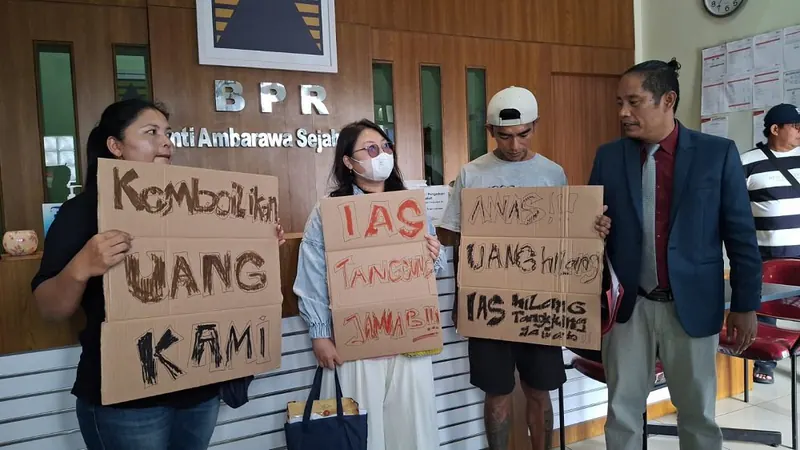
Customers of Bank Perkreditan Rakyat Inti Ambarawa Sejahtera (BPR IAS), a rural bank in Ambarawa, Semarang Regency, Central Java, are again demanding the return of savings they say have been missing for about two years. One affected customer, Vinata Kristantina, 28, said her Rp40 million deposit was listed as only about Rp350,000 when she visited the bank on Friday, 20 November 2026.
As reported by the Indonesian newspaper Jateng Pos, Vinata used the bank's mobile teller service and always kept official deposit slips, while her savings book was filled in by hand by bank staff. When she tried to withdraw money for a wedding vendor in 2025, she was directed to the customer service section and given an account statement. The statement showed a balance of only Rp350,000, while withdrawals allegedly began in late 2024.
Losses reported by other customers were larger. Lawyer for the complaining customers, Efendi Panjaitan, said his clients Adefi Susiyanto and Kumala Hesti had 14 accounts with initial savings of Rp1.12 billion (about US$68,000), but the balances now stood at about Rp300 million. According to Jateng Pos, printed account statements showed repeated withdrawals without the account holders' knowledge.
The customers have reported the suspected embezzlement to Semarang Regency Police and filed a civil lawsuit against BPR IAS at the Semarang District Court. BPR IAS director Yohanes Johan Yuniar said the bank respects the legal steps, noted that 14 customers had complained and claimed that an internal audit found transactions had been recorded in accordance with procedures.
Role of rural banks in public savings
Bank Perkreditan Rakyat are financial institutions that collect public funds in the form of deposits and extend credit, usually within a narrower area than commercial banks. Their common products include savings accounts and time deposits, with interest rates set under bank policy and supervisory rules. Because they serve many individual customers, micro businesses and community groups, rural banks depend on public trust. Savings recorded in passbooks or account statements form evidence of the legal relationship between customers and the bank.
In banking practice, services such as mobile tellers are meant to make transactions easier outside bank offices. However, each deposit still needs to produce an official proof, such as a deposit slip, and be recorded in the bank's system. A manually written passbook can serve as a supplement, but more detailed information usually appears in the account statement, which lists debit and credit transactions over a period. Account statements matter because they contain dates, amounts, reference numbers and the parties involved in each transaction. If customers find transactions they never made, the first step is usually a written objection asking the bank to trace system logs, surveillance camera recordings or staff authorisations.
A bank's internal audit checks whether cash flows, journal entries and transaction authorisations followed procedures. In cases of suspected missing balances, an internal audit can be early evidence, but it does not automatically remove customers' rights to file a civil lawsuit or a criminal complaint. Criminal and civil processes can run separately because their focus differs: proving fault and restoring the right to money.
In Indonesia, banking supervision is carried out by the Financial Services Authority (OJK), while deposit guarantee is handled by the Deposit Insurance Corporation (LPS). Customers need to understand that not every transaction or loss is automatically covered; conditions include compliance with LPS rules, including maximum limits and adherence to banking regulations.
Lessons for savers in the regions
The case shows that trust in a financial institution cannot rest only on its name or office location. Savers should keep deposit proofs, check transaction records regularly and avoid delaying confirmation when balances do not match. If a bank offers a deposit pickup service, customers still have the right to transaction proof that can be traced in the system. Manual records should be documented with photographs or copies.
For readers in Indonesia, the most immediate impact is the risk that money intended for education, weddings, business capital or emergency funds may be held up. While legal proceedings continue, customers need to understand that recovering funds can take time. It is important to record the chronology, gather documents and use official complaint channels, including the bank, OJK or financial consumer protection agencies. Customers should not rely only on verbal promises.
Cases like this can also become material for evaluation by rural banks, so that manual records, mobile services and internal audits are tightened. For customers, vigilance is part of self-protection: a missing balance is not just a number, but a disrupted life plan.