Joint search and rescue team finds Pasaman angler dead
A joint search and rescue team found Judin, 45, dead in the Batang Air Sumpu Abam river in Pasaman, West Sumatra, on 15 November 2026 after he went missing while fishing.
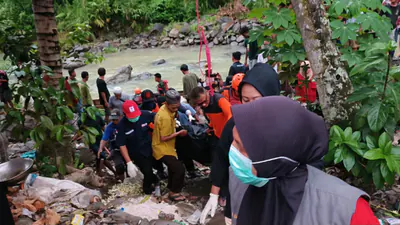
A joint search and rescue (SAR) team has found Judin, 45, an angler suspected of drowning and reported missing in the Batang Air Sumpu Abam river (Sungai Batang Air Sumpu Abam) in Nagari Lubuk Layang, a village-level unit in Kecamatan Rao Selatan, Kabupaten Pasaman, Sumatera Barat, dead on Sunday, 15 November 2026.
Abdul Malik, head of the Padang Search and Rescue Office (Kantor SAR Padang), said the victim was found at 5:20 p.m. Western Indonesian Time (WIB), about 15.7 kilometres from the initial location, and was then taken to the family home, as reported by TVRI News.
Before going missing, Judin had gone fishing on Friday, 13 November 2026, at around 2:00 p.m. WIB. His family found his sandals and fishing equipment, and he had a history of epilepsy.
The third day of the search involved two Search and Rescue Units.
River search procedures
Searches for people missing in rivers usually begin from the last known position (Last Known Position). From that point, teams set a sweep radius, judge the direction of the current, assess depth and consider places where the body might end up. In the Pasaman case, the 15.7-kilometre distance between the initial location and where the victim was found shows how currents, time and the size of the area can carry a person far away. In West Sumatra (Sumatera Barat), fast-flowing rivers can change rapidly after rain, so search areas need to be revised every day.
Splitting SAR units into two working groups is also common. One group can work on the water in rubber boats, while the other sweeps riverbanks, small estuaries or spots that are harder to reach. SAR operations often bring together staff from search and rescue offices (Kantor Pencarian dan Pertolongan), the Regional Disaster Management Agency (BPBD), the Indonesian National Armed Forces (TNI), the Indonesian National Police (Polri), volunteers and residents, because river terrain requires speed and local knowledge. Residents who know the river are often asked to point out deep pools, channels and spots where floating objects can become trapped.
Tools such as thermal drones help teams spot temperature differences on the water surface or along the banks, especially as light fades. But technology remains a support, not a substitute. Decisions to stop or widen a search depend on weather, water discharge, visibility and any belongings found. A family report about the missing person's health history is therefore part of the risk assessment on the ground. Daily evaluations also consider personnel fatigue, because water searches require stamina and constant alertness.
In Indonesia, search and rescue is a state responsibility carried out through the National Search and Rescue Agency (Basarnas) and regional search and rescue offices (Kantor Pencarian dan Pertolongan). When an incident occurs in a regency (kabupaten), the nearest SAR post usually leads the effort, assisted by local government and security agencies. That coordination is meant to prevent searches from turning into dangerous solo actions by residents or volunteers. Operations are usually reviewed periodically from the first day through the third day. The public can help by reporting the missing person's physical features, last clothing and habits, rather than joining sweeps without equipment.
Risks for anglers and residents
For communities living along river basins, the incident is a reminder that fishing is not only a way to catch fish but also an activity exposed to water, weather and health risks. A history of epilepsy is a particular concern because a sudden seizure can make someone lose control on a riverbank, in a boat or on slippery rocks. Life jackets, communication devices and simple location markers can reduce risk, though they cannot guarantee safety.
In practical terms, residents should get into the habit of telling family members where they are going, why and when they expect to return. Items left at the scene, such as sandals or fishing gear, can become early clues for search teams. Fishing groups should also avoid moving alone, especially when water levels rise or rain falls upstream. Families who report a disappearance quickly give rescuers more time to estimate the direction of drift.
For local governments, the case can be used for a simple review: warning signs at dangerous points, clear evacuation routes and fast coordination among BPBD, SAR teams and community health centres (puskesmas). The stakes are not about prices or national policy, but about the safety of residents who depend on rivers every day for work, recreation and tourism. If dangerous spots keep appearing in local news, communities should demand concrete mitigation plans, not seasonal appeals.
Related news
Police raid Pulau Sebesi, find methamphetamine paraphernalia and plastic clip bags
Central Java provincial government (Pemprov Jateng) cuts rice-field preparation cost to Rp200,000 per hectare
Four conditions John Pieris sets for vice-president (Wapres) replacing Gibran