ISI Bali students and KPK use comics in 2026 anti-corruption campaign
Students at the Institut Seni Indonesia (ISI) Bali and the Corruption Eradication Commission (KPK) are using comics to promote integrity through the Sketch Your Integrity 2026 competition.
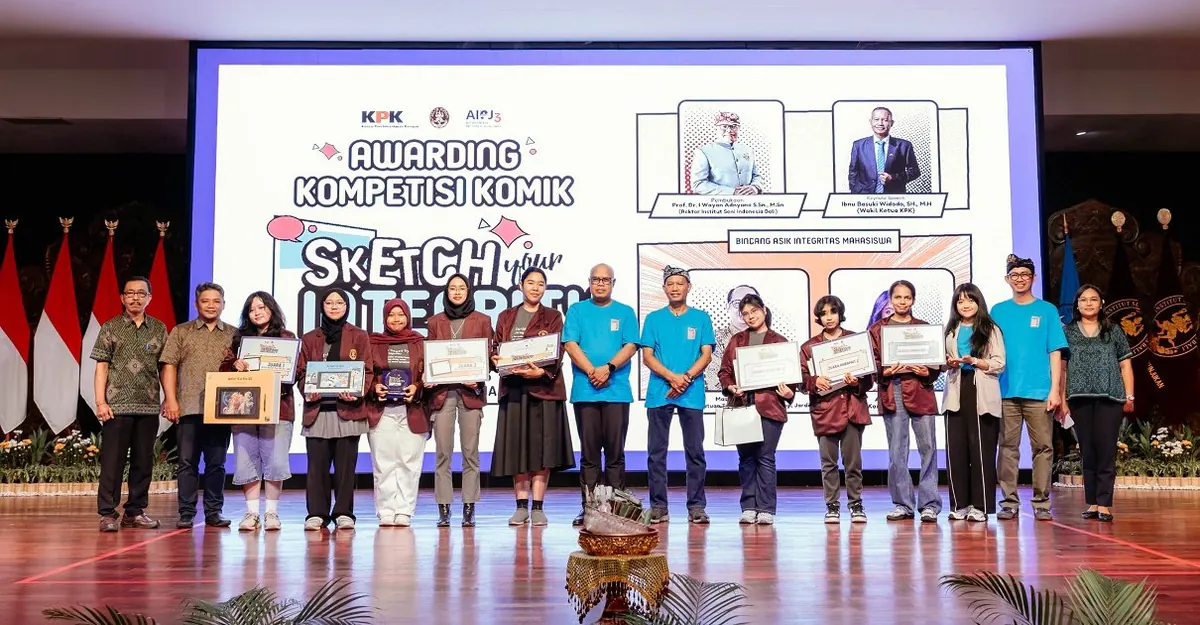
Students at the Institut Seni Indonesia (ISI) Bali and the Corruption Eradication Commission (KPK) have turned to comics as a medium for anti-corruption campaigning through the Sketch Your Integrity (SYI) 2026 competition. The campaign’s culminating awards ceremony was held at the Citta Kelangen building on the ISI Bali campus on Tuesday, 3 November 2026, with about 200 students taking part.
According to information released by the KPK, the competition drew 25 participants, both individuals and groups, who translated ideas about integrity, transparency and rejection of corruption into picture-story panels. ISI Bali rector Prof. Dr. I Wayan ‘Kun’ Adnyana said art and design could serve as tools for reading social phenomena, while comics conveyed critical messages lightly.
KPK Deputy Chair Ibnu Basuki Widodo stressed that efforts to eradicate corruption could not rely on enforcement alone; prevention, education and public participation also had to move forward. He described the joint activity with ISI Bali as part of anti-corruption education for students. Six works were named winners, from first prize to third honorable mention.
Putu Anggi Ramania took first prize with “Semua Juga Begitu”. The Triple T group placed second with “Dibalik Pameran”, while Ni Putu Prillavenia Yogiputri won third prize with “Sedikit Saja”. The activity was supported by the Australia-Indonesia Partnership for Justice Phase 3 and was part of the SYI series held at the Kalimantan Institute of Technology (ITK), ISI Bali and ISI Surakarta.
Comic artist Adelia Maghfira, speaking in a discussion session, said comic visuals worked only when the story and message were clear. Masagung Dewanto, head of the Higher Education Task Force at the KPK’s Education Networking Directorate, said anti-corruption education had to become a habit, for example honesty in assignments and campus activities.
The campus footprint of anti-corruption education
Corruption in Indonesia is not only a legal issue but also a cultural and behavioral one. For that reason, anti-corruption work is usually divided into three tracks: enforcement against cases, prevention through system improvements, and education and public participation. The third track is often seen as slower to show results, but it provides the foundation for ensuring that corrupt practices are not treated as normal. In that context, campuses are viewed as strategic spaces because students are future professionals, public officials and citizens who will make economic and social decisions.
In higher education, anti-corruption education can take the form of courses, co-curricular activities, research or creative works. The aim is not simply to memorize legal articles, but to make integrity a habit in small situations: not cheating, not plagiarizing, not manipulating data and not abusing positions in student organizations. When those values are practiced repeatedly, they become habits. The approach aligns with the spirit of the United Nations Convention against Corruption (UNCAC), which emphasizes prevention and education as part of building a society that is not tolerant of corruption.
Visual art and picture stories have an interesting place in character education. Comics can condense complex issues into scenes that are easy to remember, such as the temptation to cheat in exams, the practice of pushing projects through connections, or the normalization of small gratuities. Because the format is light, the message can reach audiences who may be resistant to formal lectures. But the medium also demands care: creators must ensure that criticism does not turn into defamation, and that the depiction of deviant behavior is not treated as entertainment without reflection.
The collaboration between the anti-corruption agency and the art institution also shows that the integrity movement need not rest on a single profession. Art students can translate public issues through visuals, while campuses provide a space for practice. In this way, anti-corruption campaigning does not stop at slogans but becomes part of learning, the production of works and social interaction in the education environment.
What it means for students and the public
For readers in Indonesia, an anti-corruption campaign carried through comics is relevant because it touches everyday habits that are often considered trivial: cheating, plagiarism, proxy attendance, or offering money to speed up services. These small practices can shape a mindset that corruption is a normal way of doing things. If that mindset is carried into the workplace, it can affect the cost of public services, the quality of projects and public trust in institutions.
Activities like this also offer an example that students do not have to wait until they become officials to help improve conditions. They can start with their work, discussions and honest conduct on campus. For the public, visual messages spread more easily on social media, so integrity values can reach groups that are not drawn to formal seminars. What needs attention going forward is sustainability: creative campaigns must be followed by concrete practices, such as transparency in campus activities, accountability in student organizations, and exemplary conduct by lecturers and administrators.
The artistic approach can also broaden the base of support for anti-corruption work. When people see corruption not only as a legal case but as a habit that can be changed through stories, social pressure to be honest becomes stronger. The impact is not immediate, but it builds a culture that is more resistant to deviant behavior.
Related news
- Hulu Sungai Selatan becomes Ber-Aksi 2026 pilot
- KPK appoints seven strategic anti-corruption officials
- KPK strengthens global cooperation to push corruption asset recovery