Indonesian National Police Trace Locations and Gather Evidence in Suspected Treason Case
The Criminal Investigation Agency of the Indonesian National Police is tracing locations and collecting evidence in a suspected treason case, including a house in Cipete linked to suspect EHS.
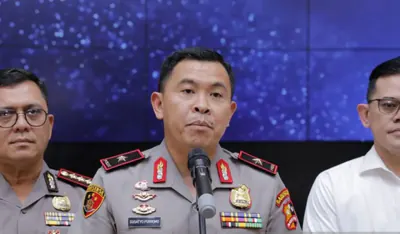
The Criminal Investigation Agency of the Indonesian National Police (Bareskrim Polri) is still tracing several locations and collecting evidence in a suspected treason case in Jakarta, as reported by TVRI News on Thursday, 19 November 2026.
Police Brigadier General Susatyo Purnomo Condro, director of the General Crimes Directorate at Bareskrim Polri, said investigators searched a house in Cipete, South Jakarta, on the night of Tuesday, 17 November 2026. The house is suspected of being a command post in the alleged treason case linked to EHS, a suspect in an alleged illegal wiretapping case.
According to the report, an internal case examination was held on Thursday to discuss new facts and evidence, involving the General Crimes Directorate, the Investigation Supervision Bureau, the Police Professions and Security Division (Propam), the Internal Supervision Inspectorate (Itwasum), the National Police Commission (Kompolnas) and experts. The results of the search had not been made public, while an expose, a coordination session with prosecutors, was scheduled for Friday, 20 November 2026, at the Attorney General's Office.
Treason and the early stages of investigation
Under Indonesian criminal law, makar is generally understood as conduct directed at threatening state security, the safety of the president and vice president, or territorial integrity. Because the subject matter is highly sensitive, proof in such cases cannot rest on intent or statements alone. Investigators must establish a sequence of acts that can be separated into preparation, execution and the consequences produced. In public debate, the term is often used loosely for criticism, protests or political speech, but an investigation requires a clear line between expression protected by law and conduct that meets the elements of a criminal offence.
Early stages of cases like this are often marked by crime scene processing, document checks, communication tracing and interviews with witnesses and people believed to be involved. Crime scene processing aims to record physical conditions, find evidence and ensure that what is collected is not mixed with assumptions. In police practice, a case examination is used to assess whether the evidence is sufficient to escalate the handling of a case, stop it or correct procedures. Investigators also need to determine whether a place was actually used for coordination or storing equipment, or whether it was only coincidentally connected to the network under review.
Another term that needs to be understood is expose. It is usually a coordination forum between investigators and prosecutors to align views on the case file, missing evidence and next steps. Meanwhile, suspect status should be read as an allegation that still has to be tested in court, not as a verdict. For that reason, internal supervisors, external oversight bodies and experts involved in a case examination serve to keep the investigation within the limits of authority.
Since the new Criminal Procedure Code (KUHAP) took effect, investigations have been required to be more orderly in the use of evidence and in protecting the rights of people being examined. A suspect is a person whose acts or circumstances reasonably indicate that he or she may be the perpetrator, based on at least two pieces of evidence. Witnesses, suspects, defendants and convicted persons must not be conflated in reporting. Those different statuses determine rights that must be respected, including legal assistance, the prohibition of torture and the presumption of innocence.
What it means for the Indonesian public
A suspected treason case does not always directly affect prices, jobs or public services. But its indirect impact can be felt in people's sense of security, freedom of expression and trust in law enforcement. When the term treason is used in political space, the public risks mistaking criticism for a crime if the legal process is not explained openly and consistently. On the other hand, law enforcement that is too slow can also weaken public confidence that the state is serious about maintaining security.
The alleged illegal wiretapping linked to this case is also relevant to phone and internet users. Wiretapping touches privacy, the secrecy of communications and the limits of state authority. For that reason, the public should watch whether digital evidence is obtained through lawful procedures, whether the right to legal assistance is respected, and whether circulating information comes from official sources that can be verified. Personal data protection becomes relevant because illegal wiretapping can draw in ordinary citizens who are not involved.
What needs to be watched going forward is the consistency of investigators in applying the new KUHAP, the transparency of the expose results, and the stance of prosecutors after receiving the case file. Until there is a final court ruling with binding legal force, all parties mentioned in this case must be treated as innocent. For readers, the main message is simple: wait for official information, avoid quick conclusions, and understand that an orderly legal process protects every citizen. In that way, law does not become a tool of fear, but remains a protector of rights and collective safety.