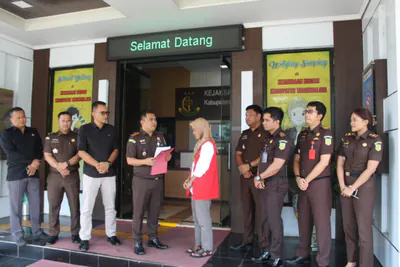
Salatiga police detain three suspects in sexual exploitation case
Salatiga City Police detained three suspects accused of exploiting a woman for prostitution after luring her with a promised Rp8 million monthly salary.
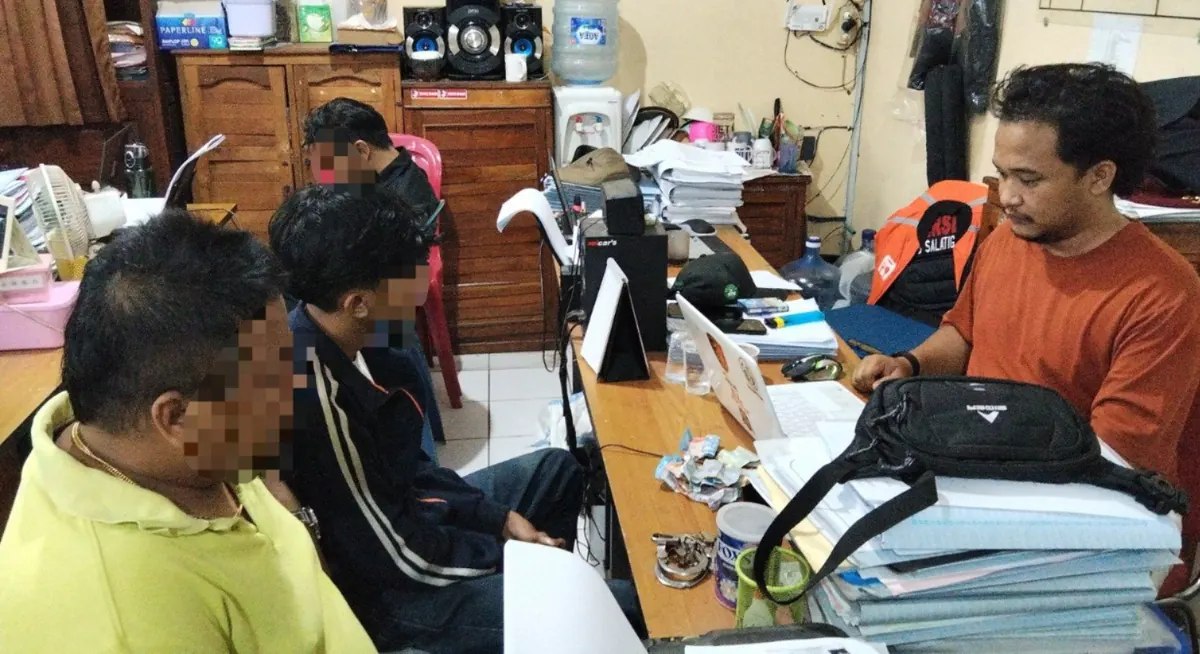
Salatiga City Police (Polres Salatiga) detained three suspects accused of exploiting a woman for prostitution at a guest house in Tingkir district, Salatiga, on Monday night, 16 November 2026. The suspects allegedly promised the victim a monthly salary of Rp8 million (about US$500) and a daily meal allowance of Rp150,000 to recruit her.
According to a report by Jateng Pos, the three suspects, identified only by their initials as W, 26, K, 23 and J, 18, allegedly had different roles. K is suspected of recruiting the victim, W of managing operations and creating a WhatsApp group named 'Form Benteng Merah' to find customers, and J of acting as an administrator who directed customers to rooms.
Officers from the Women and Children Protection Unit (PPA) of the Criminal Investigation Unit (Satreskrim) at Polres Salatiga went to the lodging after receiving information. There they found a woman believed to have just finished providing sexual services to a customer. Police seized Rp6 million in cash, Rp250,000 in customer payments, five mobile phones, underwear and a number of condoms.
Salatiga City Police Chief AKBP Afrito Marbaro said the police were committed to taking firm action against sexual exploitation and human trafficking targeting women and vulnerable groups, citing Jateng Pos. The case is being processed on suspicion of violating Article 12 of Law No. 12 of 2022 on Sexual Violence Crimes, or Article 455(1) of the Criminal Code (KUHP) in conjunction with Law No. 1 of 2026 on Penal Adjustments and Article 20(c) of the KUHP.
Recruitment tactics in human trafficking cases
Human trafficking (Tindak Pidana Perdagangan Orang, TPPO) is not a new phenomenon in Indonesia. Law No. 21 of 2007 on the Eradication of Human Trafficking has long governed the crime, covering recruitment, transportation, transfer, sheltering and receiving of people through threats, deception or abuse of a vulnerable position for exploitation. Sexual exploitation is among the most common forms, alongside forced labor and organ trafficking.
In the field, recruitment often begins with promises of apparently legitimate work: shop attendant, sales clerk, karaoke hostess or domestic worker, with wages far above average. The Rp8 million monthly salary in the Salatiga case is rarely offered for unskilled work in a medium-sized city. Trafficking networks exploit that gap to target people from economically weak backgrounds, then move them to locations that are difficult for families to reach.
The shift from job promise to prostitution usually happens gradually. Victims are isolated in guest houses or rented homes, their passports or identity documents are withheld, and debts for transport and accommodation are charged to them. When victims refuse to provide sexual services, recruiters threaten them with those debts. Chat applications such as WhatsApp have become common tools for matching customers with victims, as seen in the case uncovered by Polres Salatiga.
From a legal perspective, Law No. 12 of 2022 on Sexual Violence Crimes provides broader protection than the old KUHP because it covers sexual violence outside marriage and affirms victims' rights to assistance, protection and recovery. The new KUHP, in force since early 2026, also treats sexual exploitation as a separate offense, allowing investigators to choose the article that best fits each party's role.
Warning signs of misleading job offers
For Indonesian readers, the Salatiga case is a reminder that high-salary offers without a clear description of the job can be an entry point to exploitation. Human trafficking networks usually target people looking for work quickly, especially those from areas with limited job opportunities, and then move them to other cities where families can find them less easily.
In practice, several warning signs deserve attention: recruitment through chat groups without a clear company, placement in a guest house rather than a workplace, and requests to hand over identity documents or passports at the outset. Wages far above the standard for similar jobs, combined with large daily meal allowances, are rare in legitimate vacancies.
If you or a family member notice indications like these, the first step is to contact the Women and Children Protection Unit at the nearest police station or available complaint services. For families who have lost contact with someone who went away to work, a prompt police report can shorten the search before the person is moved again. Allowing suspicious recruitment to continue only increases the risk that victims will fall deeper into a cycle that is harder to break.