Indonesian defence minister attends US World War Two remains repatriation as 2,500 troops still missing
Defence Minister Sjafrie Sjamsoeddin attended a Jakarta ceremony returning the remains of US service members found in Morotai, as officials say about 2,500 American troops remain missing from World War Two in Indonesia.
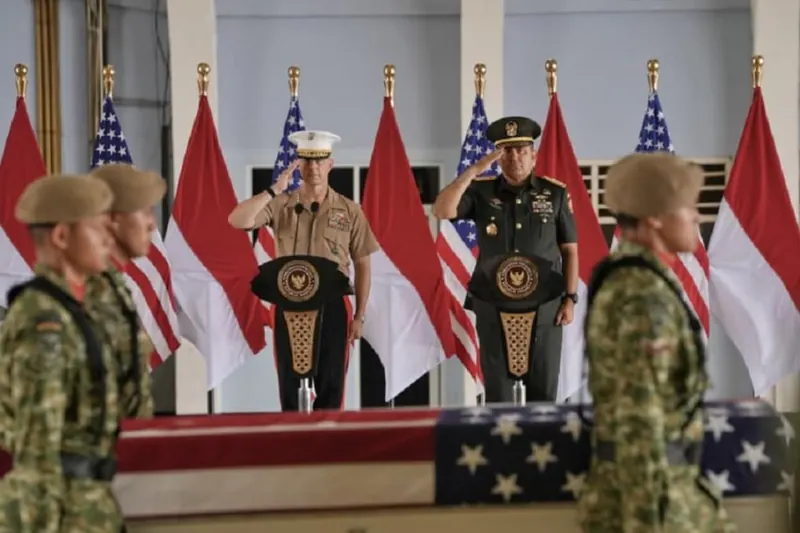
Defence Minister Sjafrie Sjamsoeddin attended a ceremony repatriating the remains of US service members killed in World War Two, as reported by SINDOnews on Saturday, 14 November 2026. The remains were found in Morotai, North Maluku, and their return was marked in an event at the hangar of Air Force Squadron 17 at Halim Perdanakusuma Air Base in Jakarta on Friday, 13 November 2026.
The ceremony was attended by Indonesian National Armed Forces (TNI) Commander General Agus Subiyanto, the chargé d'affaires ad interim of the US embassy in Jakarta, Deputy Commander of the US Pacific Command Lieutenant General George Rowell, and representatives of the Defense POW/MIA Accounting Agency (DPAA).
The defence ministry's inspector general, TNI Lieutenant General Rui F.G.P. Duarte, said data held by the ministry showed that about 2,500 US service members were still missing from battles in Indonesian territory, particularly Papua and Morotai. He said some of them were believed to still be buried or undiscovered more than eight decades after World War Two ended.
World War Two traces in Papua and Morotai
World War Two in the Pacific left many traces in Indonesia. Fighting took place not only at sea and in the air but also on land that formed part of Allied operations against Japan. Papua and Morotai were part of a complex war map because they lay in areas strategic for troop movement, logistics and air bases. Since the 1940s, eastern Indonesia has been an important point in the Pacific campaign because it linked sea routes, air routes and preparations for further military operations.
The DPAA is a US agency that works on prisoner-of-war and missing-persons issues from conflicts. In defence cooperation, agencies like it typically operate through collecting testimony, tracing archives, field research and identifying human remains. The process requires care because finds can be skeletons long buried, damaged or mixed with other material. Each find also needs contextual recording so historical evidence is not damaged.
Repatriation means returning remains to their country of origin for handover to families or official burial. For countries that sent troops, the work is not only a military matter but also a moral responsibility toward fallen and missing service members. Searches that span generations are often read as respect for war victims. For families, a return can close a long search that time does not always resolve.
For Indonesia, such cooperation places territory as both a historical space and a humanitarian space. Former battlefields may contain remains not yet found, so new discoveries require coordination among defence authorities, local governments and foreign parties involved. In a broader context, the work also helps keep diplomatic relations grounded in measured and mutually respectful cooperation. It can also serve as historical learning for generations who did not experience the war.
What the public and policy watchers should note
For Indonesian readers, this repatriation is not merely ceremonial news. It touches defence relations, historical memory and the possibility of new finds in areas that were once battlefields. For communities around Morotai, Papua and related regions, search activities can create requests for cooperation with residents, local governments and historic site managers. The impact is not always visible in prices or household spending, but relates to how the state manages conflict heritage.
Aspects to watch include transparency of cooperation, site protection and inter-agency coordination. Because the activity involves foreign states, military archives and possible field finds, the public has a right to see that the process is conducted respectfully, safely and in accordance with the law. Parliamentary oversight of defence policy is also relevant if cross-border cooperation develops into programmes that touch territory, budgets or access permits.
In the short term, readers can understand the event as a reminder that war leaves long humanitarian responsibilities. When soldiers' remains are found and returned, the state is honouring a promise to those who fell, while keeping international relations grounded in values broader than military interest alone.