Indonesia's Public Works Ministry Deploys Emergency Levees for Subulussalam Floods
Indonesia's Ministry of Public Works has prepared emergency levees, river normalisation and heavy equipment to accelerate response to follow-on flooding in Subulussalam, Aceh.
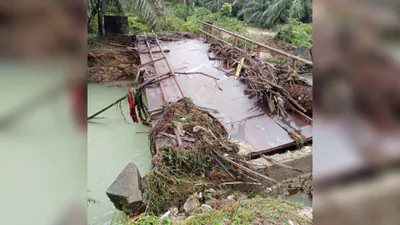
Indonesia's Ministry of Public Works (Kementerian PU) accelerated response to follow-on flooding in Subulussalam, a city in Aceh province, on Sunday, 15 November 2026, by preparing emergency levees, clearing debris and normalising rivers, according to TVRI News, the news service of Indonesia's state broadcaster. The measures are intended to reduce standing water and protect residential areas.
Public Works Minister Dody Hanggodo said personnel, equipment and resources had been mobilised to restore affected infrastructure. In a written statement, he said the response had to be rapid, coordinated with local government and focused on public safety and restoring mobility.
One priority area was the Gelombang area in Sultan Daulat subdistrict. Water from Lae Soraya River was suspected to have overflowed after siltation and damage to a levee altered the flow, hitting the riverbank on the residential side. The ministry prepared emergency boulder levees, with river normalisation to follow once discharge receded. Work also included clearing logs and debris and planning boreholes for clean water.
Operations also targeted Rundeng subdistrict for debris clearance and road access in Oboh village, and Longkib subdistrict for debris removal and a temporary bridge. Construction companies Waskita Karya and Hutama Karya were involved. From 15 November 2026, three excavators and eight dump trucks were planned for deployment to the Gelombang area, while the emergency response period runs until 19 November 2026.
Flood management across river basins
Flood response in cities crossed by large rivers usually goes beyond evacuation or emergency aid. Local governments and technical ministries need to look at river basins from upstream to downstream, including bank slope angles, channel width, sediment and narrow points that obstruct flow. When heavy rain falls repeatedly, discharge can rise quickly. If the channel can no longer carry the water, it spills onto banks and settlements. In such situations, emergency work often focuses on the points that most threaten residents, such as collapsed banks or leaking levees.
Emergency levees made from boulders are a common method because they can be installed relatively quickly and withstand the force of flowing water. Boulders are large stones arranged to hold back erosion, while other materials such as geosynthetic products or fascines may be used depending on soil conditions. The approach differs from permanent levees, which typically use compacted earth, concrete or stone masonry with deeper foundations. Emergency levees are not an end in themselves, but temporary barriers until normalisation and permanent repairs can be carried out after water levels fall.
River normalisation refers to work to restore a channel's function, such as dredging sediment, clearing rubbish or logs, and reshaping the river cross-section. The term is often misunderstood as unlimited river widening. In good practice, normalisation must consider permits, environmental impacts, ecosystem balance and worker safety, because dredging during the rainy season can increase risks if it is not coordinated. Coordination among technical ministries, disaster management agencies, city governments and contractors is therefore important to prevent overlapping work and to ensure that disposal of cleared material does not create new problems. Debris clearance and clean water supply also form part of recovery when surface water sources are contaminated.
What residents and local governments should watch
For readers in Indonesia, flooding in river basins shows that disaster impacts are measured not only by the extent of inundation, but also by severed road access, damaged clean water networks and disrupted daily economic activity. When temporary bridges are needed, the movement of workers, deliveries of basic goods and health services can be constrained. Restoring connectivity and clean water can therefore be as important as clearing mud from homes.
Going forward, residents in flood-prone areas should follow official information on the emergency response period, evacuation points and river conditions. Local governments also need to monitor landslide points, debris blocking river channels and material disposal sites so emergency work does not create new problems. Without regular monitoring, small blockages upstream can turn into flash floods downstream. Effective flood management usually depends on fast inter-agency coordination, clear contractor roles and maintenance of infrastructure after waters recede.
For regions with limited budgets, emergency work of this kind also tests governance: whether materials, heavy equipment and disposal sites are available on time, and whether medium-term recovery is planned from the outset.