Indonesia's MPR schedules vote to elect vice president to replace Gibran on 2 December 2026
The People's Consultative Assembly (MPR) has scheduled a plenary session to elect a vice president to replace Gibran Rakabuming Raka and will ask President Prabowo Subianto to submit two candidate names.
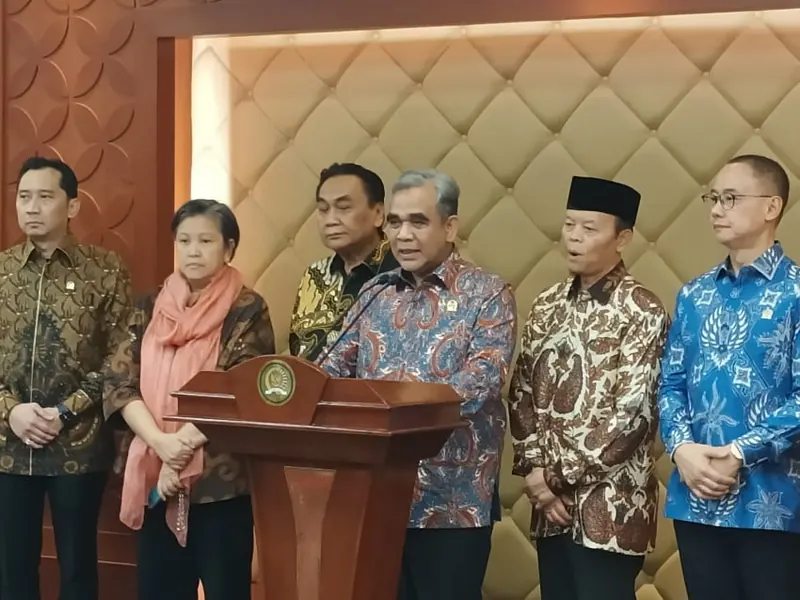
The People's Consultative Assembly (MPR), one of Indonesia's high state institutions, has scheduled a plenary session on Wednesday, 2 December 2026 to elect a vice president to replace Gibran Rakabuming Raka.
MPR chair Ahmad Muzani announced the schedule after a joint meeting of the assembly's leadership with party groups in the House of Representatives (DPR) and groups from the Regional Representative Council (DPD) at the Parliament Complex in Senayan, Jakarta, on Friday, 13 November 2026, as reported by SINDOnews.
Muzani said the session would cover the election, inauguration and ratification of the elected vice presidential candidate to fill the vacancy.
The joint meeting also decided that the MPR leadership would send a letter to President Prabowo Subianto that Friday, asking him to submit two vice presidential candidate names for verification by an MPR team, Muzani said. He said the letter was important so that the verification process would not be delayed.
How the vice presidential vacancy is filled
Under Indonesia's constitutional system, the vice presidency cannot be filled by unilateral appointment. The constitution requires the vacancy to be resolved through a political and legal process involving high state institutions. The president proposes candidates, while the MPR elects and ratifies the chosen candidate. The plenary schedule is therefore important to ensure the office is not vacant for too long. Basic provisions state that the president must propose two candidates to the MPR, which then selects one of them in a plenary session. The filling period is limited so that the government does not lose the authority attached to the vice presidential office.
The joint meeting of the MPR leadership with DPR party groups and DPD groups is a consultation forum before the plenary session. The party groups represent political parties in the DPR, while the DPD groups represent regions. Their presence shows that filling the vice presidency is not only an executive matter, but also a constitutional process involving legislative and regional representation. The MPR also forms a verification team to examine whether the candidates proposed by the president meet the required conditions. Through this mechanism, the public can see that the vacancy is being filled through designated institutions rather than a personal decision.
A plenary session of the MPR is normally the assembly's highest decision-making forum. The inclusion of election, inauguration and ratification in the agenda shows that the process does not stop at selecting a name, but continues until the candidate is declared valid to serve. The 2 December 2026 date gives the president time to prepare two candidates, the MPR verification team time to examine them, and assembly members time to study the proposed names, so the election can take place in one orderly sequence of proceedings.
The process also carries legal aspects that require public scrutiny. Each candidate must satisfy requirements set by law, including administrative conditions and constitutional provisions relating to the vice presidential office. Verification by the MPR team is intended to filter out candidates whose procedural requirements are incomplete or problematic. The letter from the MPR leadership to the president is therefore not merely a formality, but a marker that the vacancy-filling mechanism is being carried out through the proper channel.
Impact on government stability and the public
For general readers, the election of a replacement vice president does not directly change staple food prices, wages or health services. But the office is attached to the president who is currently running the government. Filling the vacancy can therefore affect policy coordination, especially where a government agenda requires complete leadership. The public may feel the impact when budget decisions, national programs or regional policies become clearer or are delayed. The absence of a vice president does not stop the bureaucracy, but it can affect the division of political tasks and the representation of the head of state in certain forums.
What will matter in the coming weeks is how quickly the president submits two candidates and how thorough the MPR's verification is. The names that emerge will shape the direction of cabinet work, relations with parliament and political communication with regions. If the process runs on schedule, uncertainty at the national leadership level can be reduced. If the submission of candidates is late, decisions awaiting a vice presidential signature or coordination may pile up. The clarity of the plenary schedule is a simple measure for the public to assess how seriously state institutions are resolving the constitutional matter.
For society, the simplest signal will be whether the session on 2 December 2026 actually produces a definitive vice president. If the agenda runs in one day, national leadership can be complete again. If it is delayed, the public will need to monitor the reasons, because delay could indicate administrative obstacles or procedural differences in the vacancy-filling process. That monitoring is important so readers can distinguish procedures that are actually under way from speculation without a basis.