Indonesia and United States repatriate remains of World War II soldiers at Halim Perdanakusuma
Indonesia and the United States held a repatriation ceremony for the remains of World War II soldiers found in Morotai at Halim Perdanakusuma Air Force Base in Jakarta.
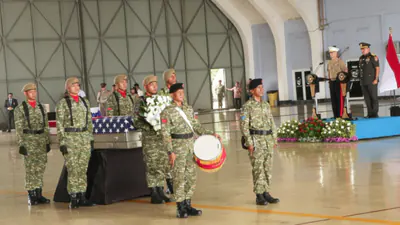
The governments of Indonesia and the United States held a repatriation ceremony for the remains of US soldiers who died in World War II at the Squadron 17 Hangar of Halim Perdanakusuma Air Force Base (Lanud Halim Perdanakusuma) in Jakarta on Friday, 13 November 2026, as reported by TVRI News, Indonesia's state television news service.
The remains were found and evacuated from Morotai island in North Maluku province by a joint team during a humanitarian mission to search for victims of the war's history. The ceremony was attended by Defense Minister Sjafrie Sjamsoeddin, Commander of the Indonesian National Armed Forces (TNI) General Agus Subiyanto, and Deputy Commander of the US Pacific Command Lieutenant General George Rowell.
The proceedings included military honors, the placing of the caskets, and the playing of the Indonesian and United States national anthems. After the ceremony, the caskets were carried to an aircraft to be flown back to the United States. Officials from the TNI, the Ministry of Foreign Affairs, the Ministry of Culture and the United States Embassy also attended.
According to TVRI News, the activity was based on a memorandum of understanding (MoU) updated on 13 April 2026 covering research, recovery, identification and repatriation of US War Department personnel who died in Indonesia.
War legacy and the role of the DPAA
Repatriation of foreign soldiers' remains in Indonesia is usually linked to the legacy of World War II. The conflict involved many parts of the Indonesian archipelago, so casualties from various sides were buried hastily, went missing or ended up in remote locations. Discovering remains decades later requires forensic archaeology, matching historical records and coordination with families and the countries of origin. The process often involves archaeologists, forensic doctors and DNA specialists, although not every discovery can be identified.
Morotai in North Maluku has a long military history. During the war, the area was a key point for Allied operations in the Pacific, including landings and the construction of air bases. The discovery of remains of foreign personnel there was therefore not entirely surprising, although the process still requires scientific caution. The Maluku and Sulawesi regions also have war legacies that need documenting, so new discoveries can prompt further research.
The Defense POW/MIA Accounting Agency (DPAA) is a United States agency that handles the search, identification and return of personnel missing from armed conflicts. Its mission includes cooperation with governments of countries where foreign personnel died, including Indonesia. In practice, such work sits at the intersection of defense diplomacy, humanitarian efforts and historical preservation. For families of soldiers long listed as missing, the return of remains closes a long chapter of questions that had remained unresolved for decades.
Halim Perdanakusuma Air Force Base often hosts military processions and the reception of remains because of its location in Jakarta and adequate aviation facilities. Ceremonies of this kind also provide space for state honors, although they do not change the legal or political status of long-past wartime events. Repatriation can therefore be read as part of memory diplomacy, cooperation that maintains relations between countries through the management of war memory. Such activities can also serve as historical learning for younger generations and across communities.
What to watch next
For Indonesian readers, this event does not directly affect food prices, electricity tariffs or job vacancies. Its impact is more visible in defense policy, diplomacy and the management of historical sites. Cooperation of this kind can open more orderly research access, especially in areas that hold wartime remains, and encourage preservation of places that have rarely attracted public attention.
What needs to be watched next is the follow-up to the identification and return process. If cooperation remains consistent, Indonesia can benefit from the exchange of forensic expertise, updated historical data and strengthened bilateral relations beyond conventional military issues alone. If it stops at the ceremony, its practical value will be limited to a symbol of respect.
The event also reminds people that war legacies still live around communities. For residents of Morotai and other areas with similar sites, preserving discoveries and providing historical education could become an opportunity for educational tourism that needs to be managed jointly by local and central government. That requires permits, documentation and careful governance so that scientific value and visitor safety are not compromised.