Hari Pahlawan 2026: Social Affairs Minister Lays Flowers at Graves of BJ Habibie, Try Sutrisno and Agus Salim
Social Affairs Minister Saifullah Yusuf, known as Gus Ipul, laid flowers at the graves of President Bacharuddin Jusuf Habibie, Vice President Try Sutrisno and Foreign Minister Agus Salim during Hari Pahlawan 2026 at Kalibata National Heroes Cemetery in Jakarta on Tuesday, 10 November 2026.
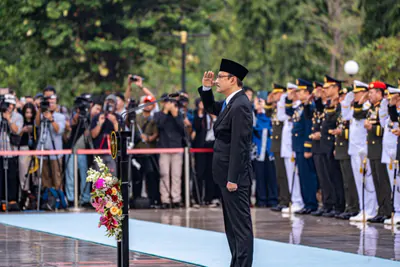
Social Affairs Minister Saifullah Yusuf, commonly known as Gus Ipul, laid flowers at the graves of Indonesia's third president, Bacharuddin Jusuf Habibie; sixth vice president, Try Sutrisno; and third foreign minister, Agus Salim, at the Taman Makam Pahlawan Nasional Utama Kalibata (Kalibata National Heroes Cemetery) in South Jakarta on Tuesday, 10 November 2026.
As reported by TVRI News, Indonesia's public broadcaster, the flower-laying followed Gus Ipul's leadership of the national pilgrimage ceremony and sacred reflection marking Hari Pahlawan, Indonesia's Heroes' Day. He arrived at about 08.10 WIB (Western Indonesian Time), laid a wreath and led a moment of silence. The tribute to the spirits of the heroes was led by Air Force Colonel Bambang Baskoro Adi, the commander of the troops. Gus Ipul then moved to the burial area after the main ceremony.
Gus Ipul said the pilgrimage was part of the government's commemorative programme, which also included promoting the values of heroism among adolescents and young people. “These values of heroism can be passed on to future generations,” he said.
This year's commemoration carries the theme “Pahlawanku Teladanku: Melangkah Bersama, Melanjutkan Perjuangan” (My Heroes, My Role Models: Moving Forward Together, Continuing the Struggle). Gus Ipul said he hoped the loyalty, discipline and sincerity of the heroes would serve as examples for the younger generation. He stressed that the event was not merely ceremonial.
Visiting Heroes' Graves as a National Tradition of Memory
Hari Pahlawan on 10 November always rests on one major event: the Battle of Surabaya in 1945. That battle became a symbol of popular resistance after the proclamation of independence, when various armed groups faced foreign forces returning to Indonesia. The event also reminds people that Indonesia's independence was defended through a very broad mobilisation of the public. That spirit continues to be taught in schools through history, civic education and national values. For this reason, 10 November was chosen as a day to remember sacrifice, not simply to commemorate one military battle.
The tradition of visiting heroes' graves is part of how the state maintains collective memory. Such ceremonies usually include the laying of a wreath, a moment of silence, a sacred reflection and the scattering of flowers. Sacred reflections are typically held at night under torch or candle light, creating a solemn atmosphere. In this context, flower-laying is understood as respect for service, not as a practice that obscures the meaning of the struggle. The state invites the public to look again at how independence was won at great cost: lives, families left behind and prolonged social damage.
In Jakarta, Taman Makam Pahlawan Nasional Utama Kalibata is often the centre of state ceremonies because many national figures, veterans and fighters from different periods are buried there. A heroes' cemetery is not only a burial ground but also a place for history education. When state officials make a pilgrimage, the message shown is that the state does not break its chain of respect for its predecessors. In that way, the pilgrimage becomes a bridge between recorded history and gratitude put into practice.
Commemorations of heroism are also usually filled with activities that reach a broad public, such as competitions, artistic performances and programmes promoting the values of the struggle. Their forms may change from year to year, but the purpose remains the same: to prevent values once fought for from becoming nothing more than slogans.
A Reminder for the Public and Regional Governments
For Indonesian readers, Hari Pahlawan does not always have a direct effect on prices, jobs or public services. Its relevance is more social and educational: it becomes a moment when schools, families and regional governments repeat messages about discipline, loyalty and the courage to take responsibility. In everyday life, those values can be translated into simple acts such as looking after public facilities, respecting teachers and veterans, and not spreading hoaxes that damage public space.
The commemoration also reminds people that programmes on heroism do not stop at ceremonies in one city. When regional governments hold competitions, artistic performances or school outreach, those activities can open a door for residents to remember local history. Many regions have heroes, fighters or resistance events that are rarely discussed in national textbooks. This matters because young people need concrete examples, not only grand narratives. Readers therefore need to pay attention to whether commemorations around them are merely annual events or whether they truly create learning spaces for children and young people.
What needs to be watched in the future is continuity, not merely coverage. Values of heroism will feel more real if they are accompanied by attention to veterans, fighters' families and honest history education. Without that, pilgrimage easily becomes a symbolic routine that is quickly forgotten once the flowers have been scattered.