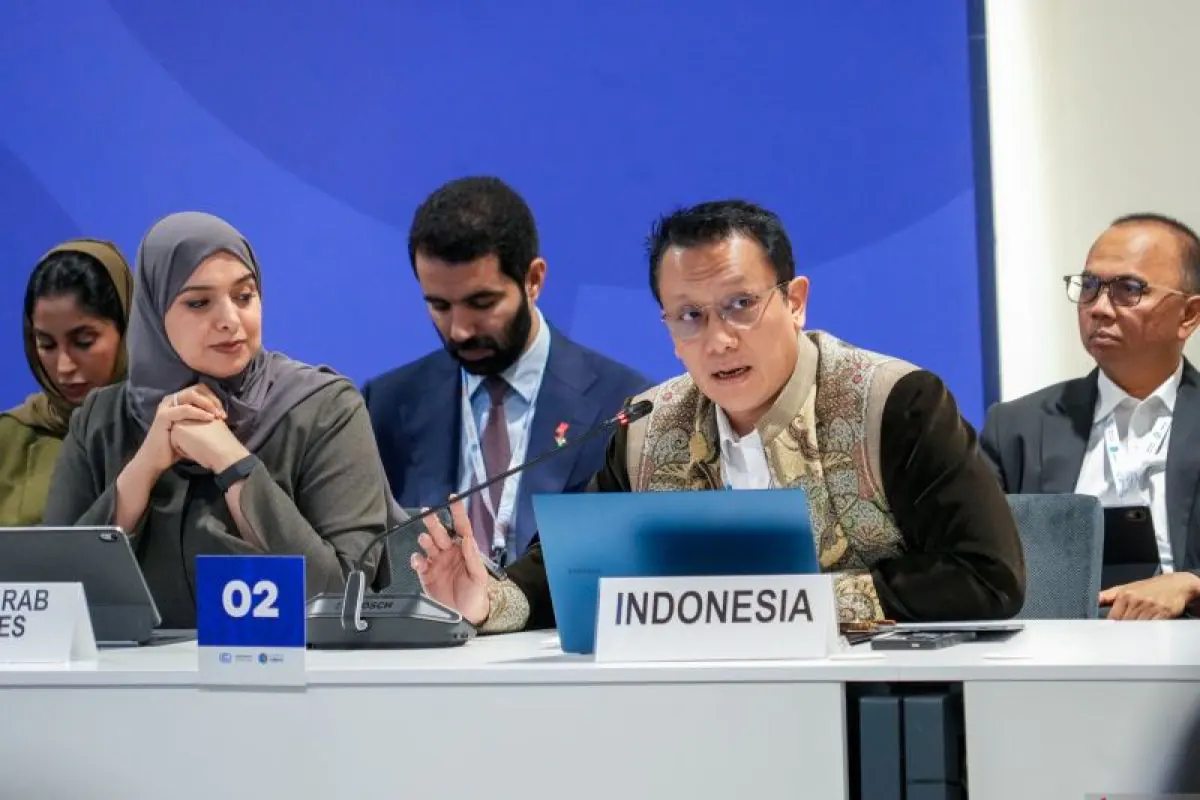
Gibran Submits Vice-Presidential Resignation, Constitutional Process to Fill Post Awaited
Gibran Rakabuming Raka has submitted his resignation as vice president; the public is waiting for the constitutional process to fill the office.

Vice President Gibran Rakabuming Raka has officially submitted his resignation to President Prabowo Subianto at Halim Perdanakusuma Air Force Base in East Jakarta on Wednesday, 11 November 2026, as reported by Jateng Pos.
The statement was delivered after Gibran met Prabowo at the air force base, following the president's working visit to Aceh. The resignation was confirmed by Budi Arie Setiadi, general chairman of Projo, a social organisation, who verified the information when contacted in Jakarta on the same day.
Signs of the resignation emerged a day earlier. Minister of State Secretariat Prasetyo Hadi said that in a closed meeting at the Presidential Palace Complex in Central Jakarta, Gibran expressed his intention to relinquish the vice presidency. He said the meeting lasted about two and a half hours. The step was taken amid political dynamics following rulings by the Constitutional Court (Mahkamah Konstitusi) and the Supreme Court (Mahkamah Agung).
Prabowo has not made a final decision on the proposal. Gibran then said the president had given him input to continue pursuing the process at the State Administrative Court (Pengadilan Tata Usaha Negara, PTUN) by preparing his educational documents from primary school through university. Until this report was written, the public is awaiting official steps by the president and the House of Representatives (DPR) on the resignation.
The Constitutional Path When the Vice-Presidential Seat Is Vacant
In Indonesia's presidential system, the vice president is not merely an assistant to the president but part of a pair elected by the people as a single ticket. Therefore, a vacancy in the office cannot be filled by ordinary appointment. The 1945 Constitution (UUD 1945) places the People's Consultative Assembly (MPR) as the institution that elects a new vice president from two candidates proposed by the president. The MPR itself is composed of members of the House of Representatives (DPR) and the Regional Representative Council (DPD), so the decision involves political representation at the centre and in the regions. This election could affect the consolidation of a government that has only just begun.
In constitutional terms, a resignation must be processed through official mechanisms to avoid a legal vacuum. A selection session is held to fill the remainder of the term, not to begin a new term. This means the elected vice president will complete the working period of the existing pair until the end of the term. The deadline for filling the vacancy is set by the constitution so that the government does not operate without a vice president for too long. Political parties that nominated the previous pair are usually the initial reference for nominations and can trigger lobbying across factions. An MPR session requires a vote.
On the other hand, the legal dynamics mentioned in the resignation raise terms that the public needs to understand. The Constitutional Court reviews statutory norms and constitutional disputes, while the Supreme Court is the highest court of general jurisdiction. The State Administrative Court examines administrative decisions by state officials. When an official chooses to pursue a case at the PTUN, what is contested is the legality of an administrative action, not criminal allegations. The public needs to distinguish between administrative disputes, judicial review and cassation because each leads to different legal consequences.
Gibran's position as vice president also makes this step different from a minister's resignation. Ministers are appointed and dismissed by the president, whereas the vice president has stronger constitutional legitimacy. A change in the number-two seat can shift the balance of the coalition, influence the legislative agenda and open space for parties to negotiate a replacement candidate. In the regions, this change could affect the delivery of programmes that depend on political support at the central level.
What the Public Should Watch
For readers in the regions, the vice president's resignation does not immediately change staple food prices or daily services. However, the office is linked to national policy coordination, including priority programmes that reach the regions, such as education, social assistance and infrastructure development. If the vacancy lasts a long time, inter-agency synchronisation could be disrupted, especially when the DPR discusses the budget or laws that require the president's signature.
The more tangible impact is on the political climate. Replacing the vice president opens the opportunity for renegotiation among parties supporting the government. For voters, this affects who could later rise to the presidency if there is a leadership change. Therefore, the public needs to monitor legal certainty, the schedule of MPR sessions and whether the process runs in accordance with the constitution.
For markets, prolonged political uncertainty can affect investor confidence in government stability. Conversely, clear and orderly mechanisms tend to dampen speculation. In the short term, citizens' attention should be directed to procedural transparency, not to rumours that have no official basis. Procedural stability is also important for civil servants awaiting policy direction and for local governments coordinating with ministries.
Related coverage
Heavy rain did not dampen the Heroes' Day ceremony in Anambas; police raided Sebesi Island and found methamphetamine paraphernalia and plastic clip bags; East Java Police deployed 3,000 personnel to secure demonstrations in Surabaya.