Gema Keadilan urges House to bring up opinion right over Vice President Gibran
Rahmat Saleh, chair of Gema Keadilan's central executive board and a member of the House of Representatives, says he is ready to sign a motion to express an opinion over Vice President Gibran Rakabuming Raka.
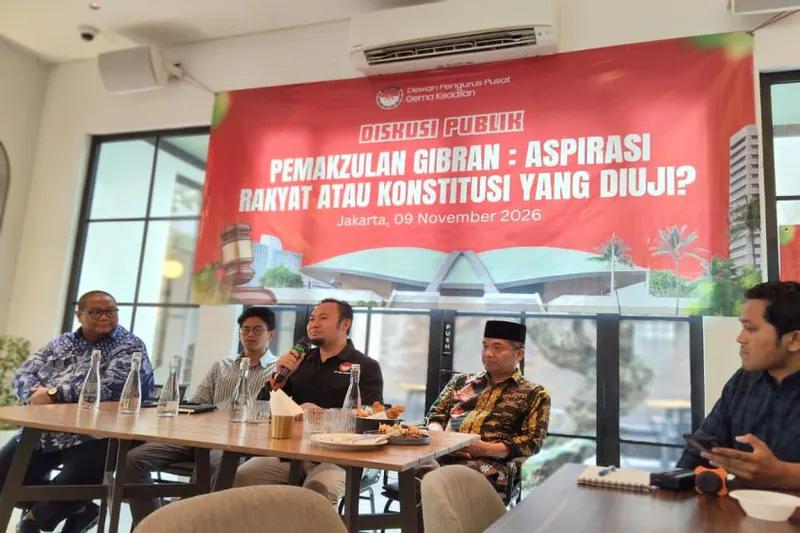
According to SINDOnews, Rahmat Saleh, chair of the central executive board (DPP) of Gema Keadilan and a member of the Indonesian House of Representatives (DPR), said he was ready to sign a proposal for the DPR to exercise its right to express an opinion (Hak Menyatakan Pendapat, or HMP) if the push to impeach Vice President Gibran Rakabuming Raka were brought forward. He made the remarks at a public discussion in Cikini, Jakarta, on Monday, 9 November 2026.
Rahmat said the decisions of the Constitutional Court (Mahkamah Konstitusi) and the Supreme Court (Mahkamah Agung) concerning the controversy over Gibran's education requirements provided a basis for the DPR to consider its constitutional rights. He said, "I am ready to be part of the members of the House of Representatives who sign the proposal." Anton Aryadi, head of Gema Keadilan's legal aid body (LBH), suggested that Gibran resign.
Mechanism of the opinion right and vice-presidential impeachment
The right to express an opinion is one of the DPR's constitutional rights, alongside the right to interpellate and the right to conduct an investigation. Under the law governing the People's Consultative Assembly (MPR), the DPR, the Regional Representatives Council (DPD) and regional legislatures (DPRD), the right belongs to the DPR as an institution, not to factions or individual members. In constitutional practice, the HMP can be used to state a position on government policies or major events, including as an early step toward a proposal to remove the president or vice president. Therefore, a member's pledge to sign such a motion is not a verdict; it is a political stage that still must pass a long process.
The 1945 Constitution places impeachment as an extraordinary mechanism. The DPR can submit a proposal to the MPR if there are allegations of legal violations or if office requirements are no longer met. Before the MPR decides, the Constitutional Court examines, adjudicates and gives its consideration on the proposal. This process means that issues over education, candidate requirements or other legal disputes cannot stop in the public space; they must be tested through the competent institutions.
The MPR then convenes to make a decision. Quorum and member support determine the outcome, so a proposal can fail even if it is widely discussed. Therefore, pledges of signature should be read as a political signal, not legal certainty. In this context, impeachment should be distinguished from resignation. Impeachment is a constitutional process involving state institutions, while resignation is a personal decision by an officeholder. The two can influence each other, but they are not the same legally.
Court or judicial rulings do not automatically change a political office. The Supreme Court handles cassation in certain cases, while the Constitutional Court has authority over constitutional cases. When the two institutions appear in one debate, the public needs to distinguish the object of the dispute, the legal basis and the constitutional consequences. Without that distinction, the discourse can shift from legal testing to political pressure. Therefore, every statement about impeachment should be tested through procedure, not only by the intensity of media coverage. This procedure gives room for clarification before political decisions are taken.
Political and economic impact for the public
For Indonesian readers, the HMP discourse most directly touches political stability. If the process moves forward, legislative agendas, budget discussions and the government's relationship with the DPR could be affected. This kind of uncertainty can also be read by markets as a risk, although there is no direct evidence yet in prices of goods or services. Economic effects usually emerge through confidence, not through a single standalone political decision. Therefore, the public needs to see whether the proposal is only a statement of position or actually enters the House's committee apparatus. If political tension rises, the rupiah and stock market may move more volatilely. However, the cause-and-effect relationship is indirect and depends on global and domestic factors at the same time.
The public also needs to see whether the issue used relates to office requirements or alleged legal violations. Without that clarity, discussion can easily split into supporters and opponents, while the DPR's oversight function becomes unmeasurable. The process at the Constitutional Court, if it continues, can indicate whether the legal arguments are strong enough to be brought to the MPR. Conversely, if it stops at the DPR, impeachment does not occur and the vice president's office continues.
In everyday terms, readers can note early signals: factions' reactions, hearing schedules and official statements by state institutions. If the impeachment process drags on, parliamentary work, economic policy and public services risk being delayed. Conversely, if the proposal stops at the consideration stage, the impact is more on political dynamics than on a change of government. The most important thing for citizens is to ensure the debate does not shift priorities away from the budget, social programmes and legal certainty for businesses.
Related news
The Population and Family Development Ministry (Kemendukbangga) and the DPR socialise the Bangga Kencana programme in Depok
Government says the Daftar Inventarisasi Masalah (DIM) for the Broadcasting Bill protects creators and micro, small and medium enterprises (UMKM)