East Java-West Java trade mission in Bandung books Rp8.6 trillion
A trade and investment mission between East Java and West Java in Bandung recorded Rp8.616 trillion in transactions, dominated by livestock and investment commitments.
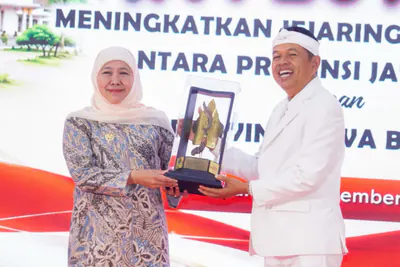
Sales, purchases and investment agreed at the East Java-West Java Trade and Investment Mission at Hotel Grand Pasundan in Bandung on Tuesday, 17 November 2026, reached Rp8,616,770,525,559, or about Rp8.616 trillion (about US$500 million), as reported by TVRI News, the news service of Indonesia’s state broadcaster. East Java Governor Khofifah Indar Parawansa led the meeting that brought together business operators from the two provinces.
According to TVRI News, the Rp8.616 trillion total comprised East Java sales to West Java of Rp8,018,133,154,340, East Java purchases from West Java of Rp408,577,527,500, and investment commitments of Rp190,059,843,719. Commodities sold from East Java included poultry meat, ruminant meat, milk, chicks, goats, sheep, animal feed, maize, horticultural seeds, agricultural equipment, timber, frozen fisheries products, and feed for fish and shrimp. In return, East Java bought arabica coffee, desiccated coconut, pangasius catfish, cloves, potato seeds, snacks, soy sauce, tomatoes and pasteurized crab meat from West Java.
The livestock sector accounted for the largest share of commitments, about Rp6.14 trillion. Cigarette sales by Gapero Surabaya to two companies in Bandung were also recorded as major commitments, at Rp856.37 billion and Rp466.44 billion respectively. The next highest was an Rp177.51 billion investment by PT Galic Bina Mada in pure carrageenan and processed porang tubers in Surabaya, Pasuruan and Magetan. Khofifah said 107 East Java business operators attended. “When measured, the combined strength of East Java and West Java represents an enormously large market,” she said. She also cited 2024 interregional trade data: total East Java-West Java trade of Rp32.48 trillion, with a Rp4.54 trillion surplus for East Java.
West Java Governor Dedi Mulyadi welcomed the mission and stressed equality in trade between regions.
Food and regional industrial supply chains
Interprovincial trade missions are essentially forums where local governments, business operators, cooperatives and prospective investors meet to agree on sales, purchases and investment commitments. In that format, the transactions announced are usually not cash changing hands, but agreements to be followed up through contracts, shipments or investment. The commitment figures therefore need to be read alongside supply readiness, product quality and distribution certainty.
East Java and West Java sit within one densely populated and industrialized economic corridor on the island of Java. East Java is known for livestock, fisheries, agriculture and agroindustry, while West Java has a large consumer base, manufacturing and retail networks. This pattern makes two-way trade logical: one province supplies raw materials, the other absorbs processed products, and vice versa. Backhaul cargo from West Java to East Java is also important so that trucks are not loaded in only one direction.
The commodities in this mission show a mutually dependent market structure. Meat, milk, eggs and animal feed are perishable products, so cold chains and distribution permits become decisive. Coffee, cloves and potato seeds from West Java reflect the added value of horticulture and plantation crops. Meanwhile, porang and pure carrageenan are industrial materials widely used in food, pharmaceuticals and cosmetics. Both require further processing, quality standards and more stable markets than selling raw materials alone.
Trade in round timber, processed timber and rattan touches on the legality of raw material sources and environmental standards. In interregional trade, cooperatives often act as collectors or distributors, but the success of commitments depends on management, financing and the ability to meet buyers’ specifications.
What business operators should watch
For readers in Indonesia, transactions of this size matter only if they actually lower supply-chain costs, widen markets for livestock farmers, fishers, growers and processors, and keep essential goods available. The livestock sector’s dominant share of commitments can affect meat, milk and egg prices, but the impact will be felt only after contracts are executed, distribution runs smoothly and supply is not disrupted by animal disease or rising feed costs.
Investment in porang and carrageenan also concerns downstream processing. If factories in Surabaya, Pasuruan and Magetan operate, tuber farmers and seaweed businesses can gain more stable buyers. But export-quality standards and industrial requirements must be met so products do not stop at the raw-material stage. For consumers, such downstreaming can create new jobs in the regions, although final product prices will still be influenced by raw materials, energy and logistics.
What must be monitored is the realization of commitments, not the ceremony. Local governments need to ensure demand data, production capacity and distribution routes are in place, while small businesses prepare legal permits and quality. Without that, trillions of rupiah in transactions will remain only numbers on a list of agreements.