East Java Police Deploy 3,000 Officers to Safeguard Public Expression in Surabaya
The East Java Regional Police (Polda Jatim) deployed about 3,000 joint personnel in Surabaya on Tuesday, 10 November 2026, to safeguard public expression.
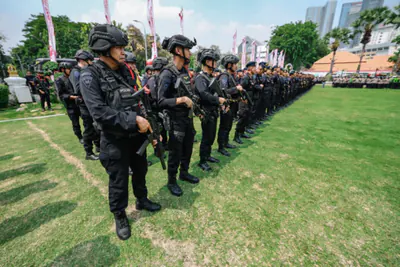
The East Java Regional Police (Polda Jatim) deployed about 3,000 joint personnel in Surabaya on Tuesday, 10 November 2026, to safeguard public expression, as reported by TVRI News.
Personnel were placed on standby at strategic points, including the areas around Gedung Negara Grahadi, the East Java provincial government building, and the East Java Regional Legislative Council (DPRD Jawa Timur). Kombes Pol Jules Abraham Abast, head of the East Java Regional Police public relations division, said a humane, persuasive and proportional approach would be prioritised.
Abast, speaking for the Indonesian National Police (Polri), said, “Polri respects and guarantees the constitutional right of every citizen to express opinions in public.”
Polda Jatim, together with relevant agencies, prepared traffic arrangements and situational diversions, while urging action participants to avoid violence and damage to public facilities.
Rules for Expressing Opinions in Public
In Indonesia, public expression is not new. The practice has grown alongside democratic tradition, from student protests and labour actions to resident demonstrations and protests by groups whose interests are ignored in regions or at the national level. The legal framework gives citizens space to gather and express opinions, while also demanding responsibility so that the right does not become a disturbance to others. Mass action therefore remains a test of balance between freedom and order.
Law No. 9 of 1998 provides that the delivery of opinions in public may be carried out freely and responsibly. In security practice in various cities, police usually prepare overt and covert protection, manage routes and guard vital objects. The humane approach is now often emphasised because mass action is not merely a threat, but a legitimate political channel when formal dialogue is seen as failing to address problems. Police presence also helps prevent third parties from using crowds for criminal acts and provocation nearby.
Government and parliamentary sites are often chosen as action destinations because they are symbolic and easy for media to reach. In big cities, crowds concentrated around such areas can also produce knock-on effects: congestion, partial road closures, changes to public transport routes, and the risk of friction among participants, residents and officers near the location. Action management is therefore not only about loudspeakers and banners, but also communication with business owners, road users and transport agencies.
Public order also depends on two often overlooked factors: participant discipline and the speed of official information. When calls circulate without an explanation of routes, times and meeting points, residents can be caught in areas they did not plan to enter. Clear coordination, by contrast, allows freedom of expression to proceed while minimising losses for people who are working, trading or taking families to public facilities. Experience in various regions shows that well-communicated actions tend to be safer, although vigilance against small provocations is still needed.
Daily Impact When Actions Divert Roads
For residents, securing an action does not stop with personnel on the ground. The most noticeable effects usually appear in mobility: travel time increases, alternative routes become congested, and some public transport services adjust their routes. When traffic diversions are applied situationally, road users need to follow official information because changes can occur suddenly according to crowd density and security conditions. Digital maps and announcements from transport agencies can help people choose more stable routes.
For workers and businesses, actions in city centres can affect daily income, especially for those who rely on direct visits. Traders, online drivers and shop owners around the location may need to adjust opening hours, stock and service routes. Meanwhile, residents who need to handle administrative matters, seek medical care or take family members to public facilities should check schedules earlier. For families, sudden changes also require better communication so household members do not wait for a long time in unsafe places.
Relevance is also seen in the public's habits of receiving information. Calls for action often spread quickly through social media, but are not always accompanied by explanations of routes, times or meeting points. Readers in Indonesia therefore need to distinguish between the right to express an opinion and the urge to join a crowd without preparation. Following official channels, obeying officers and avoiding provocation are simple ways to keep the space for aspirations safe. In that way, aspirations can still be conveyed without sacrificing the safety of many people.
Related news
- East Java Zakat Management Agency (BAZNAS Jatim) and Surabaya Religious High Court Explore Synergy
- Khofifah Leads Holy Vigil for Heroes' Day (Hari Pahlawan) in Surabaya
- East Java Indonesian Pencak Silat Federation (IPSI Jatim) Targets Six Golds at National Sports Games (PON) 2028, Two World Champion Fighters Return