East Java police chief stresses Brimob disaster readiness
East Java Police Chief Inspector General of Police Dekananto Eko Purwono has asked the Mobile Brigade Corps (Brimob) to be ready for hydro-meteorological disasters during the rainy season.
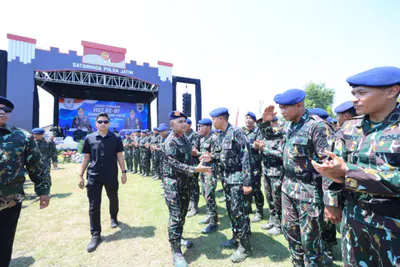
East Java Police Chief, Inspector General of Police (Irjen Pol) Dekananto Eko Purwono, has asked Brimob personnel to strengthen readiness for hydro-meteorological disasters during the rainy season.
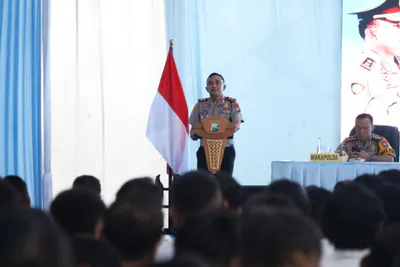
The remarks were made at a thanksgiving ceremony marking the 81st anniversary of the Mobile Brigade Corps (Brimob) of the Indonesian National Police (Polri) at Mako Kompi 3 Batalyon A Pelopor, the headquarters of Company 3 of the A Pelopor Battalion, in Porong, Sidoarjo Regency, on Saturday, 14 November 2026, as reported by state broadcaster TVRI News.
According to TVRI News, the police chief said the dedication of Brimob does not stop at handling high-risk crime. He said humanitarian assistance is also a core part of the duties of the corps, so personnel, search and rescue equipment and field kitchens must be kept ready.
In his remarks, Irjen Pol Dekananto Eko Purwono called for professionalism, discipline and operational capability to be continuously improved. He also stressed that firmness in carrying out duties must be balanced with a humane, responsive and public-service-oriented approach.
Meanwhile, the commander of the Brimob unit of the East Java Police, Senior Commissioner of Police (Kombes Pol) Dwi Yanto Nugroho, described the 81st anniversary as an opportunity to strengthen commitment. He highlighted the quality of human resources, solidarity, mastery of technology and the ability to adapt to threats.
Role of Brimob in disaster response
Brimob is one of the special units under the Indonesian National Police known for handling high-risk threats, including security disturbances, terror and emergency situations that require discipline and technical capability. In disaster response operations, the unit is often involved because it has personnel trained in search, evacuation, rescue and field logistics support.
Hydro-meteorological disasters are events triggered by weather conditions, rainfall, wind or atmospheric and hydrological processes. The most common examples in Indonesia are floods, landslides, flash floods, strong winds and high waves in coastal areas. These disasters usually increase during the rainy season, when soil is saturated with water, rivers overflow or local weather systems trigger extreme rain in a short period. In East Java, heavy rain can also cause urban flooding, river overflows and landslides in hilly areas. Areas with high population density need more orderly evacuation routes and early warning systems.
Personnel readiness is important because the initial response determines the safety of residents. In disaster operations, the speed of a team depends on training, interagency communication and equipment that is ready for use. Search and rescue equipment, such as ropes, boats, life jackets, cutting tools and communication devices, must be inspected routinely. Field kitchens are also vital because evacuations often leave residents without access to food, clean water and temporary shelter.
In many regions, disaster response cannot be handled by a single agency. The police, the Indonesian National Armed Forces (TNI), the Regional Disaster Management Agency (BPBD), local governments, volunteers and residents need to share roles. Brimob usually takes on functions that require high mobility and technical capability, while overall coordination falls under the regional emergency response mechanism. Operational readiness of this kind is therefore built into special units that can be deployed quickly. Joint exercises and updates to disaster-prone area data help teams know evacuation points, alternative routes and the groups most in need of assistance.
Impact for residents during rainy season
For readers in Indonesia, the readiness message means emergency assistance does not come only from day-to-day responders but also from units that can be deployed quickly when a disaster expands. For residents, the key is to understand local risks, such as living near riverbanks, slopes, drainage channels or coastal areas.
The rainy season also affects daily life. Flooding and landslides can disrupt roads, transport, work, schools and the distribution of basic goods. The readiness of Brimob, BPBD and volunteers is therefore part of keeping public services running. Residents should have a family plan, prepare important documents and follow official weather information.
The spirit of serving together with the community is also relevant as an invitation for residents not only to wait for help but also to protect the environment, report danger signs and assist vulnerable groups. In the context of regional budgets, such readiness requires routine training, equipment maintenance and cross-sector coordination so it does not remain a ceremony. Readiness is therefore not only a matter for authorities but also part of the security of residents. That readiness can also reduce recovery costs, because quick rescue can help prevent casualties and greater damage.