East Java Governor Inaugurates Rebuilt Sentong Bridge in Bondowoso
Khofifah Indar Parawansa reopened the Mastrip road link in Bondowoso after replacing the collapsed Sentong Bridge with a wider girder structure.
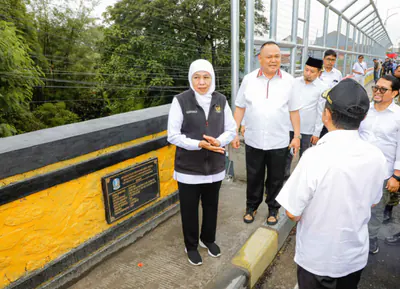
East Java Governor Khofifah Indar Parawansa inaugurated Sentong Bridge in Sukowiryo village, Bondowoso subdistrict, Bondowoso regency, on Monday, 16 November 2026, after the bridge collapsed on 23 February 2026. The reopening restored the function of the Mastrip road segment as a link for community activity in East Java's Tapal Kuda, or Horseshoe, region, as reported by TVRI News.
The old structure dated from 1923 and used a brick arch, serving mobility for more than 100 years. According to TVRI News, the bridge surface sank and cracks appeared in late 2025, before the condition deteriorated until it collapsed. The work was handled by the East Java Public Works and Road Development Agency (Dinas PU Bina Marga), using the 2026 East Java provincial budget (APBD). Construction began on 2 March 2026, was completed and handed over on 6 November 2026.
The replacement structure uses girder beams and is 14 meters wide, five meters wider than the old nine-meter bridge. Khofifah was joined at the inauguration by Agung Mulyono of Commission D of the East Java Regional House of Representatives (DPRD), Bondowoso Regent Abdul Hamid Wahid, Vice Regent Asad Yahya Syafii, and Edy Tambeng, head of the Public Works and Road Development Agency.
Khofifah said Sentong Bridge connects not only the communities of Bondowoso and Jember but also Situbondo. Abdul Hamid Wahid said the bridge's collapse made residents' access longer because alternative routes were inadequate for four-wheel vehicles or trucks.
Old bridges and structural decline risks
Bridges built in the early 20th century were generally designed for vehicle loads far lighter than modern traffic. Brick arch forms rely on the compressive strength of the material, rather than steel reinforcement or concrete girders common in today's road bridges. As they age, such structures can experience surface sinking, cracking, or foundation movement caused by repeated loads, changes in water flow, and maintenance that is not always adequate.
In Indonesia, bridges on provincial road segments are usually under the authority of local public works and road development agencies. When damage reaches a dangerous level, the usual options are partial repair, load restrictions, or full replacement. Replacement is chosen when the old structure no longer meets lane width, safety, and traffic capacity needs. A wider new bridge gives safer room for vehicles travelling in opposite directions, while girder beam construction makes it easier to transfer loads to piers and foundations. Periodic inspections and crack monitoring are important parts of road asset management.
Bridge sinking is also often linked to drainage around abutments and waterways. Accumulated waste can block flow, raise water pressure during heavy rain, and erode embankments near bridge ends. Keeping the surrounding area clean is therefore not only an aesthetic matter but part of infrastructure maintenance. In road and bridge contexts, the term over dimension over loading, or ODOL, refers to vehicles carrying loads or dimensions beyond permitted limits. Such excessive loads accelerate damage to pavement, joints, and bridge structures, especially on routes carrying agricultural produce, building materials, and goods between regencies. This is relevant to bridges in areas that produce agricultural and plantation commodities.
Impact on mobility and local economy
For residents of Bondowoso and neighboring regencies, a bridge that functions again means daily routes become shorter and more predictable. While the bridge was closed, vehicles had to take longer alternative routes, raising fuel costs, travel time, and the risk of delivery delays. For the transport of agricultural produce, building materials, and goods between regencies, restored access helps reduce distribution costs and shipping obstacles.
The added bridge width is also important for safety. Narrow routes often force large and small vehicles to share space, while a wider bridge gives safer distance when passing, pulling over, or waiting for repairs. But the benefit lasts only if vehicles obey load and dimension limits. Without such discipline, new roads and bridges can quickly be damaged, forcing local governments to close or restrict traffic again.
Maintaining cleanliness around the bridge is a shared responsibility. Residents, businesses, and road users can help by not dumping waste into waterways, reporting cracks or flooding, and supporting enforcement against overloaded vehicles. In that way, newly built infrastructure becomes not only a symbol of recovery but also an asset that truly supports economic activity and daily mobility.