DPR Opens Session as Gibran Education Certificate Opinion Right Awaits Factions
The House of Representatives opened its second session of the 2026-2027 parliamentary year on Tuesday, while a proposed right to express opinion over Gibran Rakabuming Raka's educational equivalence certificate awaits steps by parliamentary factions
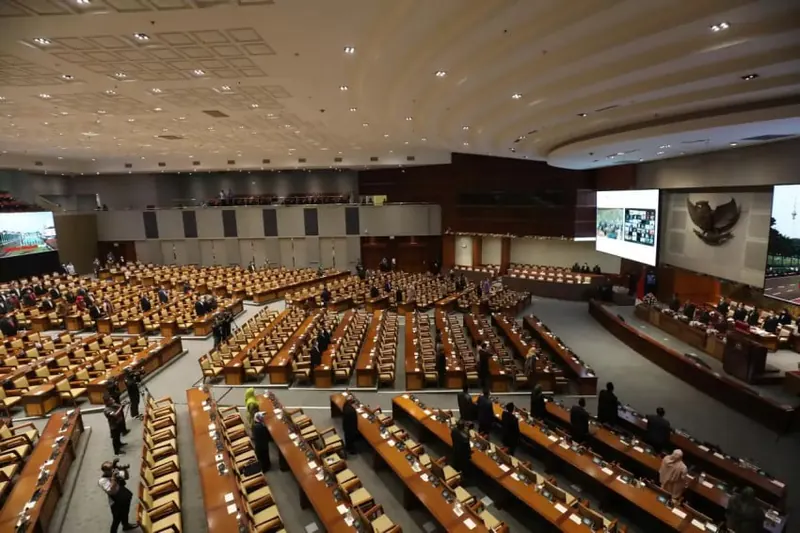
The Indonesian House of Representatives (DPR RI) opened the second session of the 2026-2027 parliamentary year at its 11th plenary meeting in Jakarta on Tuesday, 10 November 2026, at 09.30 Western Indonesian Time (WIB), with a speech by Speaker Puan Maharani as the main agenda.
According to SINDOnews, the meeting raised the question of whether a right to express opinion would move forward on the follow-up to the Supreme Court (Mahkamah Agung) cassation decision concerning the educational equivalence certificate for Gibran Rakabuming Raka.
The opening of a parliamentary session usually sets out the DPR's work plan and priority agenda in its legislative, budget and oversight functions.
Constitutional law expert Jimly Asshiddiqie, after attending the People's Action to Defend Indonesia in Jakarta on Sunday, 8 November 2026, urged DPR faction leaders to follow up public pressure for a political process against Vice President Gibran.
Jimly said considerations from Constitutional Court (Mahkamah Konstitusi) and Supreme Court cassation decisions could be used as a basis for handling the issue in parliament.
How the DPR's right to express opinion works
In Indonesia's constitutional system, the right to express opinion is one of the DPR's rights alongside the rights to interpellation and inquiry. The right is used when parliament wants to state its assessment of government policy or a major event considered to have broad impact. Unlike interpellation, which seeks an explanation, the right to express opinion can lead to more serious political recommendations. During a parliamentary session, it can become one of the agendas that changes the rhythm of parliamentary work.
The process usually begins with a proposal from members across factions, not from a single person. Once the proposal is accepted, the DPR forms an internal mechanism to hear views, evidence and testimony from relevant parties. In the chamber, expert testimony, official documents and factional opinions are tested to determine whether the issue is fit to be brought as the DPR's collective assessment. This stage is important so that conclusions are not merely driven by public pressure but have a legal and political basis that can be accounted for.
For the vice presidency, the right to express opinion can serve as a bridge to a higher forum, the People's Consultative Assembly (MPR). The Constitution places the MPR as the body authorized to dismiss the president or vice president during their term upon a proposal from the DPR. The MPR does not act alone; it receives a proposal after the DPR has completed an internal assessment and, where necessary, constitutional review. Parliament therefore needs to ensure that any political step taken is consistent with legal provisions and does not exceed its authority.
On the other hand, court or judicial decisions can be used as references but do not automatically change a public official's political status. In a presidential system, impeachment remains a constitutional process that requires broad consensus. The question is not only whether legal evidence exists, but also whether DPR factions can unite their stance without depriving the government of room to work. The speed and accuracy with which factions read legal documents are therefore as important as their ability to manage public opinion. Without clear majority support, parliamentary discourse risks stopping at political statements and failing to produce a legitimate constitutional step.
What it means for stability and the budget
The issue may not directly affect food prices or electricity tariffs in Indonesia. But political uncertainty at the top of government can affect market confidence, the rupiah's value and investment decisions. In financial markets, reactions can appear quickly through bonds, stocks and country risk premiums. When the public sees elites busy debating an official's legitimacy, economic agendas that should be moving forward can be delayed because parliamentary attention is divided.
A closer impact is usually felt in budget policy and government programs. If the right to express opinion develops into a long political process, discussions on laws, oversight of state spending and the distribution of social assistance can consume time and space. Delays in implementing regulations or budget revisions can also hold up projects that affect employment. The public needs to watch whether the DPR continues to carry out its legislative and budget functions routinely, or becomes absorbed in conflict that produces no decisions.
The signals to watch next are from the factions: whether they choose a clear constitutional path, delay action, or let the discourse become a tool for political bargaining. For citizens, the main concern remains certainty in public services, price stability and programs that meet everyday needs.