Denny: Prabowo's Polite Tone Is Not Permission for Gibran to Stay
Constitutional law expert Denny Indrayana says President Prabowo Subianto's polite tone is not permission for Vice President Gibran Rakabuming Raka to stay in office.
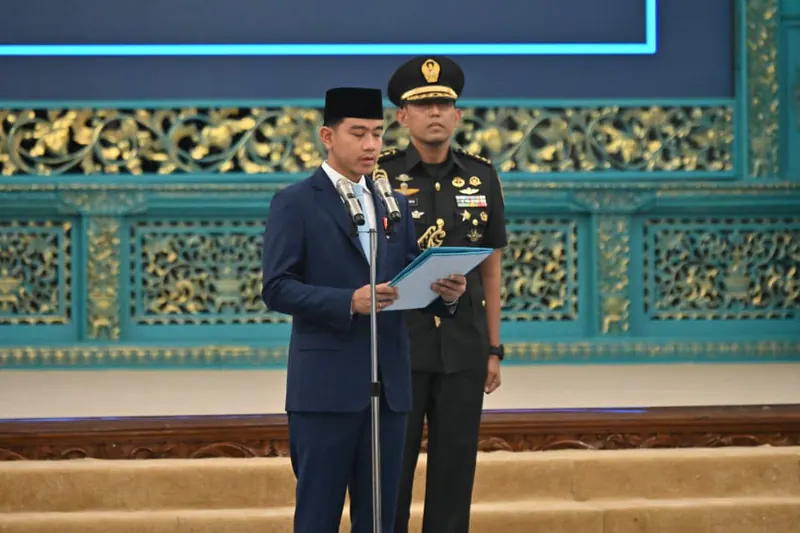
Vice President Gibran Rakabuming Raka has been urged not to interpret President Prabowo Subianto's polite manner as permission to remain in office. According to a report by SINDOnews, constitutional law expert Denny Indrayana gave the warning after Gibran said he would fight to prove the education record that has drawn public scrutiny.
Denny said on Tuesday, 10 November 2026, that Prabowo did not want to make others feel uncomfortable. Therefore, he said, the suggestion that Gibran pursue legal channels does not automatically mean rejecting his intention to resign.
“There must be no manipulation,” Denny said.
He argued that resignation would instead be a form of Gibran's compliance with the constitution.
Political ethics and constitutional process
In Indonesia, the vice presidency is not an ordinary administrative position. It is part of a ticket chosen by the people in a single general election, so any signal of resignation affects the design of the government currently in place. The position also determines the line of succession if a vacancy occurs, because the vice president can replace the president until the end of the term.
The 1945 Constitution (UUD 1945) mostly regulates the removal of the president and vice president through impeachment: a proposal by the House of Representatives (DPR), review by the Constitutional Court, and then a session of the People's Consultative Assembly (MPR). The constitution does not set out detailed procedures for a vice president's resignation. For that reason, such a step is often read as a combination of personal political will, ethics of office, and a state governance process that needs agreement among state institutions. Without clear procedures, each side can choose its own interpretation. That opens room for debate while demanding caution so that interpretation does not turn into a command that was never given.
In public debate, the term PTUN also needs to be understood clearly. The State Administrative Court (PTUN) reviews state administrative decisions, such as decrees or actions by officials that produce legal effects. Education disputes can enter this domain if there is an object of a state administrative decision. However, the requirements for holding the offices of president and vice president are closer to constitutional law and constitutional mechanisms, not merely an administrative dispute. Therefore, legal channels need to be distinguished from political pressure or demands for clarification in public.
Political ethics also shape how the message is received. A head of state who replies politely may intend to preserve the atmosphere, allow room for clarification, or avoid open conflict. In a presidential system, this communication style is often read as a signal, not a command. Public interpretation therefore matters: whether courtesy means approval, rejection, or simply a way to postpone tension so state institutions can keep working. If that interpretation is left vague, the public can be split between those waiting for legal processes and those demanding certainty about the office. Such tension can easily develop into symbolic debate, especially when social media spreads snippets of sentences without context.
What the public should watch
For readers in Indonesia, this issue does not directly touch staple prices, electricity tariffs, or job vacancies. Its impact is closer to the quality of public trust in state officials. When the vice presidency is questioned, citizens face a simple but important question: whether a leader follows the rules, explains his record, and does not create his own interpretation of the attitude of his political superior. That question is relevant because government legitimacy is usually influenced by public belief that office is carried out honestly and openly.
What should be watched is whether the resignation signal will be processed formally, whether legislative and constitutional institutions will take a role, and whether legal channels will be used to examine education documents. If the process is open, the public can assess that the state is running according to procedure. If it is closed, the issue risks becoming political noise that shifts the government's agenda. In the context of parliament, every political proposal related to executive office can also affect meeting priorities, inter-faction communication, and relations between the DPR and the government.
For general readers, the practical lesson is to distinguish three things: political intention, legal decision, and norms of politeness. Respect does not automatically become permission. Conversely, a refusal to resign does not automatically become defiance. Certainty is born only from a clear process, not from snippets of sentences interpreted against one another on social media. Official statements by state institutions are a clearer reference than supportive narratives from interested parties.
Related news
- Surabaya crowd urges DPR to impeach Vice President Gibran
- 50 DPR members reportedly sign proposal on the right to express opinion regarding Gibran
- Palace respects DPR's proposal on the right to express opinion regarding impeachment of Vice President Gibran