Creative Economy Ministry Expands Islamic Financing Access for Regional Entrepreneurs
The Ministry of Creative Economy is expanding access to Islamic financing for regional creative entrepreneurs through the Islamic Creative Economy Founders Fund (ICEFF) 2026 program.
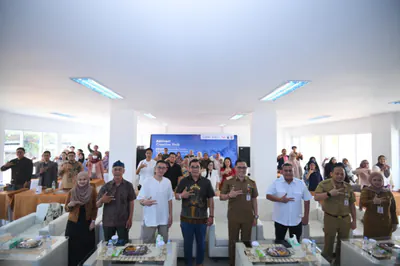
The Ministry of Creative Economy/Creative Economy Agency is expanding access to Islamic financing for creative entrepreneurs in the regions through the Islamic Creative Economy Founders Fund (ICEFF) 2026 program at Creative Hub Bakauheni Harbor City, Lampung Selatan, as reported by TVRI News on Thursday, 12 November 2026.
The program brought together 40 creative entrepreneurs with partner Islamic financial institutions. According to TVRI News, 25 of them have the potential to obtain financing of more than Rp2.12 billion (about US$130,000) from Islamic financial institutions.
The two-day event included workshops, mentoring and pitching in front of partners. Materials on Islamic financing and pitch deck preparation were delivered by, among others, Jaya Setiabudi and Shindy Purnamasari.
Creative Economy Minister Teuku Riefky Harsya said strengthening synergy among government, financial institutions and entrepreneurs was necessary for creativity to grow into productive businesses. The ICEFF program in Lampung was supported by Bank Syariah Indonesia (BSI), an Islamic bank; Pegadaian Syariah, an Islamic pawnshop; and BMT UGT Nusantara, an Islamic microfinance institution.
Islamic financing for creative businesses
In Islamic banking practice, financing is not built on interest as a return on money, but on contracts that bind real transactions or business cooperation. In this context, the contract must be understood by both parties, because differing interpretations of a transaction can trigger disputes later. Commonly used schemes include sale with a margin, leasing, profit sharing and partnership. For creative entrepreneurs, choosing the right contract matters because their income models are often unstable, seasonal or project-based, so repayment and profit-sharing structures need to match cash flow.
Regional creative economies usually grow from intangible assets: ideas, brands, skills, works and networks. As a result, financing feasibility assessments cannot always rely on physical collateral. Business mentors, pitch decks and business track records become entry points for financial institutions to gauge repayment potential. Mentoring programs like this also help entrepreneurs understand the documents requested by partners, from business plans and revenue projections to working capital needs. Basic skills such as recording sales, separating personal and business money, and disciplined reporting also make prospective borrowers easier to consider.
The presence of partner Islamic financial institutions gives entrepreneurs who want Sharia-compliant financing an alternative. Islamic banks, Islamic pawnshops and BMTs serve different segments and use different mechanisms. Banks usually meet larger formal needs, Islamic pawnshops can reach specific collateral, while BMTs are generally close to micro communities. This combination of partners widens entry points for creative businesses that are not yet fully bankable.
Meanwhile, collaborative spaces in the regions play a role in connecting government, entrepreneurs and capital providers. When meetings are held face to face, entrepreneurs can explain specific needs, while financial institutions can screen candidates for financing who are more ready. The process does not automatically turn interest into disbursement, but makes opportunities more measurable from the start.
Impact on regional creative entrepreneurs
For readers in Indonesia, especially creative entrepreneurs outside big cities, programs like this are relevant because the main obstacle is often not ideas, but working capital for production, promotion or capacity building. For consumers, this can lead to more local creative products and services growing without relying on interest-bearing loans. Islamic financing can be an alternative for businesses that want to avoid interest, but it must still be assessed from the perspective of cost, term and contract compatibility with cash flow.
What needs attention is follow-up after matchmaking sessions. Potential financing figures do not automatically mean disbursement, because financial institutions will assess business readiness, payment history, legality and revenue projections. Entrepreneurs should prepare simple financial records, clear proposals and carefully understand their obligations after signing a contract.
For the wider public, the expansion of Islamic financing in the creative sector can also influence habits of seeking capital, especially in regions with long-standing community bases and strong Islamic financial institutions. Regional governments and business communities can also act as information bridges, so entrepreneurs do not rely only on limited local networks. However, tangible benefits will only be felt if mentoring, screening and monitoring are carried out consistently, rather than as ceremonial activities.
Related news
President Prabowo ensures economic fundamentals remain strong.
The Ministry of Protection of Indonesian Migrant Workers (P2MI) strengthens workforce readiness to break into the Japanese labor market.
Prabowo recalls the meaning of a Javanese proverb at the NasDem Party anniversary.