Coordinating Minister Urges Indonesian Police to Grow Closer to Citizens and Guard President's Priority Programs
Coordinating Minister for Political and Security Affairs Dudung Abdurachman asked the Indonesian National Police to strengthen ties with communities and guard the president's priority programs.
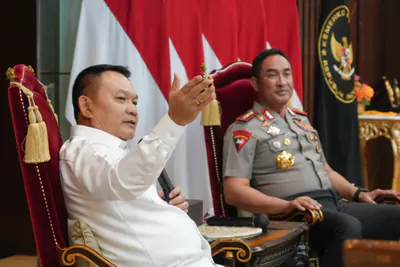
Coordinating Minister for Political and Security Affairs (Menko Polkam) Dudung Abdurachman has urged the Indonesian National Police (Polri) to grow closer to citizens and guard the president's priority programs. He made the remarks when Police General Suyudi Ario Seto, the Indonesian National Police Chief (Kapolri), visited the Kemenko Polkam office in Jakarta on Tuesday, 17 November 2026, according to TVRI News.
In the meeting, Dudung stressed Polri's strategic role in maintaining national security stability and building public trust. He asked that the spirit of 'Polri Bersama Masyarakat' — police working together with the community — be echoed so the police are present directly among residents, as reported by TVRI News.
Dudung also said the success of government programs would not depend only on the ministries and agencies that implement them, but would also require Polri's support in anticipating potential security disturbances in society.
The coordinating minister touched on the handling of actions by the Armed Criminal Group (KKB) in Papua and invited residents to filter information that had not been verified.
Polri Chief Suyudi expressed appreciation for the Menko Polkam's direction and said cross-sector coordination was an important part of maintaining public security and order throughout 2026.
Coordination between Kemenko Polkam and Polri
The Coordinating Ministry for Political and Security Affairs coordinates policy in the political and security fields. In the government structure, it does not take over the operational tasks of ministries or technical agencies, but aligns policy direction so that responses to national security issues are more integrated. The meeting between Menko Polkam and Polri's leadership can therefore be read as a strengthening of the coordination channel, not merely a courtesy visit.
Polri itself has a mandate to maintain public security and order, enforce the law, and provide protection, guidance and services to the community. That mandate makes closeness to the public a measure of the institution's success. When residents see police as present, responsive and not repressive, public trust tends to grow. Conversely, social distance between police and residents can make information quickly distorted and trigger anxiety. Public trust is also linked to the professionalism and accountability of officers in every action.
The phrase 'Polri Bersama Masyarakat' marks an approach that places residents not only as objects of surveillance but as partners in maintaining security. In modern security practice, preventing disturbances often depends on information flowing from local surroundings, cooperation with community figures, and the ability of officers to understand social context. The approach is also relevant when the state runs the president's priority programs, because development and public policy can create social friction if residents feel excluded or do not understand their benefits. In that sense, security is measured not only by falling crime rates, but by the sense of safety residents feel.
Papua's dynamics are one test of that coordination. The government and security forces use the term Armed Criminal Group (KKB) to refer to armed groups carrying out violent actions in the region. Handling Papua issues is not only about security operations, but also public communication, protection of residents and efforts to prevent narratives that worsen the situation. In this context, the coordinating minister's message that residents should filter unverified information is part of a strategy to maintain stability. Cross-agency coordination is important so that security measures do not proceed without social understanding.
What it means for everyday public security
For Indonesian readers, the message 'Polri Bersama Masyarakat' is easiest to feel in daily services: how quickly reports are answered, how police handle community conflicts, and how officers appear in public spaces without creating fear. If that closeness works, residents are more likely to report problems, cooperate and treat security as a shared responsibility. That condition also supports economic activity, because a sense of safety affects people's mobility, businesses and investment in regions.
The direction for Polri to guard the president's priority programs can be read as a signal that security stability is considered a prerequisite for government policy. It matters to residents when national programs touch areas, resources or rule changes that could trigger protests. A transparent and participatory approach will determine whether the guard protects residents or widens social distance.
Amid fast-moving information flows, the appeal to filter news is also relevant to daily habits. Provocative content can trigger panic, conflict between groups or distrust of authorities. The public therefore needs to check official sources, avoid sharing unclear messages and distinguish criticism of policy from narratives that threaten unity. If residents become accustomed to verifying information, the space for provocation narrows. The impact can be seen in calmer neighborhoods and smoother public services.