Central Java prepares drinking water system for Klaten village hit by clean water crisis
Central Java province and Klaten regency are preparing a drinking water supply system for Kalikebo village, where residents face clean water shortages every dry season.
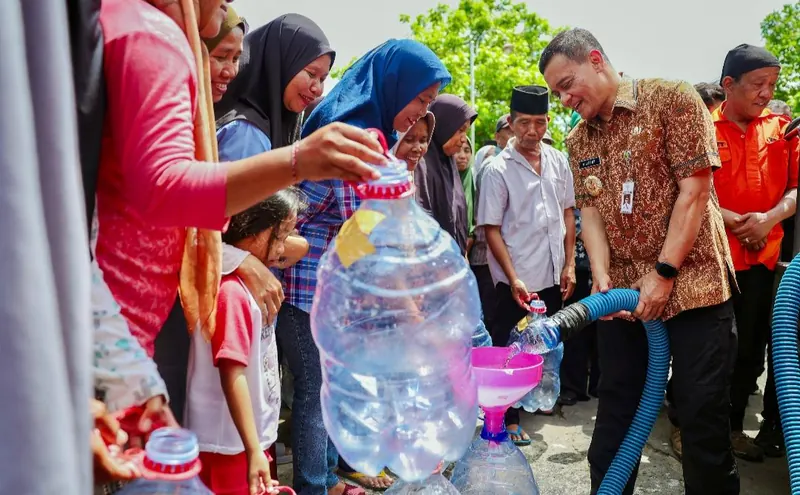
The Central Java provincial government and Klaten regency government are preparing to build a drinking water supply system (SPAM, or Sistem Penyediaan Air Minum) for residents of Kalikebo village in Trucuk district, who face clean water shortages every dry season, according to Jateng Pos. Central Java Governor Ahmad Luthfi inspected clean water distribution in the village on Friday, 13 November 2026, and said he had coordinated with the Klaten regent to optimise and expand the SPAM network.
The newspaper reported that residents' wells dry up during the dry season, while water from boreholes drilled to almost 40 metres deep tastes salty and is not fit for consumption. Parts of the village are already connected to a SPAM network supplied from a neighbouring village, but the coverage has not reached all households.
In the meantime, authorities are distributing emergency clean water. By 7 November 2026, 245,000 litres had been delivered through 49 tanker trips to about 1,100 residents. The distribution involved the Central Java and Klaten regency disaster management agencies (BPBD) and environmental activists.
Kalikebo village head Purwanto said more residents needed water assistance this year than last year, as a longer dry season left wells in five neighbourhood units (RW) short of supply. The Pamsimas programme, a national community-based water and sanitation scheme, has been implemented three times in the village, but the salty quality of the water has limited its results.
How SPAM works and why the water turns salty
A SPAM is drinking water infrastructure managed by a local government, usually through a regional drinking water company (PDAM) or a dedicated management unit. It includes a water treatment plant, transmission and distribution pipelines, and house connections. Unlike individual boreholes, a SPAM draws raw water from more stable sources such as rivers, reservoirs or mountain springs and treats it before delivery. That allows centralised control of water quality and reduces dependence on groundwater levels, which fluctuate with the seasons.
The clean water crisis in northern Klaten, including Trucuk district, has a geological cause. The area's soil formation contains easily soluble mineral layers, so groundwater moving through them can carry high levels of dissolved salts. When the dry season lengthens and rainfall falls, groundwater volume shrinks while the concentration of dissolved substances rises. As a result, newly dug boreholes can produce salty water. The problem differs from seawater intrusion in coastal areas, but both can make water unfit to drink.
Pamsimas targets villages with limited access to clean water by building small community-based infrastructure such as boreholes, rainwater harvesting systems and simple distribution networks. However, it does not always solve raw water quality problems. Where the available water source contains excessive dissolved substances, community-scale facilities may lack adequate treatment capacity. That is what happened in Kalikebo, where three rounds of Pamsimas support have not produced potable water for residents.
By contrast, a SPAM project requires a raw water source with sufficient flow throughout the year. If the source relies only on deep wells, the risk of salty water remains. Selecting the right water source will therefore determine whether the project succeeds.
Daily burden and long-term challenges
For Kalikebo residents, the water crisis is more than an inconvenience. Every dry season, families spend extra time and money buying gallon drinking water or waiting for tanker deliveries. For housewives, the process can take several hours a day. For small-scale farmers and livestock owners, water shortages directly affect harvests and milk production. The 245,000 litres distributed for about 1,100 people works out to roughly 222 litres per person for the entire dry-season period, enough only for drinking and cooking, not sanitation.
Building a SPAM is an important step, but its success depends on two factors. First, the pipeline network must reach all neighbourhood units, not only the two covered in the initial stage. Second, the chosen raw water source must provide consistent flow and quality throughout the year, including during extreme dry seasons. Without routine maintenance and sufficient PDAM capacity, new infrastructure could fall back into annual emergency aid.
The village government also needs to ensure residents understand how to report problems and maintain house connections, so leaks do not reduce water pressure at the far end of the network.