Central Java cuts rice-field preparation costs to Rp200,000 per hectare
A Rotary Cultivator provided in Blora has cut the cost of preparing rice fields from Rp2 million to about Rp200,000 per hectare.
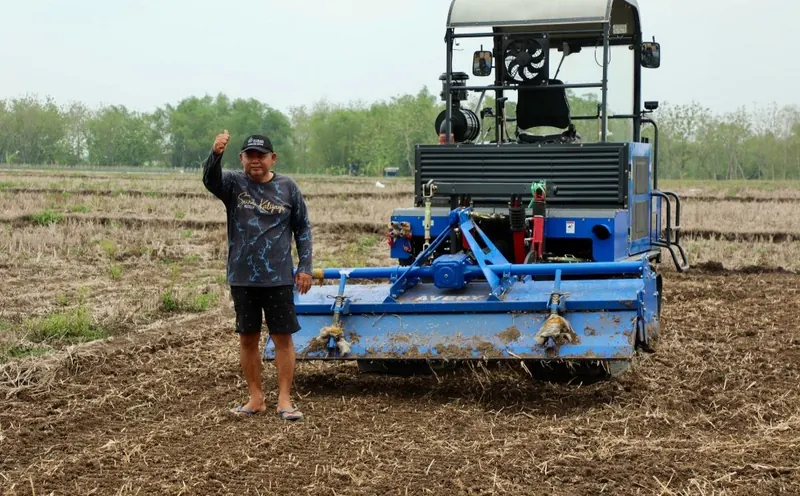
The Central Java provincial government, known locally as Pemprov Jateng, has cut the cost of preparing rice fields from about Rp2 million to Rp200,000 per hectare in Botoreco Village, Kunduran District, Blora Regency, by providing a Rotary Cultivator, according to a report by Jateng Pos on Thursday, 14 November 2026.
The savings emerged after farmers used agricultural machinery and equipment (alsintan) provided by the Central Java provincial government to work the land. According to Jateng Pos, the cost of preparing one hectare fell by almost 90 percent because the diesel fuel needed was only about 30 litres. At Rp6,800 per litre, fuel costs came to about Rp204,000, far below the Rp2 million per hectare cost of renting a tractor.
Ivtor Abu Mulyanto, a farmer in Botoreco Village, said he could prepare about 1.5 hectares of rice fields in a day, depending on soil conditions and plot size. Another farmer, Mulyadi, said preparing one hectare, which usually took a full day with a hand tractor, could now be completed in four hours.
“In a day I can prepare one and a half hectares, depending on the conditions and the size of the plot,” Ivtor Abu Mulyanto told Jateng Pos.
The assistance with agricultural machinery and equipment also reduced farmers’ dependence on manual labour and expensive equipment rentals, making land preparation less burdensome.
Rice-field mechanisation amid production costs
Agricultural machinery and equipment are an important part of modernising rice farming in Indonesia. For farmers with small plots, land preparation is often a major cost because they must rent tractors, buy fuel or pay for labour. When diesel prices move, the cost of preparing rice fields changes with them, while harvest yields do not always rise quickly. Savings at one stage of production can therefore affect farmers’ margins, especially those who rent land or rely on credit.
The Rotary Cultivator differs from a hand tractor, which generally only turns over soil. The machine uses a rotating rotor to break up clods, mix in straw residue and level the surface of a plot. That makes land more ready for planting, especially in rice fields previously worked repeatedly with simple tools. Farm operators can also reduce the need for hard physical labour during busy planting seasons.
In field practice, machine efficiency is not determined only by purchase price or government assistance. Soil conditions, plot size, distances between plots, fuel availability and operator skill all affect how much saving farmers can realise. A machine suited to large plots may not be economical on small, fragmented plots. Shorter preparation time also helps farmers keep to planting calendars as rains arrive.
Local government assistance with agricultural machinery and equipment is usually directed at strengthening farmer groups and cooperatives, rather than being handed to individuals. The model aims to keep equipment in shared use because its investment value is large relative to one season’s income. The programme’s success depends on maintenance, spare parts availability and village-level agreements on use. Without shared management, equipment risks sitting idle after one or two seasons.
What it means for rice prices and farmers
For readers in Indonesia, cutting rice-field preparation costs touches two things close to daily life: food prices and farmer incomes. If similar technology is adopted more widely, rice production costs can fall at the land-preparation stage. But the impact on rice prices is not automatic, because the supply chain is also affected by fertiliser, irrigation, seasonal conditions, distribution and demand. Urban readers may not feel the saving directly, but rice supplies from farming areas still affect market prices.
For smallholders, equipment operated collectively can reduce cash spending at the start of the planting season. This saving matters because many farm businesses depend on borrowed capital or previous harvests. When preparation costs fall, farmers have more room to improve seed quality, fertilisation or crop care. It can also help restrain rising living costs for households that rely on rice as a main source of calories.
Going forward, attention is needed on machine suitability across different field conditions, access to maintenance and sharing of operating time. Assistance with agricultural machinery and equipment will have an impact only if farmers can use it routinely and do not bear expensive repair costs. With proper management, modernisation of this kind can strengthen food security without making farmers dependent on labour that is becoming harder to find.