BNPPDT Strengthens Capacity of Border Area Village Officials
BNPPDT holds technical training for subdistrict and village officials in Nunukan to accelerate border area development.
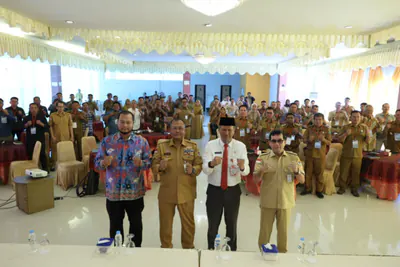
The National Border and Remote Areas Management Agency (BNPPDT) held the 2026 Technical Training to Strengthen the Capacity of Government Officials in State Border Areas for Accelerating Village Development in Nunukan Regency, North Kalimantan, as reported by TVRI News.
The programme targeted subdistrict heads, subdistrict secretaries and village heads as public service providers in border areas. Major General Edi Nurhabad of the Indonesian National Armed Forces (TNI), the BNPPDT deputy for border area infrastructure management, described border areas as the country's front door that require serious attention to infrastructure, welfare and basic services.
According to TVRI News, Edi stressed that border development must be supported by accurate and up-to-date data from villages to regencies. That data forms the basis for policy-making and priorities so they are on target. He asked subdistrict heads and village heads to actively report real conditions in their areas, potential, problems and community needs.
The training also emphasised coordination among central, regional, subdistrict and village governments so planning is not slowed by bureaucracy. The Nunukan Regency Government considered the training important because its territory directly borders Malaysia. Participants attended sessions on development planning, village finance and assets, cooperation, village economy, and facilities and infrastructure.
Borders as the Front Line of Public Services
Indonesia's border areas have a special character because they lie at the edge of the state, close to neighbouring countries, and are often far from centres of government. That geography means access to roads, communications, electricity, clean water, health care and education is not always equal to that in the country's interior. In many areas, reaching a regency capital can take hours or even days. Border area development is therefore not only about economic growth, but also about the state's presence in basic services and a sense of security.
In governance, villages are the unit closest to residents. Village governments are responsible for administering public affairs, development and community empowerment, while subdistricts serve as the extended arm of local governments. When both are weak in administration, planning and reporting, programmes from central or regional governments may fail to reach communities, arrive late or miss local needs. Training officials is one way to improve that capacity without changing existing authority.
Up-to-date data is also important in village and border area development. For years, many policies have been based on reports that were not updated, so budget priorities can be off target. Accurate data helps determine what is more urgent: village road repairs, health facilities, electricity networks or local economic support. Without the same data, central government, regional governments, subdistricts and villages may work from different assumptions.
The role of a national border management agency is relevant because development in the country's edge requires coordination across ministries and regions. No single agency can solve all border problems alone. Education, health, infrastructure, security and village economies are interconnected. Strengthening the capacity of officials at the lowest levels can therefore be read as an effort to align national policy with field realities.
What It Means for Border Residents
For residents of border areas, strengthening village officials' capacity can mean faster services and programmes that better fit local needs. When village data is accurate, road repairs, integrated health service posts (posyandu), schools or small-business assistance do not rely only on assumptions. For residents, the impact is felt in easier access to basic services, clearer support and more active local economic opportunities.
The success of such training depends on follow-up after the event ends. Village officials need to be able to prepare plans, manage finances and report needs in a disciplined manner, and use simple technology for reporting. Without follow-up, the training's impact on residents may be limited. Readers can judge the results by village budget transparency, the quality of community consultations and whether promised development truly matches field conditions.
In the long term, strengthening village governance in border areas is also linked to everyday sovereignty. Residents who experience good state services tend to trust public institutions more and are less likely to rely on informal channels when dealing with a neighbouring country. This can also narrow the gap between the centre and the edge. Border village development is therefore not only a budget matter, but also a way for the state to maintain its presence in the country's frontline areas.
Related news
BNPPDT accelerates operation of the Sebatik state border post (PLBN) in Nunukan; the government strengthens capital market reform to protect public assets; the Ministry of the Protection of Indonesian Migrant Workers (P2MI) strengthens worker readiness to enter Japan's labour market.