Surabaya District Prosecutor Temporarily Relieved of Duties Over Alleged Affair and Domestic Violence
The Surabaya District Prosecutor's Office temporarily relieved prosecutor Deddy Arisandi of case-handling duties after allegations of an affair and domestic violence went viral.
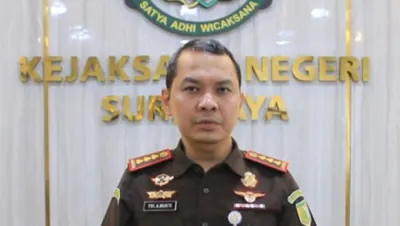
The Surabaya District Prosecutor's Office (Kejaksaan Negeri Surabaya, or Kejari) temporarily relieved prosecutor Deddy Arisandi of case-handling duties on Sunday, 15 November 2026, after allegations of an affair and domestic violence (KDRT) drew public scrutiny.
According to a TVRI News report, the head of the Kejari Surabaya, Tri Anggoro Mukti, said the step was taken to maintain the objectivity of law enforcement and ensure cases continued to be handled professionally.
The Kejari said an internal clarification had been conducted with Deddy before the temporary relief from duties, as stated in a press release dated 15 November 2026. The scrutiny began with a TikTok post by the Bangpena Media Center account on 13 November 2026 that linked Deddy to the alleged personal issue.
Deddy was the public prosecutor in the Surabaya District Court case number 1693/Pid.Sus/2026/PN.Sby, with defendant Erica Natasha Risakotta, for whom the prosecution sought a sentence of three years and six months in prison at a hearing on 10 November 2026. Through the head of the intelligence section of the Kejari Surabaya, Yogi Aryanto, Tri Anggoro Mukti said, “We will not tolerate any form of disgraceful conduct.”
The Kejari asked the public to monitor the trial so it would not be influenced by controversy and said it had opened official complaint channels.
Prosecutor ethics and the limits of private matters
In Indonesia, prosecutors are not merely administrative officials but law enforcement officials who hold important authority in the criminal process. Because their position determines the direction of prosecution, prosecutors are supervised through a code of ethics, rules of conduct, and internal disciplinary mechanisms. Scrutiny of a prosecutor's personal life can trigger an ethics examination, although it does not always mean there has been a criminal violation. Within the prosecution service, hierarchical supervision allows the head of a prosecutor's office to take temporary steps before a final conclusion that is administratively binding.
Temporary relief from duties is usually understood as a safeguard for the process, not a verdict. Its purpose is to prevent conflicts of interest, maintain objectivity, and give superiors room to clarify reports. In the legal system, a person who has not been found guilty by a court must still be treated as innocent. That is why the term “alleged” matters, so the public does not judge a prosecutor or a defendant one-sidedly. The step is also often used when a report lacks sufficient evidence to impose punishment but has raised serious public questions.
Personal issues and criminal cases also need to be separated. An affair generally falls within the moral, domestic, and ethical domain, while domestic violence can become a criminal offence if it meets the elements of applicable law. The two can intersect when the person involved is a law enforcer, because the public expects someone who prosecutes cases to uphold integrity first. But that assessment still awaits the results of an official investigation.
Social media has changed how ethics cases surface. A short post can trigger national attention before an internal clarification is complete. This demands that law enforcement institutions move quickly but proportionally: to examine reports, protect the rights of defendants in ongoing cases, and open complaint channels for parties who feel harmed. Without official channels, controversy can easily turn into mass judgment. Institutions that respond quickly may dampen speculation, provided they disclose findings transparently and in a measured way.
What the public should watch
For readers in Indonesia, cases like this touch trust in law enforcement more than prices or routine policies that directly affect daily life. When a prosecutor handles a public case, the community has the right to assess whether the process is clean. Temporary relief from duties signals that the institution is not ignoring scrutiny, but also not punishing anyone before the investigation produces results.
The practical impact is visible in how the public responds to viral information. Allegations of an affair and domestic violence can quickly trigger emotion, but a person's legal status changes only through an official process. For parties who feel harmed, complaint channels matter so that grievances can be tested with evidence. For a defendant in an ongoing case, the right to a fair process must still be upheld in the courtroom.
Going forward, what needs to be watched is whether the internal clarification results in ethical sanctions, whether criminal reports are followed up, and whether the trial proceeds without pressure from public opinion. The public can monitor the case, but it should clearly distinguish allegations, investigations, and verdicts. That approach keeps justice from turning into a prolonged controversy.
Related news
- East Java Regional Police (Polda Jatim) Deploy 3,000 Personnel to Safeguard Public Aspirations in Surabaya
- Central Java Provincial Government Cuts Rice Field Cultivation Costs to Rp200,000 per
- John Pieris's Four Conditions for Vice President to Replace Gibran