Malang Mayor Links Heroes' Day 2026 to Collaboration for Welfare
Malang Mayor Wahyu Hidayat led the Heroes' Day 2026 ceremony and urged residents to continue the struggle through collaboration for public welfare.
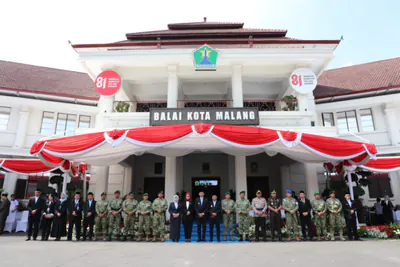
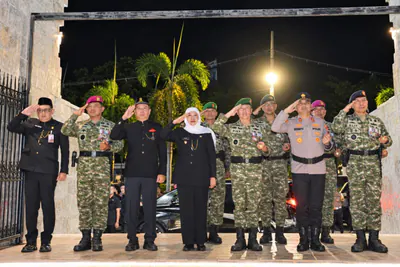
Malang Mayor Wahyu Hidayat led the Heroes' Day 2026 ceremony at the courtyard of Malang City Hall on Tuesday, 10 November 2026, and urged residents to emulate the heroes' struggle through concrete contributions to public welfare, as reported by TVRI News.
The ceremony was held after Wahyu and Deputy Mayor of Malang Ali Muthohirin took part in the National Pilgrimage at the Suropati Heroes' Cemetery. The event was attended by members of the Forum Koordinasi Pimpinan Daerah, a regional leadership coordination forum, heads of regional government units, and personnel from the Indonesian National Armed Forces (TNI), the Indonesian National Police (Polri) and the Civil Servants Corps (Korpri). According to TVRI News, Wahyu said the commemoration must not stop at ceremony. He linked the spirit of Heroes' Day with central government programs, including the Sekolah Rakyat (People's School) program, to widen access to education and improve human resources. Wahyu also reaffirmed the Malang City Government's commitment to support policies aimed at improving residents' quality of life and paying attention to groups in need.
Meaning of the National Pilgrimage and Sekolah Rakyat
Heroes' Day in Indonesia is generally centered on 10 November to commemorate the 1945 Battle of Surabaya. The date was chosen because it marks a key moment in the struggle to defend independence. As a result, visits to heroes' cemeteries are not merely annual rituals; they signal that the state continues to treat veterans' sacrifices as part of public memory. In Malang, the pilgrimage to the Suropati Heroes' Cemetery and the ceremony at City Hall followed the same pattern: honouring those who have died was linked to a message that living generations must carry forward the values of the struggle.
The Sekolah Rakyat program, mentioned by Wahyu in the context of Heroes' Day, should be understood as part of a push to widen access to education for groups that have long been hard to reach with formal services. The word rakyat here refers to an approach aimed at communities with basic needs, not merely school construction. In regional policy practice, such programs usually require cross-sector coordination, from providing teachers and learning facilities to collecting beneficiary data and financing that does not rely entirely on the city budget. For regions, the program is also a test of governance: whether beneficiary data is accurate, whether budgets reach their targets, and whether education services can reach areas that have long been neglected.
Malang's position in this issue is distinctive. The city is known as a higher education hub with many universities, yet it can still face gaps in access to basic and secondary education. The mayor's call for development not to rely on government alone can therefore be read as an invitation to collaborate. Businesses, academics, community groups, social organisations and young people can fill spaces that the bureaucracy cannot always reach, for example through mentoring, scholarships, teacher training or support for residents. Such involvement can also help the city government reduce budget burdens, provided it is carried out under public oversight.
The success of that message is usually measured not by the number of ceremonies, but by whether residents experience better education services and welfare. In a regional context, heroism thus shifts from a symbol of physical courage to consistency in working for the public interest. Residents can therefore judge the commemoration's success by visible changes around them, not by the completeness of ceremonial formations.
Impact for Malang Residents
For readers in Malang, this kind of Heroes' Day commemoration is most meaningful when it leads to policies that are easy to access. An expansion of the Sekolah Rakyat program, for example, can affect education costs, the availability of learning spaces and attention to children who have dropped out of school. If the program truly targets groups in need, its impact can be seen directly in families' ability to allocate daily spending, especially for transport, school supplies and children's learning needs. Residents can also use the moment to demand transparency in education budget spending at the subdistrict and school levels.
The collaboration requested by the mayor also opens practical roles for residents. Companies can channel corporate social responsibility funds for scholarships or vocational training; campuses can send students to teach in schools that lack teachers; and communities can help identify residents who are not yet served. That way, public welfare does not stop as a slogan in a ceremony, but becomes an agenda that can be monitored together. With open mechanisms, collaboration does not turn into symbolic activity or mere ceremonial documentation.
What needs attention going forward is clear targeting, complaint mechanisms and honest program evaluation. Without those, the call to emulate the heroes will only become a prelude to the next ceremonial event for residents.
Related news: Kabupaten Asahan earned an exceptional category in the Corruption Eradication Commission (KPK)'s Ber-Aksi assessment.