Khofifah Leads Heroes Day Solemn Vigil in Surabaya
East Java Governor Khofifah Indar Parawansa leads a Heroes Day solemn vigil in Surabaya and urges citizens to make independence meaningful through their professions.
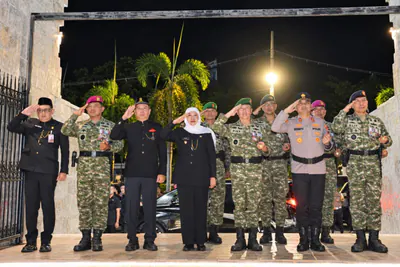
Khofifah Indar Parawansa, governor of East Java (Jawa Timur), led an Honor Ceremony and Solemn Vigil at Taman Makam Pahlawan (TMP) Sepuluh Nopember, the Sepuluh Nopember Heroes Cemetery, in Surabaya in the early hours of Tuesday, 10 November 2026, to mark Heroes Day (Hari Pahlawan).
According to TVRI News, the ceremony began at exactly 00.00 Western Indonesian Standard Time (WIB). Khofifah, together with members of the Regional Leadership Coordination Forum (Forkopimda), the Indonesian National Armed Forces (TNI) and the Indonesian National Police (Polri), observed a moment of silence before the fallen heroes.
In her address, as reported by TVRI News, Khofifah said modern heroism is shown through dedication in one's profession, not simply by remembering history. She said journalists, teachers and workers in other sectors can make concrete contributions to society, the nation and the state.
Khofifah also urged residents to strengthen unity, brotherhood and integrity. She said differences in background and profession could become a shared strength in safeguarding national integrity. She was accompanied by Sekretaris Daerah Provinsi Jawa Timur (Jawa Timur Provincial Secretary) Adhy Karyono, Pangdam V/Brawijaya (V/Brawijaya Military Region commander) Major General (TNI) Piek Budyakto, and Kapolda Jawa Timur (East Java police chief) Inspector General (Polri) Dekananto Eko Purwono.
The Battle of Surabaya Behind Heroes Day
Heroes Day is observed every 10 November to recall the 1945 battle in Surabaya, when British forces and Indonesian fighters clashed after the proclamation of independence. The battle became a symbol of popular resistance, particularly because Surabaya is remembered as a city that did not surrender easily, making the date a national commemoration honoring the service of those who fell. The national observance also ties together collective memory of the courage shown by civilians, soldiers and ordinary residents in defending the city.
The tradition of a solemn vigil at a heroes cemetery is usually held just before or exactly at midnight. It is simple: silence, prayer and respect for names that can no longer witness the results of the struggle they joined. The ritual treats the heroes' deaths not as an ending but as a reminder that independence was born from costly sacrifice. For participants, the silence offers a chance to separate ceremony from responsibility: once the prayers end, public work must improve.
In Jawa Timur, TMP Sepuluh Nopember is important because it preserves traces of the struggle in Surabaya. The cemetery is not only a burial ground but also a public education site. Many schools, social organizations and government agencies visit to introduce local history to younger generations. For that reason, a commemoration at the site is easily read as a message that heroism did not stop with a single battle. For Surabaya residents, the cemetery is also a reminder that the city was once a space of solidarity across groups: soldiers, militia members, students, traders and ordinary people.
The shift in the meaning of heroism from the battlefield to everyday work also needs to be seen clearly. During the physical revolution, the most immediate risks were weapons and death. After the state was established, those risks moved into public service, education, health, security, the economy and the media. The challenge is no longer to shoot or be shot at, but to maintain public trust, prevent corruption, improve service quality and preserve unity amid differences. Contemporary heroism can be measured by consistency: whether an official serves without self-interest, whether a teacher educates without discrimination, and whether a worker safeguards safety and quality in their output. In this way, heroism is not only commemorated but practiced.
Heroes Day Message for Jawa Timur's Public
For readers in Indonesia, commemorations such as this are useful only when translated into concrete standards of work. For local government staff, dedication means fast services, clean budgets and open decisions. For teachers, contribution can be realized by teaching honestly and preparing students who can think critically. For health workers, heroism appears in readiness to serve, maintaining the quality of medicines and not allowing residents to be delayed by cumbersome procedures.
The link to daily life may not be immediately felt. But the values of unity, brotherhood and integrity cited in the regional commemoration can become benchmarks for judging officials' performance, media quality and civic ethics in public spaces. When moral promises stop at a ceremony, the public has the right to demand proof: whether roads, schools, community health centers (puskesmas) and local administrative services have truly improved.
What matters going forward is continuity. The Heroes Day spirit should not appear once a year and then vanish when routine work begins. Residents can monitor it through simple actions: demanding budget transparency, respecting professions that serve the public and rejecting practices that damage trust, from small bribes to the spread of hoaxes.