Indonesian police chief urges officers to protect good name and integrity
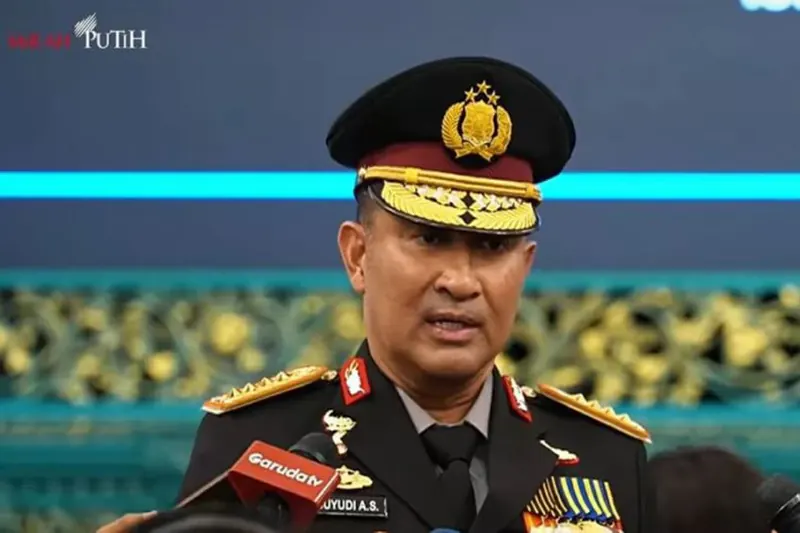
Chief of the Indonesian National Police (Kapolri) Police General Suyudi Ario Seto visited the grave of former police chief Hoegeng Iman Santoso on Heroes' Day and urged officers to uphold honesty and the institution's good name.
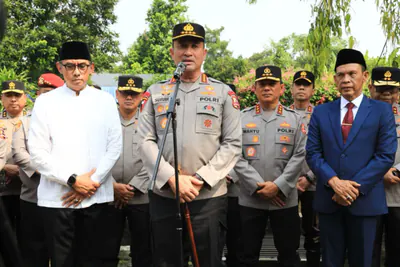
Chief of the Indonesian National Police (Kapolri) Police General Suyudi Ario Seto urged all members of the Indonesian National Police (Polri) to protect honesty, the institution's good name and integrity while carrying out their duties. He made the appeal during a visit to the grave of former Kapolri Police General (Ret.) Hoegeng Iman Santoso at Giri Tama Public Cemetery (TPBU) in Tonjong, Bogor Regency, on Heroes' Day, Tuesday, 10 November 2026, as reported by TVRI News.
During the visit, Suyudi described Hoegeng as a role model for police officers across generations. According to TVRI News, he cited Hoegeng's decision while serving as head of the Immigration Directorate (Jawatan Imigrasi): asking his wife, Meriyati Hoegeng, to close her flower shop so no one could exploit his position. Suyudi also mentioned Hoegeng's choice to be buried at Giri Tama Public Cemetery rather than Taman Makam Pahlawan (the Heroes' Cemetery) so that he would be close to his wife.
Suyudi stressed that the authority held by Polri members must be accompanied by responsibility. He recalled Hoegeng's message, “It is good to be an important person, but it is more important to be a good person,” and said the value of integrity does not change even as Polri's leadership changes.
Hoegeng's example in Polri history
Hoegeng Iman Santoso is known to the public as one of Polri's figures associated with honesty and simplicity. He is remembered as a former Kapolri and once served as head of the Immigration Directorate. In the course of that career, stories about rejecting requests, gifts or the abuse of office are often cited as examples of official ethics. For that reason, visiting his grave on Heroes' Day was not merely ceremonial but also an affirmation that integrity remains a legacy discussed within Polri. The message is relevant because Polri is often involved in cases that demand public trust.
The commemoration of Heroes' Day on 10 November each year is rooted in the 1945 Battle of Surabaya. The state usually uses the occasion to reconnect the values of dedication, courage and exemplary conduct with the duties of public officials. In Polri's context, the message shifts from physical courage to moral courage: guarding authority so that it does not become a tool for seeking profit, suppressing reports or protecting particular interests. Such moral courage demands leadership by example, not just instructions.
Integrity in law enforcement institutions is also linked to internal mechanisms. Polri members are bound by disciplinary rules, a code of ethics, oversight by internal supervisory functions, and external oversight by state institutions and the public. The phrase “the institution's good name” in the Kapolri's message can be read as a reminder that one member's action can shape public judgment of the entire organization. Conversely, the example set by leaders is a measure of whether values expressed in words are genuinely practiced. Oversight matters because the public assesses Polri through everyday services.
Hoegeng's story about asking his wife to close her flower shop is often used to explain conflicts of interest. A conflict of interest arises when a public office can influence decisions that benefit the private businesses of family members or close associates. In modern bureaucracy, such risks are usually managed through asset reporting, separation of personal affairs from official duties, and limits on the role of family members in business activities related to the office's authority.
What it means for public services and public trust
For the public, the Kapolri's message on Heroes' Day is not only about remembering a former police leader. The integrity of officers is directly linked to residents' experience when they process certificates, driving licences, passports or report cases. If police members exercise authority honestly, residents can anticipate the service they will receive without having to bear extra costs, pressure or special treatment. Conversely, one alleged abuse of authority can make people reluctant to report crimes and reduce trust in law enforcement. That trust also determines whether residents are willing to take part in crime prevention.
The value of “being a good person” also gives the public a simple measure for assessing officials. People can see whether talk about the institution's good name is followed by strict internal oversight, open complaint handling and consistency by Polri officials in rejecting conflicts of interest. In the long run, Hoegeng's example remains relevant because he connected office with responsibility: power is not a place to seek profit, but a space for service.
Therefore, the commemoration of Heroes' Day can be read as a reminder that reforming Polri cannot stop at ceremonies. It is tested every day by interactions between officers and residents seeking justice or services.
Related news
- Gibran conveys resignation intention to Prabowo, official letter not yet available
- Calls for Vice President Gibran's impeachment after Constitutional Court and Supreme Court rulings
- President Prabowo ensures economic fundamentals remain strong