Hulu Sungai Tengah Police Name Nine Narcotics Suspects, Seize 1.86 Kilograms of Methamphetamine
The Hulu Sungai Tengah Police Resort in South Kalimantan named nine narcotics suspects and seized 1.86 kilograms of methamphetamine during an increased routine police operation.
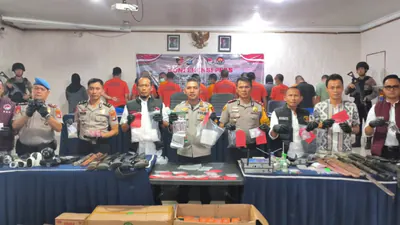
The Hulu Sungai Tengah Police Resort (Polres HST), a district-level police command in South Kalimantan, named nine narcotics suspects in cases uncovered between 15 October and 10 November 2026. Police seized 1.86 kilograms of methamphetamine (sabu), 2.97 grams of cocaine and 34 etomidate cartridges, according to TVRI News.
Other evidence secured included 22 parang (machetes), one improvised firearm, one airsoft gun, 19 surveillance cameras and one drone. According to TVRI News, Hulu Sungai Tengah police chief AKBP Jupri JHP Tampubolon (AKBP is a senior police rank) said the disclosures were part of Kegiatan Rutin yang Ditingkatkan (KRYD), an Increased Routine Activity program. He said, “this does not mean our operations will stop,” noting that investigations were still developing and that a list of wanted persons (DPO) remained.
The police resort also named the owner of a warung (small food stall) with the initials MT as a suspect in the suspected exploitation of three minors in Sungai Buluh village, and seized 42,370 tablets of Seledryl.
The role of KRYD in regional narcotics enforcement
Kegiatan Rutin yang Ditingkatkan, or Increased Routine Activity (KRYD), is a police work pattern that strengthens patrols, checks and law enforcement during set periods. In narcotics cases, it usually targets locations considered vulnerable, such as food stalls, entertainment venues, transit routes and areas frequently reported by residents. When one series of operations ends, public reports remain the gateway to new cases, so development does not always stop at the number of suspects announced. In practice, operations like this are often carried out before or after sensitive periods, such as long holidays, local festivals or a rise in residents’ reports.
In South Kalimantan, narcotics enforcement is carried out by the regional police and district-level police commands (resor) in regencies and cities. Areas such as Hulu Sungai Tengah have a mixed character of small towns, subdistricts and rural zones. That condition means supervision cannot rely only on large operations, because distribution can move to quieter places, including night food stalls or spots rarely covered by cameras. In this case, evidence such as surveillance cameras and a drone can be read as part of efforts to trace movement patterns, although their legal status must be proven in court. In areas with limited access, coordination between the district police command, village police liaison officers (bhabinkamtibmas) and village governments becomes important to ensure information does not stop at the subdistrict level.
The terms appearing in the disclosures also need to be understood separately. Sabu is a Class I narcotic under Law No. 35 of 2009 on Narcotics, so abuse and distribution carry heavy penalties. Cocaine is also a controlled narcotic. Etomidate, referred to in the report as cartridges, is better known as an anesthetic drug; if abused, handling may touch drug and narcotics rules according to classification and evidence collected by investigators. Seledryl, a medicine circulating in the community, can become a concern when large quantities are involved and abuse is suspected, but its status must still be proven.
The naming of suspects, as in the child exploitation case, is still at the stage of allegation. Names, initials and roles announced by investigators must be read with the presumption of innocence until a court issues a final and binding verdict.
Impact on social supervision in Hulu Sungai Tengah
For residents, the disclosures show that neighborhood reports can still lead to legal action. In areas with close social networks, information about suspicious transactions, unusual nighttime activity or children involved in risky work can speed police intervention. But residents also need to distinguish suspicion from accusation. The release of names or initials in public should not be treated as a verdict, because the burden of proof remains with the court.
Cases involving large quantities of medicines and alcoholic drinks are also relevant for parents and business owners. Food stalls, entertainment venues and medicine-selling points must pay closer attention to permits, operating hours and who they serve. If minors are involved, vigilance is not only about crime but also about protection from exploitation. For readers outside HST, this pattern is a reminder that social problems often appear as small everyday violations before growing into networks that are difficult to dismantle without routine supervision.
What needs attention going forward is the continuation of the investigation, not only the press conference. Without action against wanted persons and checks on the flow of goods, operations can stop at provisional figures.
Transparency about case progress, including whether files have been handed to prosecutors, will determine public trust in the operation.
Related news
Police raid Sebesi Island, find meth smoking paraphernalia and zip-lock bags
Jember Police Resort steps in to help residents affected by a tornado
South OKU Police Resort deploys 300 personnel to secure Grand Fondo 2026