East Java Police and Navy Tighten Maritime Security Against Drug Trafficking
East Java police and the Indonesian Navy's Second Fleet Command are stepping up cooperation to secure waters and prevent drug trafficking, especially around Pulau Madura.
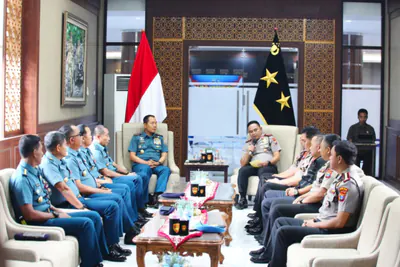
East Java Regional Police (Polda Jatim) Chief Inspector General Dekananto Eko Purwono met Rear Admiral I Gung Putu Alit Jaya, commander of the Indonesian Navy's Second Fleet Command (Koarmada II), at Gedung Mahameru in Surabaya on Tuesday, 17 November 2026, to strengthen cooperation against drug trafficking and other crimes in East Java's waters, as reported by TVRI News.
During the courtesy visit, Dekananto said cooperation between the military and police was essential because the narcotics threat in East Java, especially on Pulau Madura, needed to be addressed jointly to protect young people during the demographic bonus period.
He also asked Koarmada II and the East Java Regional Police's Water and Air Police Directorate (Ditpolairud) to tighten maritime surveillance, given the high level of trade activity in the area.
Putu Alit Jaya said he was ready to collaborate so that public order and security in East Java remained safe and conducive.
How maritime and drug security work intersect
Maritime security in Indonesia has never been the responsibility of a single institution. The Indonesian Navy (TNI AL) is tasked with defending sovereignty and maintaining defence at sea, while the Indonesian National Police (Polri) is responsible for public order and security, including law enforcement in maritime areas. In practice, the two agencies can support each other when threats cross formal boundaries, such as smuggling involving vessels, ports, local networks and flows of goods.
Drug trafficking by sea is a concern because Indonesia is an archipelago with a long coastline. Official routes can be monitored, but small boats, coastal unloading points and cargo transfers at sea mean surveillance requires intelligence, patrols and inter-agency coordination. Pulau Madura, located near the centre of East Java's economic traffic, sits in a geographic position that requires maritime and land-based oversight to complement each other.
A demographic bonus is a condition in which the number of working-age residents exceeds the number of non-working residents. That opportunity can become an economic strength if young people are healthy, educated and employed. If social and economic spaces are not managed well, however, young people can become easy targets for drug networks, either as users or as participants in trafficking. Prevention therefore is not only a law-enforcement matter, but also involves education, public health, economic empowerment and community oversight.
At the regional level, the police Water and Air Directorate is the frontline for maritime patrols, vessel inspections and criminal investigations in maritime areas. The Navy's Second Fleet Command has maritime observation, sea security operations and support for law enforcement when needed. The meeting between the two institutions' leaders shows that crime prevention cannot wait for major incidents; routine coordination, information sharing and joint training can shorten response times in the field. Such coordination is also relevant to port oversight, because vessels can move quickly from sea routes to land-based networks and are difficult to monitor without shared field data.
Impact on maritime activity and residents
For readers in Indonesia, closer police and military cooperation in the waters may sound like an institutional matter. But the results can affect daily life. Better maritime security supports smooth goods distribution, lowers the risk of disruption to commercial ships and fishermen, and maintains confidence in ports as economic hubs. When trade routes are secure, logistics costs can become more stable and export-import activity is less vulnerable to criminal incidents. That matters for regions that rely on industry, trade and maritime services.
For coastal communities and residents of Pulau Madura, coordinated oversight can mean more integrated patrols, more orderly inspections and clearer information channels when suspected smuggling occurs. But the public also needs to understand that surveillance must not turn into baseless suspicion. Law enforcement must respect citizens' rights, rely on evidence and preserve the presumption of innocence for people questioned as witnesses or suspected of involvement.
In the future, attention should focus not only on the number of operations but on the quality of coordination: whether community information is acted upon, whether sea and land patrols are connected, and whether drug prevention programmes reach schools, Islamic boarding schools, youth communities and workplaces. If the cooperation stops at a courtesy visit, its impact will be limited. But if it is followed by routine mechanisms, it can become part of protecting young people and East Java's economic security. In that case, the results will be visible not only in operation statistics, but also in residents' sense of safety and business certainty.