Asahan Regency earns special category in KPK Ber-Aksi anti-corruption pilot assessment
Asahan Regency in Sumatera Utara earned the special category in the Corruption Eradication Commission (KPK) Ber-Aksi pilot assessment and is scheduled to be inaugurated during Hari Antikorupsi Sedunia, or World Anti-Corruption Day, 2026.
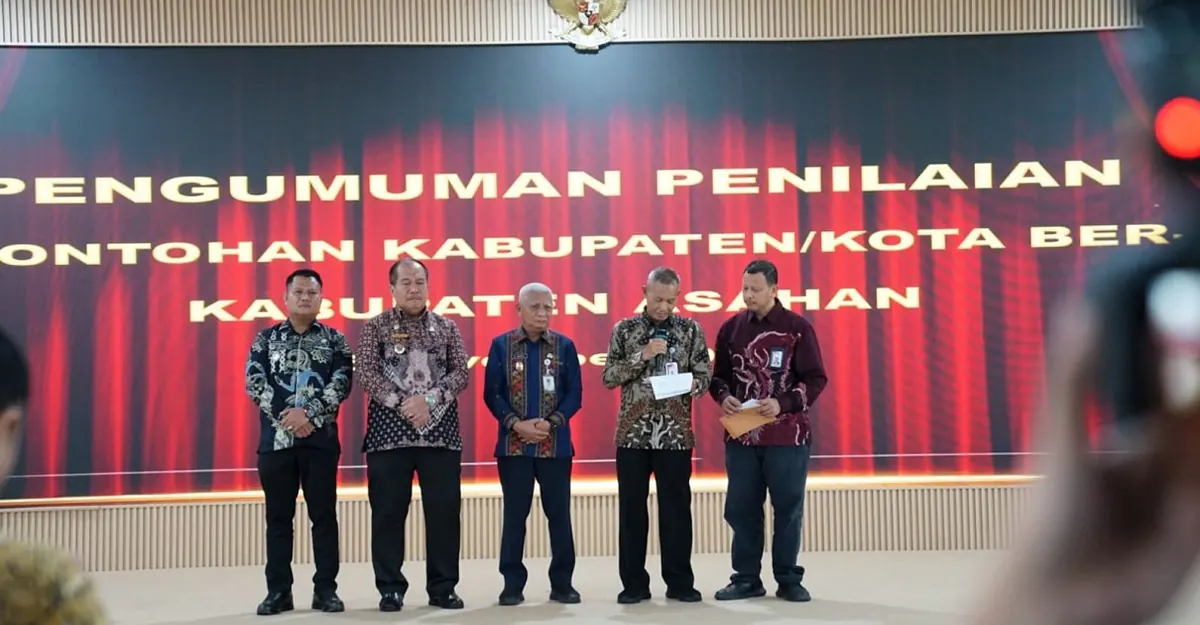
Asahan Regency in Sumatera Utara earned the special category in the 2026 Pilot Assessment of Regencies and Cities Courageous in Eradicating Corruption (Ber-Aksi), the Corruption Eradication Commission (KPK) said in an official statement on Thursday, 5 November 2026. The region’s inauguration is scheduled for 9 December, during Hari Antikorupsi Sedunia, or World Anti-Corruption Day (Hakordia), 2026.
KPK Deputy Chairman Ibnu Basuki Widodo announced the result at the Asahan regent’s office. The assessment was conducted by a joint team involving the KPK, the Ministry of Finance, the Ministry of Home Affairs, the Ministry of Administrative and Bureaucratic Reform (Kementerian PAN-RB), the Ombudsman RI Sumatera Utara office, the BPKP Sumatera Utara office, and the Sumatera Utara provincial inspectorate. According to the KPK report, Asahan met five components and 15 indicators after a six-month evidence verification process.
Ibnu also presented the KPK’s national records from 2004 to the second quarter of 2026: 1,892 enforcement cases, with local governments accounting for the largest share at 731 cases. He therefore stressed prevention and anti-corruption education. “It would be better if we stay on the prevention path,” he said, as quoted from the KPK statement.
Among the standout achievements were a Monitoring Controlling Surveillance for Prevention (MCSP) score of 87.5 against a minimum threshold of 75, a bureaucratic reform index of 2.86 against a threshold of 2.5, and a surge in gratification control programs from 38.20 in 2025 to 80.75 in 2026. Asahan also recorded an unqualified opinion (Wajar Tanpa Pengecualian) from the Audit Board of the Republic of Indonesia (BPK) for two consecutive years, with no regional head or echelon II official caught in legal proceedings.
Asahan Regent Taufik Zainal Abidin said strengthening the internal complaint system, the gratification control unit and the digitalization of services were next steps. Sumatera Utara Deputy Governor H. Surya described the inauguration as a responsibility that must be proven through commitment and data.
KPK’s shift toward regional prevention
The observance of 9 December as Hari Antikorupsi Sedunia, or World Anti-Corruption Day, is rooted in the United Nations Convention against Corruption (UNCAC), adopted in 2003 and entering into force two years later. That moment is used by many countries, including Indonesia, to emphasize that anti-corruption efforts cannot rely solely on enforcement but also on improving systems, education and public participation. In Indonesia, the commemoration is usually filled with education campaigns, integrity declarations and stronger reporting channels.
Within the national framework, the KPK carries out coordination and supervision functions, with prevention as one of its main pillars. At the local level, vulnerable points usually arise in budget planning and spending, procurement of goods and services, licensing and personnel transfers. Therefore, assessments of local governance practices are important as early indicators, not substitutes for legal proceedings.
Terms such as gratification, gratification control and public complaint systems often appear in prevention programs. Gratification is a gift considered related to an official’s position and contrary to their duties; reporting it is a way to break chains of quiet transactions. Meanwhile, public complaint channels serve to test whether residents’ complaints are actually followed up, not merely recorded. Bureaucratic reform, financial audit opinions and public satisfaction surveys are often used as the language for measuring that change.
The use of local wisdom and the strengthening of an integrity culture are also part of prevention strategy because corruption is not solely a matter of rules but also organizational habits. When officials, civil servants and residents see transparent services, informal costs can be reduced. On the other hand, successful prevention does not automatically erase legal risk; it acts as a brake against new cases. Without continuous monitoring, good assessment scores can decline when budget pressure rises or leadership changes.
What it means for residents and service users
For Asahan residents, the recognition is most felt when it translates into services that are faster and less costly in informal terms. Digital services, cashless payments and gratification control units can reduce space for brokers or demands for money outside official rules. The impact is not only on satisfaction but also on the costs that residents must bear to handle administrative matters.
For readers outside the region, the case shows that regional anti-corruption prevention can be measured through relatively concrete indicators: complaint response, information transparency and follow-up on audit findings. For other local governments, similar experiences can serve as a comparison, as long as they do not stop at document compliance. For the central government, a signal to watch is whether bureaucratic improvements truly reduce the risk of misuse of the regional budget (APBD).
What needs to be watched going forward is consistency. Inauguration on World Anti-Corruption Day is not the end, but a reminder that integrity is tested daily as budgets are executed, permits processed and residents’ complaints handled. If complaint channels are busy only at the start of an assessment, their benefits will quickly evaporate. Therefore, residents need to monitor whether their reports receive written answers, not just receipts.
Related coverage: Hulu Sungai Selatan becomes Ber-Aksi 2026 pilot; KPK appoints seven strategic anti-corruption officials; KPK strengthens global cooperation to push the recovery of corruption assets.