130th TMMD closes in Pamekasan as TNI, police and East Java government strengthen village development synergy
The closing of the 130th TNI Manunggal Membangun Desa programme in Pamekasan underscored collaboration among the TNI, police and the East Java provincial government in village development.
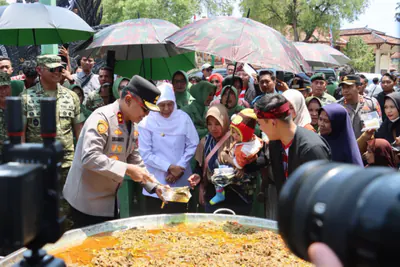
The closing ceremony of the 130th TNI Manunggal Membangun Desa (TMMD) programme — an initiative of the Indonesian National Armed Forces (TNI) to develop rural areas together with residents — was held at Nagara Bhakti Mandhapa Aghung Ronggosukowati Square in Pamekasan, Madura, on Thursday, 12 November 2026. According to TVRI News, the attendance of East Java Police Chief Inspector General Dekananto Eko Purwono and East Java Governor Khofifah Indar Parawansa marked a strengthening of cross-sector cooperation for village development.
The event was also attended by Army Chief of Staff General Tandyo Budi Revita, V/Brawijaya Military Region Commander Major General Piek Budyakto, 084/Bhaskara Jaya Military Resort Commander Brigadier General Kohir, and Pamekasan Regent Kholilurrahman. The officials reviewed stalls at a cheap basic-needs bazaar, local food vendors and flagship products from micro, small and medium enterprises (UMKM).
TMMD is a programme of TNI oneness with the people, with gotong royong, or mutual cooperation, as the foundation for developing rural areas. In the TVRI News report, Dekananto said, “Through the TMMD programme, we strengthen the spirit of gotong royong among residents and the TNI to realise the TNI’s oneness with the people.”
The presence of regional leaders also signalled police support for security and the continuity of development work.
The role of TMMD in village development
TMMD is a territorial programme long carried out by the TNI to bring state institutions closer to village residents. In its regular format, the work does not stop at the closing ceremony; it is combined with physical and non-physical development. Physical projects usually address basic needs that village budgets often struggle to cover, such as neighbourhood road repairs, small bridges, water channels, the renovation of substandard homes, and public facilities that connect settlements with markets and schools.
Non-physical activities provide space for counselling, basic services and capacity building. Common topics include national insight, public health, agriculture, the environment, security and assistance for micro businesses. This approach makes TMMD different from ordinary infrastructure projects because its results are not limited to buildings; they can also include new habits, cooperation networks and a sense of ownership over the facilities built.
The term “kemanunggalan TNI dengan rakyat”, or TNI’s oneness with the people, refers to a relationship that is social as well as administrative. TNI personnel work and interact with residents while the programme is running. That interaction can narrow the distance between the state and communities in areas with limited access. For villages, the presence of officials can also encourage residents to take part in deliberation, communal work and oversight of development results.
Synergy among the TNI, the Indonesian National Police (Polri) and local government is important because village development cannot rest on one institution alone. Local governments provide policy, budgets and services; the TNI can mobilise territorial resources; and the police maintain a safe social space. When the three meet in one programme, residents receive the message that village development is a shared agenda, not a project that arrives and leaves without oversight. The programme can therefore serve as a cooperation model that is easier to replicate in other areas without waiting for large budgets.
What TMMD means for Pamekasan residents
For readers in the region, the closing of TMMD is not merely the end of an official activity but an opportunity to assess whether the programme has touched everyday needs. Better village roads, for example, can shorten the time needed to transport agricultural products and lower logistics costs. The effect may be felt in food prices at local markets, especially when weather or distance is the main driver of higher distribution costs. That relevance is particularly clear in areas with limited basic infrastructure.
Activities such as the cheap basic-needs bazaar and the display of UMKM products also show in practical terms that village development can run alongside strengthening the local economy. For micro, small and medium enterprises, such events open market access, introduce products and build confidence to move up. For residents, direct interaction with officials and local government can raise awareness of the need to monitor the facilities that have been built.
Going forward, sustainability will be key. TMMD will have a greater impact if physical results are maintained by village governments, non-physical activities are followed up by relevant agencies, and neighbourhood security is safeguarded collectively. For the public, the synergy among the TNI, police and local government can be measured in simple terms: whether villages become easier to reach, safer and more productive after the programme ends.
Related coverage
The East Java office of the National Zakat Management Agency (BAZNAS) and the Surabaya High Religious Court explore cooperation; the Riau provincial government strengthens equitable health services for the 62nd National Health Day; and the East Java police chief meets the Indonesian Islamic Da'wah Association (LDII) to maintain public order and security.