Semarang Police Deploys 90 Personnel for 14-Day Zebra Candi 2026 Traffic Operation
The Semarang police command (Polres Semarang) will deploy 90 personnel in a 14-day Zebra Candi 2026 traffic operation from 16 to 29 November 2026 to reduce violations, crashes and fatalities in Semarang Regency.
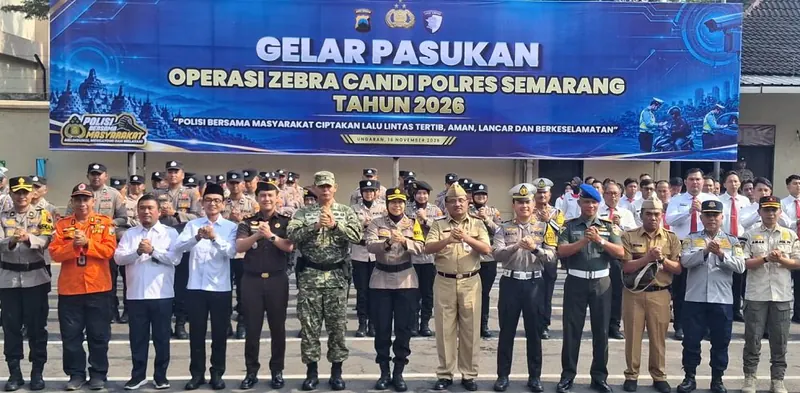
The Semarang police command (Polres Semarang) will deploy 90 personnel in a 14-day Zebra Candi 2026 traffic operation from 16 to 29 November 2026 to reduce violations, accidents and victim fatalities in Semarang Regency.
According to a report by Jateng Pos, readiness for the operation was marked by a troop formation (Apel Gelar Pasukan) at Catur Prasetya Field at the Semarang police command on Monday, 16 November 2026. The formation was led by Deputy Semarang police chief Kompol Wahdah Maulidiawati and attended by the Semarang Regency coordination forum of regional leaders (Forkopimda), the Indonesian National Armed Forces (TNI), the Regional Disaster Management Agency (BPBD), the Transportation Agency (Dinas Perhubungan) and other supporting units.
Wahdah said the operation would not focus only on enforcement but also on education and prevention. She said traffic discipline needed to be built so that the public understood the risks to themselves and to other road users.
Semarang police traffic unit head AKP Bagus Satya Dhira told Jateng Pos that the main targets of the operation were to lower the number of violations, accidents and victim fatalities. The operation is also part of preparations for securing Christmas 2026 and New Year 2027. To that end, monitoring will be carried out on arterial roads, toll roads and rest areas, including vehicle roadworthiness inspections, or ramp checks. The police command is also preparing banners, additional warning signs and coordination with BPBD to place closed-circuit television (CCTV) at congestion and accident hotspots.
Routine Operation Ahead of Year-End
Zebra operations are generally understood as periodic police traffic operations, especially before periods when public mobility increases. In a local context, operation names usually follow the code used by the police region concerned. The focus is not simply to find faults among drivers, but to prepare road conditions before the peak of year-end activity.
A Zebra operation is usually a preparatory stage before Christmas and New Year security. In this phase, authorities assess hotspots, test personnel readiness and regulate risky driving behaviour. That approach is considered important because traffic accidents are often linked to speed, negligence, vehicle condition and changing weather.
Some technical terms need to be understood by the public. Victim fatality refers to the severity of an accident to the point of causing death, not simply the number of accidents. A hotspot is a road section that, based on mapping by authorities and relevant agencies, has a higher potential for congestion or accidents. A ramp check is a roadworthiness inspection of a vehicle, covering brakes, lights, tyres, documents and safety equipment.
Cross-agency involvement is also a feature of modern traffic operations. Police do not work alone because road safety involves transport operators, disaster management, transportation agencies and local government. That synergy is needed when monitoring takes place on arterial and toll roads, especially during rain, homecoming travel (mudik) or congestion at rest areas.
Ahead of year-end, travel patterns in Indonesia usually shift. School, work and tourism activities meet at the same time, so vehicle volume rises on national roads, provincial roads and toll roads. This means monitoring depends not only on enforcement but also on traffic engineering, weather information and emergency service readiness.
In operations like this, success is also measured by whether the public changes behaviour after the operation ends, not only by the number of enforcement actions during the operation on the road.
Impact on Year-End Road Users
For road users in Semarang Regency and surrounding areas, the operation means checks will be more visible, especially on roads mapped as hotspots. Drivers need to prepare vehicle documents, ensure an Indonesian National Standard (SNI) helmet is fitted correctly, wear seat belts and check tyres, brakes and lights before setting off. Those obligations are not only to avoid penalties but also to reduce risk in rain or limited visibility.
For travellers and tourists using toll roads, monitoring at rest areas can affect travel rhythm. Rest areas may become crowded, while public and freight vehicles may undergo roadworthiness checks. Therefore, the public should allow more travel time, avoid pushing on while tired and follow official information on weather and traffic engineering.
At the local level, traffic operations also relate to public trust in road safety. When signs, lighting and information on hotspots are clearer, residents can adjust routes and travel times.
The link between this operation and prices or national policies is not direct. However, its impact is felt in everyday driving habits: the more disciplined road users are, the less likely year-end journeys are to be disrupted by accidents or severe congestion.