Judicial Commission Pilots Judge Oversight Model Without Disrupting Hearings
The Judicial Commission (KY) has introduced a model for monitoring judges' conduct in Manado, North Sulawesi, to make oversight orderly and professional while respecting judicial independence.
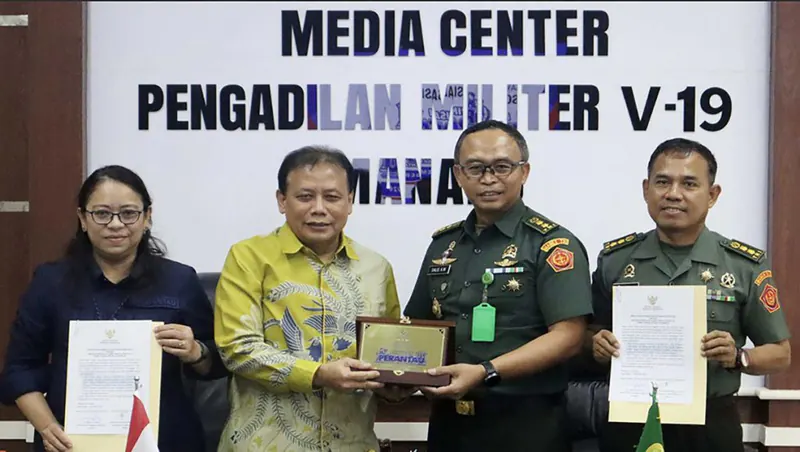
The Judicial Commission (KY) introduced the Pengadilan Ramah Pantau (PERANTAU), or Monitoring-Friendly Court, model in Manado, North Sulawesi, on Thursday, 12 November 2026, to strengthen oversight of judges' conduct without undermining judicial independence, according to a report by InfoPublik, the government's public information portal.
Abhan, a KY member and head of its Judicial Conduct Oversight and Investigation Division, presented the design at Military Court V-19 and the High Court in the Manado Integrated Court Complex. Abhan said monitoring must be planned, orderly and professional, while the examination of cases remains the judges' authority.
PERANTAU is being prepared as both a conceptual and operational model. It sets out information preparation, access, coordination, and the roles of monitoring officers and courts. Its aim is for oversight to operate within the proper authority and not be reduced to the presence of officers in the courtroom.
During the introduction, KY outlined four dimensions of readiness: information, access, communication and coordination, and supporting facilities. Abhan said monitoring must “be carried out professionally and in a planned manner,” as reported by InfoPublik.
Limits of KY oversight and judges' authority
The Judicial Commission is a state institution established to safeguard the honor and dignity of judges. Within Indonesia's constitutional framework, it oversees judges' conduct, including ethics, propriety and integrity, but is not empowered to assess the content of rulings or annul case proceedings. Conduct oversight differs from technical judicial oversight: the former concerns how judges behave, while the latter touches legal substance and the reasoning behind decisions. Ethical oversight is also part of efforts to maintain the judiciary's integrity in the public eye.
That division stems from the principle of an independent judiciary. Judges must be free from pressure from the government, other state institutions and public opinion when examining and deciding cases. Loose oversight can create a perception of intervention, while overly strict oversight risks undermining judicial independence. In practice, the boundary is often debated when the public views a ruling as unfair, even though ethical assessment and the annulment of decisions follow separate paths. Courts also need guidance so that oversight visits do not disrupt order, including rules on seating, entry times and how findings are conveyed.
In the field, monitoring of judges' conduct is usually carried out through courtroom observation, follow-up on public reports and coordination with courts. The challenge is to ensure officers understand the limits: they may assess a judge's behavior in the courtroom, such as politeness, neutrality, punctuality and treatment of the parties, but may not determine the direction of a case. Different areas of the judiciary also have varied courtroom practices, so officers need to understand courtroom protocols and the rights of parties involved in proceedings.
A structured oversight model also relates to public accountability. The public needs to know how judges are monitored, what can be reported and how follow-up is handled. Without clear procedures, oversight can be seen as a formality or, conversely, as pressure on courts. Detailed procedures help the oversight body and courts speak the same language: what is monitored, who has authority and how findings are followed up. Dialogue between monitors and court leadership can reduce misunderstandings in the field, because both have an interest in preserving the dignity of the judiciary.
Implications for justice seekers in the regions
For the public, orderly oversight can make the experience of attending a hearing more predictable. If monitoring officers understand the limits of access and the procedures for entering a courtroom, people involved in cases need not worry that monitoring will become an interruption to the legal process. This is especially important in the regions, where courts are public service points close to residents, and for justice seekers who rely on disciplined hearing schedules.
Another point of relevance is trust in justice. The public often assesses judges from visible behavior: whether hearings start on time, whether the parties are given a chance to speak, and whether the judge maintains neutrality. Clear monitoring procedures provide a basis for public reports while protecting judges from allegations unrelated to ethics.
Going forward, it will be important to see whether the model is implemented with open rules, including a complaint mechanism, follow-up deadlines and procedures for courts to receive monitoring officers. Without that, monitoring would become new administration rather than a tool to improve judicial services. The public also needs to see whether findings on judges' conduct are reported proportionately.
Related news
- Government Strengthens Capital Market Reform to Protect Public Assets
- Coordinating Minister for Infrastructure Says Accountants Strategically Guard Infrastructure Development
- Ministry of Creative Economy Strengthens Access to Sharia Financing for Regional Creative Economy Actors