Indonesian police uncover suspected mail-order bride trafficking to China
Indonesian police have uncovered an alleged human trafficking case involving a mail-order bride scheme to China, with three Indonesian women as victims and suspects charged under the anti-trafficking law.
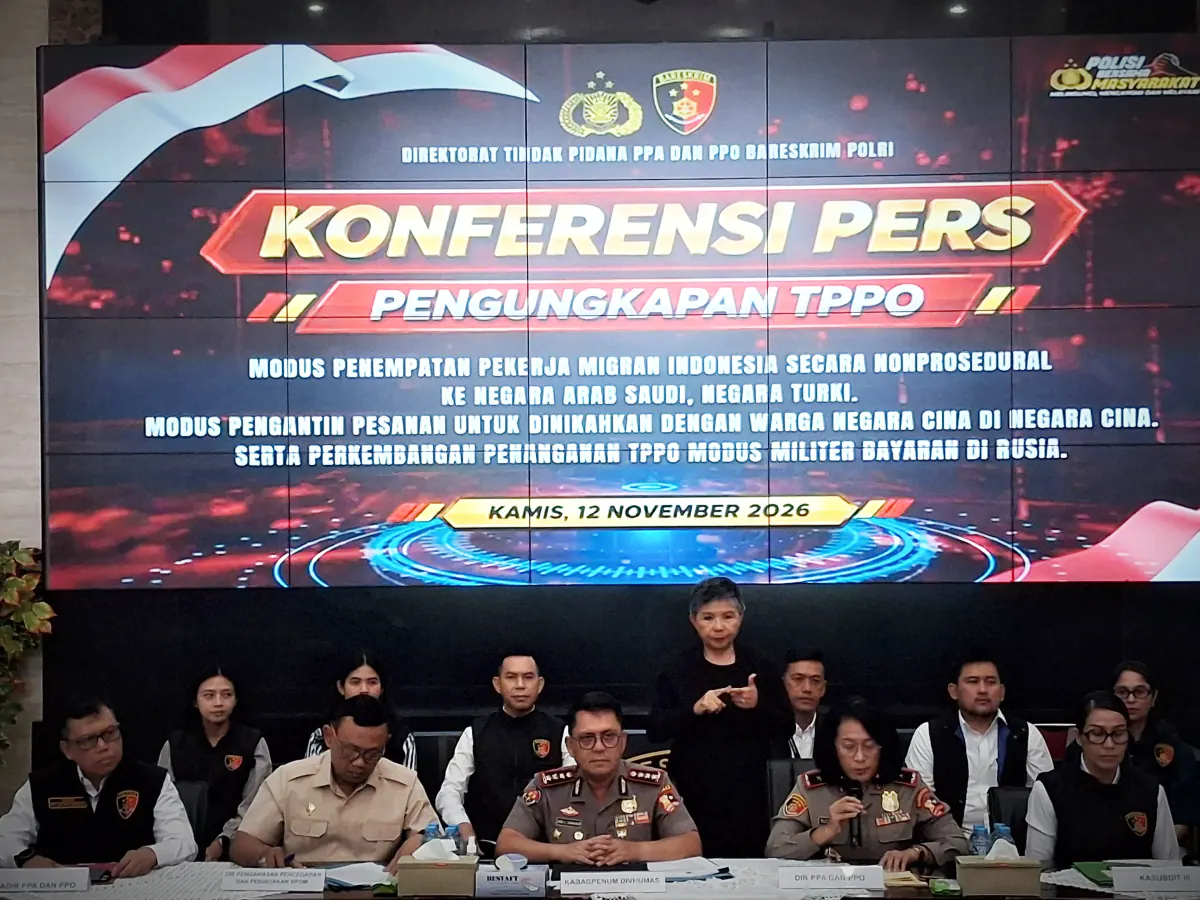
The Criminal Investigation Agency (Bareskrim) of the Indonesian National Police has uncovered an alleged human trafficking (TPPO) case involving a mail-order bride scheme to China, as reported by state broadcaster Radio Republik Indonesia (RRI), after immigration officers found indications of trafficking before the departure of three Indonesian women from Soekarno-Hatta International Airport on 10 October 2026.
Kombes Pol. Yolanda Evalyn Sebayang, head of Sub-directorate III of the Directorate of Criminal Investigation for Women and Children Protection and Human Trafficking (Dittipid PPA-PPO) at Bareskrim, said the recruitment of the victims, identified by the initials HA, MM and MA, took place from August to October 2026. The three women were promised a bride price of Rp20 million to Rp25 million (about $1,250 to $1,550) and a monthly allowance of Rp4 million to Rp5 million (about $250 to $310) after arriving in China.
According to RRI's report, photographs of the victims were sent to agents in China to be used as a catalogue of prospective brides, while intermediary networks in Indonesia and Hong Kong allegedly offered them at transaction values of Rp400 million to Rp500 million (about $25,000 to $31,250). Investigators also found suspected identity forgery, including altering the victims' birth years, and non-procedural siri marriages, or unregistered religious marriages, before departure.
Bareskrim named three suspects, identified by the initials YB, RMM and FC alias IA. YB, whom investigators said acted as the prospective groom, allegedly came to Indonesia to marry the victims before taking them to China. RMM allegedly persuaded the victims and arranged the non-procedural marriages at Grand Pramuka Apartment. FC alias IA allegedly helped forge civil registration and travel documents. They face charges under Articles 4 and 10 of Law No. 21 of 2007 on the Eradication of Human Trafficking. Investigators are still probing the involvement of recruitment networks and transaction flows.
Traces of mail-order bride practices
Mail-order bride schemes are not a new phenomenon in human trafficking. The practice usually emerges when recruitment networks exploit economic inequality, social pressure to marry and victims' limited knowledge of cross-border marriage procedures. In many cases, women are lured with narratives of a comfortable life, a bride price or a monthly allowance, while agents in the destination country seek prospective brides through photo catalogues and local intermediaries.
In Indonesia, cross-border marriage requires administrative conditions and layered legal protection. Civil registration, passports, visas and official marriage documents are state tools to ensure that a relationship is not forced. For that reason, unregistered siri marriages and changes to identity data, such as a victim's birth year, are important signs that the process may violate the law. Without a valid marriage certificate, victims lose a legal basis to seek protection while abroad.
The 2007 anti-trafficking law places deception, inducement or the abuse of vulnerability at the core of the offence. In mail-order bride cases, victims are not always chained or confined; exploitation can occur through false promises, isolation in shelters and control of documents. Economic vulnerability and dependence on intermediaries make victims easier to direct, especially when perpetrators offer travel costs, accommodation and administrative processing.
Cases involving cross-border intermediaries also show that such networks often work in a modular way. Some members recruit victims, others forge documents, others arrange shelters and others act as the formal groom. This pattern means law enforcement cannot stop at the point of departure; it must trace money flows, digital communications and the involvement of agents outside Indonesian jurisdiction.
What Indonesian readers should watch for
For Indonesian readers, the case is a warning that offers to marry, work or move abroad can become an entry point for exploitation. The public should check whether a prospective spouse, sponsor or agent is legally recognised, whether the marriage will be registered by the state, and whether travel documents are issued in the victim's name without manipulated identity data. Promises of a bride price or monthly money that are not set out in a valid agreement should be treated with suspicion.
Law enforcement at airports and seaports is also an important layer of public protection. Immigration checks are not a mere formality; they can break a trafficking chain before victims leave Indonesia. People who find signs of shelters holding victims, forged documents or irregular recruitment should report them to police, immigration authorities or agencies responsible for protecting women and migrant workers.
Going forward, the impact of the case will depend on whether authorities can trace networks rather than only arrest field-level actors. If transaction flows and overseas agents are not exposed, similar schemes can reappear under different names, cities or destination countries. Victim protection also needs to be ensured, including psychological recovery, legal assistance and preventing stigma after the victims return.
Related coverage
- Ministry of Industry (Kemenperin) expands digital industry vocational cooperation with China
- Rofik Hananto urges investigation into alleged wiretapping of the president and main actors
- Prabowo recalls meaning of Javanese proverb at NasDem anniversary